Whether you’re expanding your vocabulary, improving your writing skills, teaching English, or helping a child learn parts of speech, knowing verbs that start with C can be incredibly useful.
Verbs are action words that bring sentences to life, and learning them alphabetically makes vocabulary building easier and more organized.
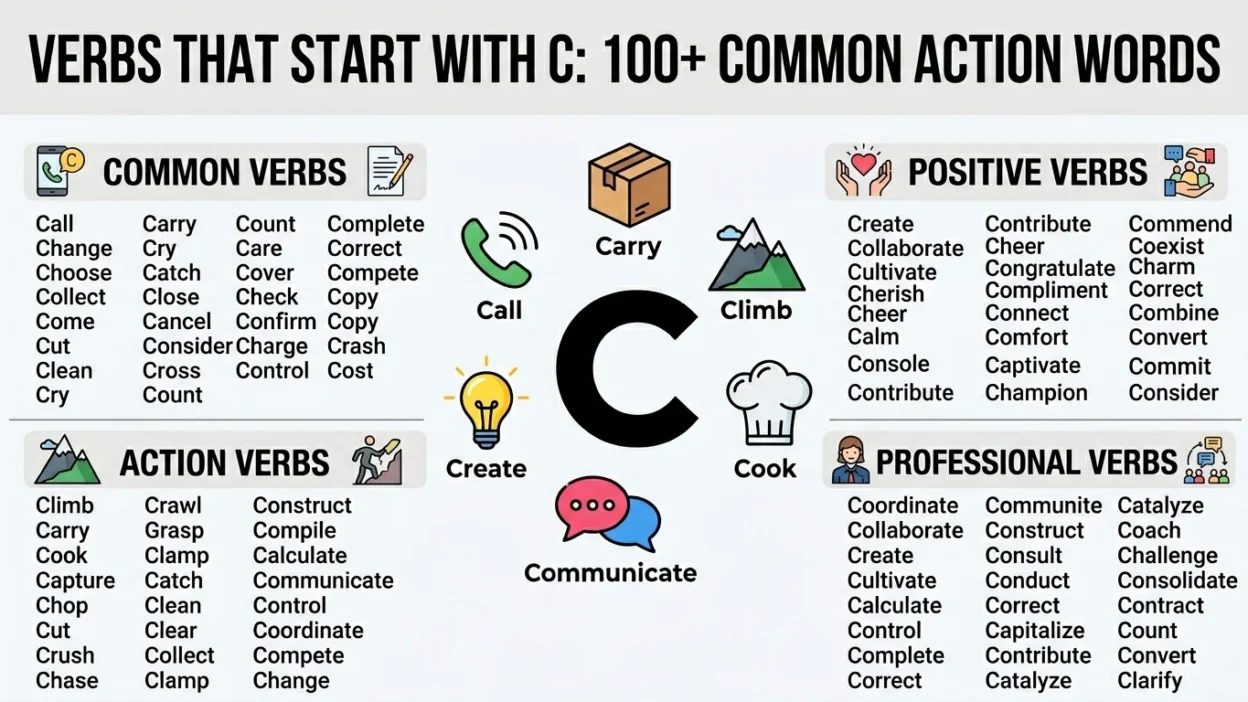
From everyday words like call, carry, and clean to advanced verbs such as calculate, collaborate, and cultivate, the letter C offers a wide range of powerful action words.
In this guide, you’ll discover common and advanced C verbs, their meanings, example sentences, common mistakes, and practical tips for using them correctly in speaking and writing.
Quick Answer
Verbs that start with C are action words beginning with the letter C.
Examples include:
- Call
- Carry
- Catch
- Change
- Choose
- Clean
- Climb
- Collect
- Create
- Communicate
These verbs describe actions, processes, or states and are commonly used in everyday English.
What Is a Verb?
Before exploring C verbs, it’s helpful to understand what a verb is.
A verb is a word that expresses:
- An action
- An occurrence
- A condition or state
Examples
- She calls her friend every day.
- They climbed the mountain.
- We created a new plan.
In each sentence, the highlighted word shows what someone is doing.
Common Verbs That Start With C
Here are some of the most frequently used C verbs in English.
| Verb | Meaning |
|---|---|
| Call | To contact or name |
| Carry | To transport |
| Catch | To grab or capture |
| Change | To make different |
| Chase | To pursue |
| Check | To examine |
| Choose | To select |
| Clean | To remove dirt |
| Climb | To move upward |
| Close | To shut |
| Collect | To gather |
| Come | To move toward |
| Compare | To examine similarities |
| Complete | To finish |
| Cook | To prepare food |
| Copy | To reproduce |
| Correct | To fix errors |
| Count | To calculate numbers |
| Cover | To place over |
| Create | To make |
These verbs appear frequently in daily conversation and writing.
100+ Verbs That Start With C
Here is an extensive list of verbs beginning with C.
Everyday C Verbs
- Call
- Carry
- Catch
- Change
- Chase
- Chat
- Check
- Cheer
- Choose
- Clean
- Clear
- Climb
- Close
- Collect
- Color
- Comb
- Come
- Comfort
- Command
- Compare
School and Work Verbs
- Calculate
- Communicate
- Complete
- Confirm
- Connect
- Consider
- Construct
- Continue
- Contribute
- Correct
Creative and Professional Verbs
- Compose
- Conceptualize
- Coordinate
- Craft
- Create
- Cultivate
- Customize
- Collaborate
- Consult
- Convince
Advanced C Verbs
- Categorize
- Circulate
- Clarify
- Combine
- Compile
- Concentrate
- Conclude
- Conduct
- Conserve
- Consolidate
Learning these words can significantly improve both written and spoken communication.
Examples of Verbs That Start With C in Sentences
Understanding verbs in context makes them easier to remember.
Call
- Please call me after work.
Carry
- She carried the groceries home.
Change
- We changed our plans.
Choose
- You may choose any seat.
Create
- The designer created a new logo.
Communicate
- Good leaders communicate clearly.
Collaborate
- The teams collaborated on the project.
Cultivate
- Farmers cultivate crops every season.
These examples demonstrate how versatile C verbs can be.
Verbs That Start With C by Category
Grouping verbs by topic helps vocabulary retention.
Communication Verbs
- Call
- Chat
- Communicate
- Consult
- Convince
- Confirm
- Comment
- Complain
Example:
- Employees communicate regularly with clients.
Movement Verbs
- Climb
- Crawl
- Chase
- Carry
- Come
- Cruise
Example:
- The children climbed the tree.
Thinking Verbs
- Consider
- Compare
- Calculate
- Conclude
- Conceptualize
Example:
- She carefully considered the proposal.
Creative Verbs
- Create
- Compose
- Craft
- Customize
Example:
- The artist created a beautiful painting.
Powerful Action Verbs That Start With C
Strong action verbs can improve writing quality.
Examples
- Conquer
- Command
- Construct
- Cultivate
- Coordinate
- Compete
- Commit
- Collaborate
These words often strengthen resumes, business writing, and academic work.
Example
Weak:
- He worked on the project.
Stronger:
- He coordinated the project.
Strong verbs make writing more engaging and precise.
Positive Verbs That Start With C
Positive verbs are useful in motivation, leadership, and professional communication.
Examples
- Care
- Celebrate
- Cheer
- Comfort
- Compliment
- Cooperate
- Cultivate
- Connect
Example:
- Great managers encourage employees and celebrate achievements.
These verbs often convey support, growth, and positivity.
Common Mistakes When Using Verbs That Start With C
Even simple verbs can be used incorrectly.
Mistake 1: Confusing Similar Verbs
Examples:
- Choose
- Chose
Correct:
- I choose today.
- I chose yesterday.
Remember:
- Choose = Present tense
- Chose = Past tense
Mistake 2: Incorrect Verb Forms
Incorrect:
- She create a website.
Correct:
- She creates a website.
Verb agreement matters.
Mistake 3: Using Vague Verbs
Weak:
- He did the project.
Better:
- He completed the project.
Specific verbs improve clarity.
How Verbs That Start With C Improve Writing
Good writing relies on strong action words.
Benefits
- Improve clarity
- Increase engagement
- Add variety
- Strengthen storytelling
- Enhance professionalism
For example:
Instead of:
- The company did a review.
Use:
- The company conducted a review.
The second sentence sounds more precise and authoritative.
Verbs That Start With C for Students
Students often learn vocabulary alphabetically.
Useful beginner-level C verbs include:
- Call
- Carry
- Catch
- Clean
- Climb
- Close
- Count
- Color
- Cook
- Come
These words appear frequently in reading materials and classroom activities.
Verbs That Start With C for Resume Writing
Strong verbs can make resumes more impactful.
Examples
- Coordinated
- Created
- Conducted
- Calculated
- Collaborated
- Completed
- Cultivated
- Consulted
- Constructed
- Controlled
Resume Example:
- Coordinated a team of 10 employees.
- Created marketing campaigns.
- Conducted customer research.
These verbs highlight achievements effectively.
American vs British English
Most verbs that start with C have the same spelling and meaning in American and British English.
Examples:
- Call
- Carry
- Create
- Communicate
- Compare
However, some related verb forms may vary slightly.
Example
American English:
- Catalog
British English:
- Catalogue
Despite a few exceptions, the majority of C verbs remain consistent across both varieties.
FAQs
What are verbs that start with C?
They are action words beginning with the letter C, such as call, carry, create, and communicate.
What is the most common C verb?
Common examples include call, come, carry, choose, and change.
Why should I learn verbs alphabetically?
Alphabetical learning improves vocabulary organization and retention.
Are C verbs useful in professional writing?
Yes. Words like coordinate, conduct, collaborate, and create are frequently used in business communication.
What are some positive C verbs?
Examples include care, celebrate, comfort, compliment, cooperate, and connect.
What are some strong action verbs that start with C?
Examples include conquer, cultivate, construct, coordinate, and command.
Are verbs that start with C common in English?
Yes. Many everyday English sentences contain C verbs.
How can I remember more C verbs?
Practice writing sentences, reading regularly, and grouping verbs by category.
Summary
Learning verbs that start with C is an excellent way to expand your English vocabulary and improve your communication skills.
From everyday action words like call, carry, and catch to advanced verbs such as collaborate, cultivate, and coordinate, these words play an essential role in both casual and professional communication.
Strong verbs make writing clearer, more engaging, and more persuasive. Whether you’re a student, teacher, writer, job seeker, or English learner, building your knowledge of C verbs can help you express ideas with greater precision and confidence.
Actionable Takeaway
Start by learning 10 of the most common C verbs:
- Call
- Carry
- Catch
- Change
- Check
- Choose
- Clean
- Climb
- Collect
- Create
Then challenge yourself to use each one in a sentence today. The more frequently you practice these action words, the more naturally they’ll become part of your everyday vocabulary.