Have you ever paused while writing a thank-you message because you weren’t sure whether to use greatful or grateful? You’re not alone.
This is one of the most common English spelling mistakes because the word grateful sounds as if it could contain the word great.
The truth is simple: grateful is the only correct spelling in standard English. Greatful is a common misspelling that appears because of pronunciation and the association with the word great.
In this guide, you’ll learn the difference between greatful vs grateful, discover why people confuse them, see plenty of examples, and learn easy tricks to remember the correct spelling forever.
Quick Answer
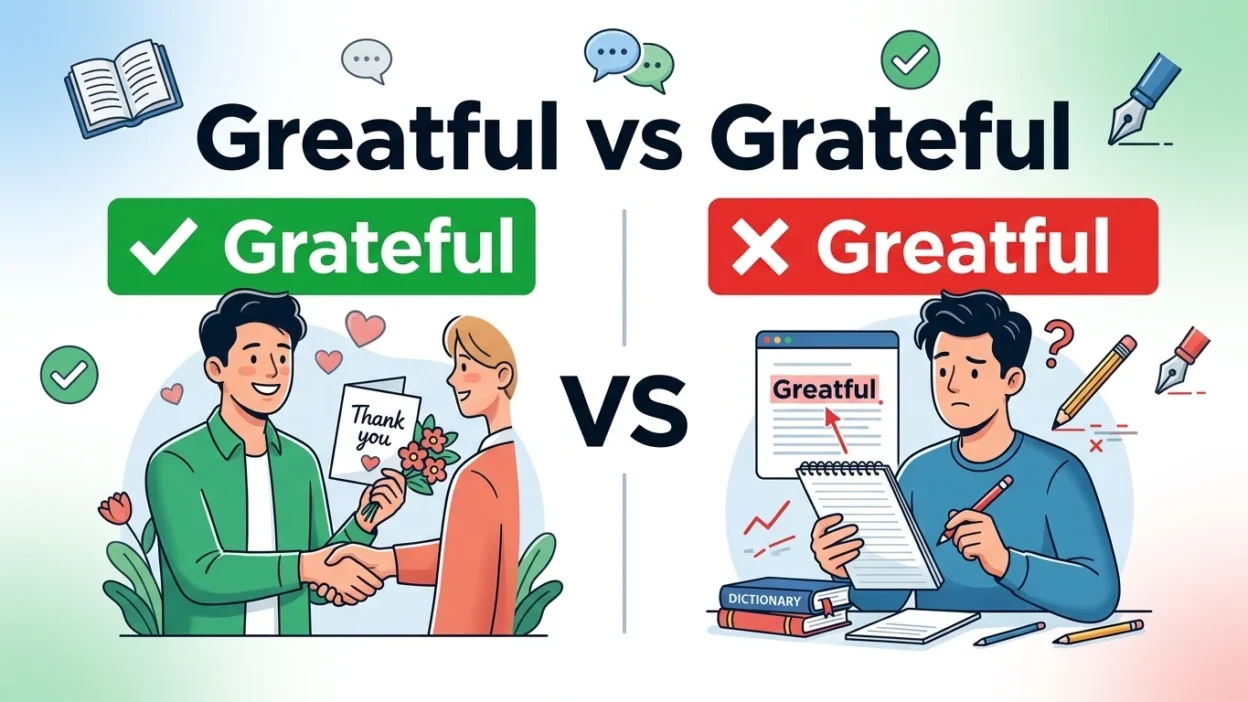
The correct spelling is grateful.
- ✅ Grateful means feeling thankful, appreciative, or thankful for kindness or help.
- ❌ Greatful is not a correct English word. It is a common spelling mistake.
Correct: I am grateful for your support.
Incorrect: I am greatful for your support.
Whenever you want to express thanks or appreciation, always use grateful.
What Does “Grateful” Mean?
Grateful is an adjective that describes feeling thankful, appreciative, or deeply thankful for something someone has done.
People often use grateful when expressing appreciation for:
- Kindness
- Help
- Support
- Opportunities
- Gifts
- Friendship
- Good health
- Success
It is one of the most common words used in thank-you messages, speeches, and professional communication.
Examples of Grateful
- I am grateful for your kindness.
- She felt grateful after receiving the scholarship.
- We are grateful to everyone who supported us.
- He remains grateful for the opportunity.
- They were grateful for the warm welcome.
In each sentence, grateful expresses sincere appreciation.
What Does “Greatful” Mean?
The simple answer is:
Greatful has no meaning in standard English.
It is not recognized as the correct spelling in dictionaries.
People accidentally write greatful because:
- It sounds similar to grateful.
- They associate gratitude with something “great.”
- English spelling can sometimes be confusing.
Although the mistake is understandable, it should always be corrected.
Greatful vs Grateful: Comparison Table
| Feature | Greatful | Grateful |
|---|---|---|
| Is it a real English word? | No | Yes |
| Correct spelling | ❌ No | ✅ Yes |
| Meaning | None | Feeling thankful or appreciative |
| Dictionary recognition | No | Yes |
| Appropriate for formal writing | No | Yes |
| Everyday usage | Misspelling | Standard English |
Why Is “Grateful” Correct?
The word grateful comes from the noun gratitude, not from great.
Notice the connection:
- Gratitude
- Grateful
- Gratefully
All these words share the root grat-, which comes from the Latin word meaning thankful or pleasing.
Even though grateful sounds similar to great, the spelling follows its historical origin rather than pronunciation.
Why Do People Write “Greatful”?
There are several reasons this mistake is so common.
1. Pronunciation
The pronunciation makes many people hear the word great.
2. Familiarity
People use the word great much more often than gratitude, making the incorrect spelling seem logical.
3. Typing Quickly
Fast typing often leads to automatic spelling errors.
4. Phonetic Assumptions
English spelling doesn’t always match pronunciation.
That’s exactly what happens with grateful.
When Should You Use “Grateful”?
Use grateful whenever you’re expressing appreciation.
Common Situations
- Thank-you emails
- Job interviews
- Graduation speeches
- Personal messages
- Social media captions
- Business communication
- Letters
- Wedding speeches
Correct Examples
- I’m grateful for your advice.
- She is grateful to her parents.
- We feel grateful for this opportunity.
- The charity was grateful for every donation.
- He is forever grateful.
Common Mistakes to Avoid
Many writers accidentally make these errors.
1. Writing Greatful
❌ I am greatful.
✅ I am grateful.
2. Confusing Grateful with Gratitude
Remember:
- Grateful = adjective
- Gratitude = noun
Examples:
- I feel grateful.
- I express my gratitude.
3. Misspelling in Professional Writing
Writing greatful in:
- Resumes
- Emails
- Cover letters
- Academic essays
can make your writing appear less polished.
Always proofread before sending.
4. Relying Only on Pronunciation
English spelling often requires memorization.
Don’t spell by sound alone.
Easy Memory Trick
Here’s one of the easiest ways to remember.
Think:
Grateful comes from Gratitude.
Not:
Great + ful
If you can spell gratitude, you’ll always spell grateful correctly.
Another simple reminder:
GRATitude → GRATeful
The shared letters make the connection easy to remember.
Related Words and Synonyms
Here are common synonyms for grateful.
- Thankful
- Appreciative
- Obliged
- Indebted
- Pleased
- Blessed
- Acknowledging
- Appreciative of
These words can make your writing more varied while expressing similar ideas.
Common Expressions with Grateful
Native English speakers frequently use phrases like:
- Grateful for your support
- Deeply grateful
- Forever grateful
- Truly grateful
- Extremely grateful
- Grateful to everyone
- So grateful
- Grateful beyond words
These expressions appear regularly in professional and personal writing.
American vs British English
There is no spelling difference between American and British English.
Both varieties use:
✅ Grateful
❌ Greatful
Examples:
American English:
- We’re grateful for your business.
British English:
- We’re grateful for your support.
The spelling remains exactly the same across both forms of English.
Example Sentences
Correct Examples
- I am grateful for your kindness.
- She felt grateful after the ceremony.
- We’re grateful for your patience.
- He remains grateful to his teachers.
- They are grateful for every opportunity.
Incorrect Examples
- ❌ I’m greatful.
- ❌ She is greatful for the gift.
- ❌ We are greatful.
- ❌ They felt greatful.
- ❌ He was very greatful.
Every sentence should use grateful instead.
Why Correct Spelling Matters
Using the correct spelling improves:
- Professionalism
- Credibility
- Academic writing
- Business communication
- Search engine optimization
- Reader trust
Small spelling mistakes can distract readers from your message.
Writing grateful correctly demonstrates attention to detail.
FAQs
Which is correct: grateful or greatful?
Grateful is the correct spelling. Greatful is a common misspelling.
Is greatful a real English word?
No. Standard English dictionaries recognize grateful, not greatful.
Why do people spell grateful as greatful?
Because it sounds similar to great, and many people mistakenly assume the word is formed from great instead of gratitude.
How can I remember the correct spelling?
Remember that grateful comes from gratitude, so both words share the letters grat.
Is grateful an adjective?
Yes. Grateful is an adjective describing someone who feels thankful.
Is there an American and British spelling difference?
No. Both American and British English use grateful.
What is another word for grateful?
Some common synonyms include thankful, appreciative, obliged, blessed, and indebted.
Summary
Understanding greatful vs grateful is surprisingly simple once you know the origin of the word. Grateful is the only correct spelling and comes from gratitude, meaning thankfulness or appreciation.
Although greatful may seem logical because of its similarity to the word great, it is not a recognized English word and should be avoided in all forms of writing.
If you’re writing a thank-you note, a professional email, a school assignment, or a social media post, using grateful correctly helps your writing appear polished, accurate, and trustworthy.
Paying attention to this small spelling detail can make a positive impression on readers and strengthen your overall communication.
Actionable Takeaway
Whenever you’re about to write grateful, pause and think of the word gratitude. If you remember that both words begin with grat-, you’ll avoid the common mistake of writing greatful. This simple memory trick will help you spell the word correctly every time.