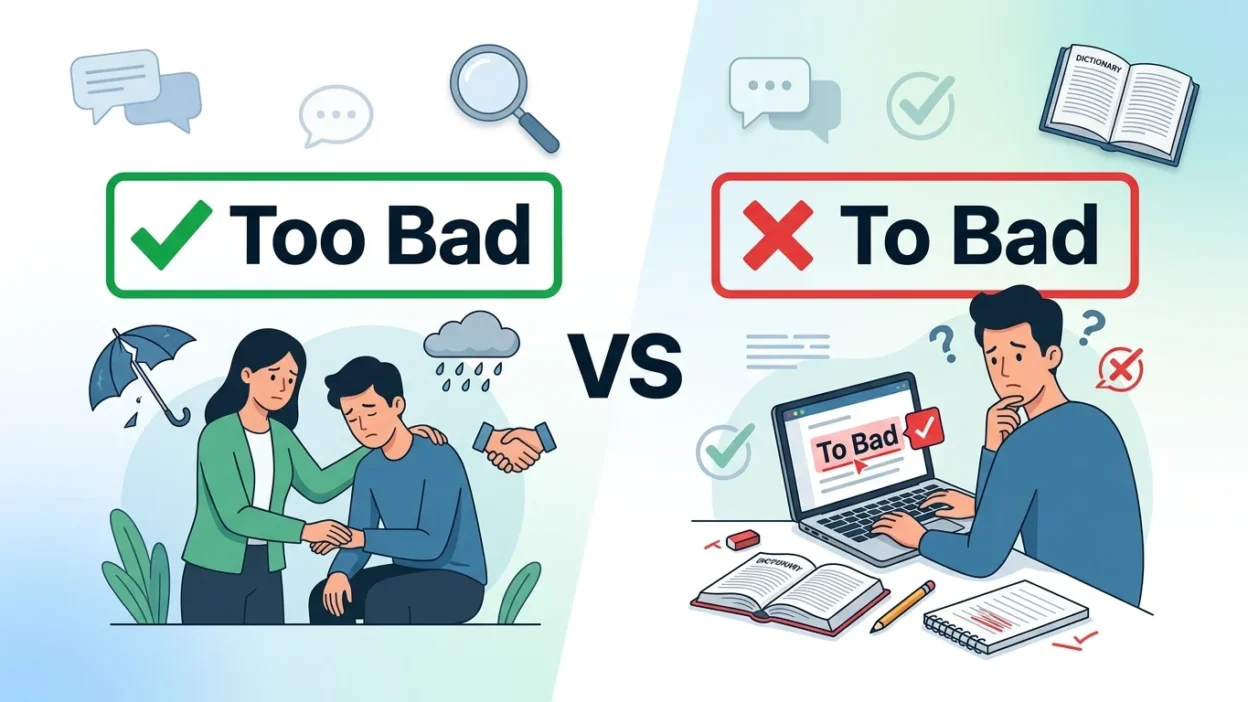
Have you ever wondered whether to write too bad or to bad? It’s a common question because the words to and too sound exactly the same.
This pronunciation similarity often leads to spelling mistakes, especially in casual writing, text messages, and social media posts.
The good news is that the rule is easy to remember. In almost every situation where you’re expressing disappointment or sympathy, too bad is the correct phrase.
To bad is generally incorrect because to and bad do not naturally form a meaningful expression on their own. In this guide, you’ll learn the difference between too bad vs to bad, see practical examples, avoid common mistakes, and gain confidence using the correct phrase.
Quick Answer
The correct phrase is too bad.
- ✅ Too bad means unfortunate, disappointing, or regrettable.
- ❌ To bad is almost always grammatically incorrect in standard English.
Correct:
- That’s too bad.
- It’s too bad you couldn’t come.
Incorrect:
- That’s to bad.
- It’s to bad you missed the meeting.
Whenever you’re expressing disappointment, always use too bad.
What Does “Too Bad” Mean?
Too bad is a common English expression used to show sympathy, disappointment, regret, or mild sadness about an unfortunate situation.
It can also describe something that is excessively bad or worse than expected, depending on the context.
People use too bad in everyday conversations, emails, and informal writing.
Examples of Too Bad
- That’s too bad you couldn’t attend.
- It’s too bad the weather changed.
- I lost my wallet. That’s too bad.
- It’s too bad we missed the train.
- The movie wasn’t too bad after all.
Notice that the expression can express sympathy or evaluate something negatively.
What Does “To Bad” Mean?
In standard English, to bad is not a correct phrase.
The word to is a preposition or part of an infinitive verb.
Examples include:
- Go to school.
- Want to learn.
- Speak to me.
The adjective bad does not naturally follow to without additional words.
Because of this, writing to bad is almost always a spelling mistake.
Too Bad vs To Bad: Comparison Table
| Feature | Too Bad | To Bad |
|---|---|---|
| Correct spelling | ✅ Yes | ❌ No |
| Meaning | Unfortunate or regrettable | None in standard English |
| Common usage | Very common | Incorrect |
| Dictionary recognized | Yes | No |
| Used in formal writing | Yes (when appropriate) | No |
| Everyday English | Standard | Misspelling |
Why Is “Too Bad” Correct?
The word too has several meanings.
It can mean:
- Also
- More than enough
- Excessively
In the phrase too bad, too means excessively or forms an idiomatic expression expressing regret.
Examples:
- That’s too bad.
- It’s too bad you were sick.
- The damage was too bad to repair.
In every case, too is the correct word.
Why Do People Write “To Bad”?
The mistake usually happens because to and too are homophones.
Homophones are words that sound the same but have different meanings and spellings.
Other common homophone pairs include:
- Their / There / They’re
- Your / You’re
- Its / It’s
- Two / Too / To
Since to is one of the most frequently used words in English, many people accidentally type it instead of too.
When Should You Use “Too Bad”?
Use too bad when expressing:
- Sympathy
- Disappointment
- Regret
- Mild criticism
- Something unfortunate
Correct Examples
- It’s too bad you couldn’t join us.
- That’s too bad about your injury.
- The timing was too bad for the event.
- We thought it was too bad to continue.
- It’s too bad the restaurant closed.
Is “Too Bad” Always Negative?
Usually, yes.
However, the tone depends on context.
Expressing Sympathy
- That’s too bad your flight was canceled.
Mild Disappointment
- It’s too bad we didn’t win.
Casual Conversation
- Too bad! Maybe next time.
Sometimes, people also use not too bad, which has a positive meaning.
Example:
- How was your day?
- Not too bad.
Here, it means “fairly good” or “okay.”
Common Mistakes to Avoid
Here are the most common errors.
1. Writing To Bad
❌ That’s to bad.
✅ That’s too bad.
2. Confusing Too with To
Remember:
- To = direction or infinitive
- Too = also or excessively
3. Forgetting Context
Correct:
- It’s too bad you left early.
Incorrect:
- It’s to bad you left early.
4. Mixing Up “Too” and “Two”
Remember:
- Two = number
- Too = also or excessively
Examples:
- I have two brothers.
- I want to come too.
Easy Memory Trick
Here’s a simple way to remember.
Think:
Too = Extra O
The extra O reminds you that too means extra, more than enough, or forms expressions like too bad.
If you’re expressing regret or disappointment, choose too.
Related Expressions
English has several expressions similar to too bad.
Examples include:
- What a shame
- That’s unfortunate
- That’s disappointing
- Sadly
- What a pity
- That’s regrettable
- It’s unfortunate
- That’s a shame
These phrases can make your writing sound more natural and varied.
American vs British English
There is no difference between American and British English regarding too bad.
Both varieties use:
- Too bad.
- That’s too bad.
- It’s too bad you couldn’t come.
Neither variety accepts to bad as correct.
The grammar and spelling remain identical.
Example Sentences
Correct Examples
- That’s too bad.
- It’s too bad we missed the concert.
- She said it was too bad.
- It’s too bad the shop closed.
- We thought the weather was too bad for hiking.
Incorrect Examples
- ❌ That’s to bad.
- ❌ It’s to bad you weren’t there.
- ❌ The weather was to bad.
- ❌ To bad we missed the bus.
- ❌ It was to bad to continue.
Every sentence should use too bad.
Why Correct Spelling Matters
Using the correct spelling improves:
- Professional writing
- Academic assignments
- Business communication
- Emails
- Social media credibility
- Reader confidence
Even small spelling mistakes can affect how readers perceive your writing.
Choosing too bad instead of to bad helps your English appear polished and accurate.
FAQs
Which is correct: too bad or to bad?
Too bad is correct. To bad is almost always a spelling mistake.
What does too bad mean?
It means something is unfortunate, disappointing, regrettable, or deserving of sympathy.
Is to bad ever correct?
Not as a standalone phrase. Standard English uses too bad.
Why do people confuse to and too?
Because they are homophones—they sound the same but have different meanings and spellings.
Is too bad informal?
It is common in everyday conversation but is also acceptable in many forms of informal and neutral writing.
Is there a British and American difference?
No. Both American and British English use too bad.
What are alternatives to too bad?
You can say:
- What a shame
- That’s unfortunate
- That’s disappointing
- What a pity
- Sadly
Summary
Understanding too bad vs to bad is simple once you know the role of the word too.
The phrase too bad is the correct expression for showing disappointment, sympathy, or regret. It is widely used in everyday conversations, emails, and written English.
In contrast, to bad is not a standard English phrase and should be avoided in both formal and informal writing.
If you’re comforting a friend, reacting to unfortunate news, or describing a disappointing situation, too bad is the natural and grammatically correct choice.
Paying attention to the difference between to and too will improve your spelling, make your writing more professional, and help you avoid one of the most common English mistakes.
Actionable Takeaway
Whenever you’re about to write too bad, remember the simple rule: if you’re expressing disappointment or sympathy, use the version with the extra “O.” Think of that extra letter as representing extra emotion. This quick memory trick will help you choose the correct spelling every time.