Have you ever wondered whether to write shown or showed? These two forms of the verb show often confuse English learners because both are real words, yet they aren’t always interchangeable.
It’s common to hear people say, “I have showed you,” while others insist that “I have shown you” is the correct phrase.
The confusion comes from the fact that showed and shown serve different grammatical purposes.
Knowing when to use each form will make your writing and speaking more natural, whether you’re writing an email, preparing for an English exam, or having a casual conversation.
This guide explains shown vs showed with clear rules, practical examples, common mistakes, and easy memory tips.
Quick Answer
The difference between shown and showed depends on the verb tense.
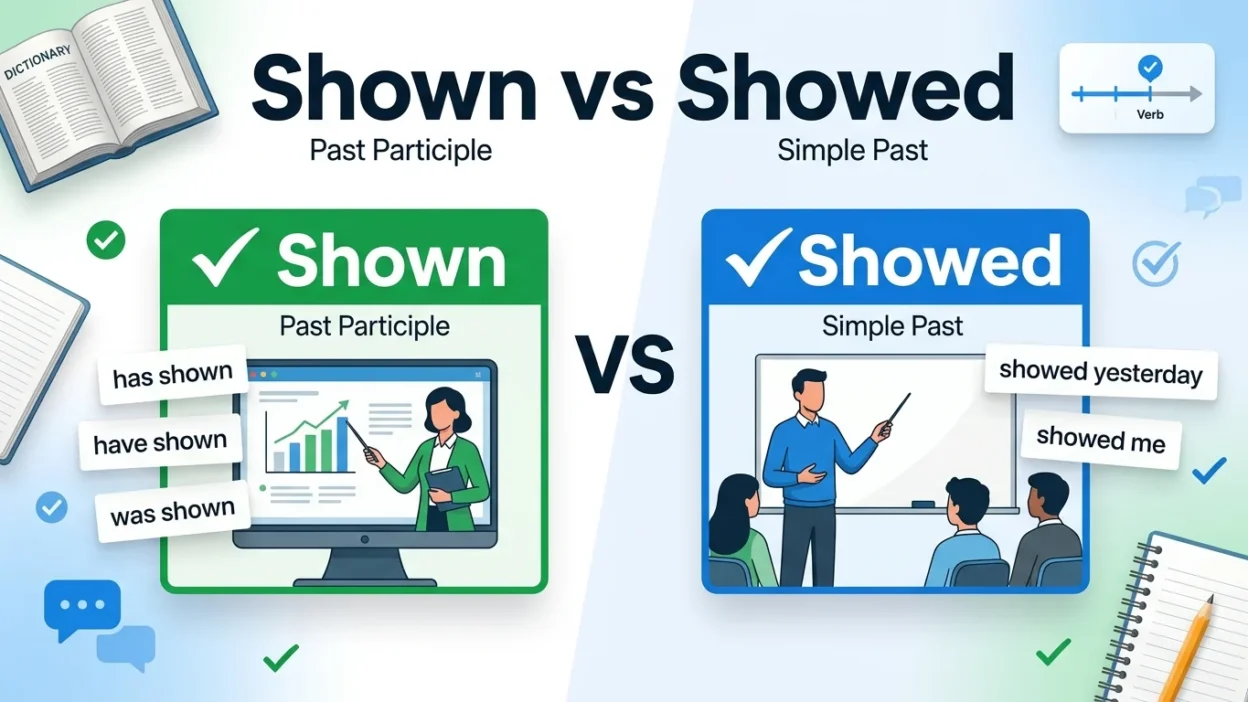
- Showed is the simple past tense of show.
- Shown is the past participle, usually used with helping verbs such as has, have, had, is, was, were, or been.
Correct examples:
- ✅ She showed me the photos yesterday.
- ✅ She has shown me the photos.
In modern English, both words are correct—but they are used in different grammatical structures.
What Does “Showed” Mean?
Showed is the simple past tense of the verb show.
Use showed when describing an action that happened and finished in the past.
Examples of Showed
- He showed me his new car.
- The teacher showed the class a science experiment.
- She showed kindness to everyone.
- We showed our tickets at the entrance.
- They showed us around the city.
Each sentence describes a completed action in the past.
What Does “Shown” Mean?
Shown is the past participle of show.
Past participles are usually used with helping verbs, including:
- Have
- Has
- Had
- Is
- Was
- Were
- Been
Examples of Shown
- She has shown great leadership.
- I have shown you the document.
- The results were shown on the screen.
- They had shown interest before.
- His work has been shown worldwide.
Notice that shown almost always appears with an auxiliary (helping) verb.
Shown vs Showed: Comparison Table
| Feature | Showed | Shown |
|---|---|---|
| Verb Form | Simple past | Past participle |
| Used Alone | Yes | Usually no |
| Used with Helping Verbs | No | Yes |
| Example | She showed me. | She has shown me. |
| Grammar Function | Past action | Perfect and passive tenses |
| Correct? | ✅ Yes | ✅ Yes |
Understanding the Difference
The easiest way to remember the difference is by thinking about verb tenses.
Use “Showed”
When talking about a completed action in the past.
Examples:
- He showed me the answer.
- They showed us the museum.
- I showed my passport.
Use “Shown”
When using perfect tenses or passive voice.
Examples:
- I have shown my passport.
- The evidence was shown in court.
- She had shown remarkable patience.
The helping verb signals that shown is needed.
Verb Forms of “Show”
Learning all forms of the verb makes the distinction much easier.
| Verb Form | Word |
|---|---|
| Base Form | Show |
| Present | Show / Shows |
| Simple Past | Showed |
| Past Participle | Shown |
| Present Participle | Showing |
Understanding this pattern helps you use the correct form automatically.
When Should You Use “Showed”?
Choose showed when:
- The action happened in the past.
- No helping verb is present.
- You’re using the simple past tense.
Correct Examples
- We showed our IDs.
- She showed compassion.
- The guide showed us the castle.
- I showed him my homework.
- They showed excellent teamwork.
When Should You Use “Shown”?
Choose shown when:
- A helping verb appears.
- You’re using the present perfect tense.
- You’re using the past perfect tense.
- You’re writing in passive voice.
Correct Examples
- He has shown improvement.
- The film was shown yesterday.
- They had shown interest earlier.
- The chart has been shown below.
- I’ve shown you everything.
Common Mistakes to Avoid
Here are the errors learners make most often.
1. Using Showed After “Have”
❌ I have showed you.
✅ I have shown you.
2. Using Shown Without a Helping Verb
❌ Yesterday I shown him.
✅ Yesterday I showed him.
3. Mixing Verb Tenses
Incorrect:
❌ She had showed us.
Correct:
✅ She had shown us.
4. Forgetting Passive Voice
Incorrect:
❌ The results were showed.
Correct:
✅ The results were shown.
Easy Memory Trick
Here’s a simple trick.
Showed = Yesterday
If you’re talking about something that happened yesterday or at a specific time in the past, use showed.
Example:
Yesterday she showed me her painting.
Shown = Has, Have, Had
If you see:
- Has
- Have
- Had
- Been
- Was
- Were
You’ll usually need shown.
Example:
She has shown great improvement.
Shown in Passive Voice
Passive voice commonly uses shown.
Examples:
- The photos were shown on television.
- The report has been shown to the committee.
- The artwork was shown at the exhibition.
This is one of the most common uses of shown in formal writing.
American vs British English
Both American and British English follow the same grammar rule.
American English
- She showed me.
- She has shown me.
British English
Exactly the same:
- He showed us.
- He has shown us.
There is no spelling or grammatical difference between the two varieties regarding shown and showed.
Related Words and Synonyms
Depending on context, show can be replaced with:
- Display
- Present
- Demonstrate
- Reveal
- Exhibit
- Illustrate
- Introduce
- Expose
- Indicate
- Explain
Using synonyms can make your writing more engaging and varied.
Example Sentences
Showed Examples
- She showed me her artwork.
- They showed remarkable courage.
- We showed our boarding passes.
- The teacher showed us a video.
- He showed genuine concern.
Shown Examples
- She has shown remarkable progress.
- I’ve shown you this before.
- The results were shown online.
- They had shown interest earlier.
- His paintings have been shown internationally.
Why Do People Confuse Showed and Shown?
The confusion happens because English irregular verbs often have different past tense and past participle forms.
Compare:
- Write → Wrote → Written
- Break → Broke → Broken
- Speak → Spoke → Spoken
- Show → Showed → Shown
Many learners mistakenly assume showed works in every tense, but the past participle requires shown.
FAQs
Which is correct: shown or showed?
Both are correct, but they are used in different grammatical situations. Showed is the simple past tense, while shown is the past participle.
Is “I have showed” correct?
No. The correct sentence is:
“I have shown.”
Can I say “She showed me”?
Yes. This is the correct simple past tense.
Can I say “She has shown me”?
Yes. This is the correct present perfect tense.
Is shown a real word?
Yes. Shown is the past participle of show.
Is there a British and American difference?
No. Both American and British English use showed and shown in the same grammatical way.
How can I remember the difference?
Remember:
- Showed = simple past.
- Shown = after has, have, had, or in passive voice.
Summary
Understanding shown vs showed becomes much easier once you recognize their grammatical roles.
Showed is the simple past tense of show, making it the correct choice for actions completed in the past without a helping verb.
Shown, on the other hand, is the past participle and is used with helping verbs such as has, have, had, and in passive voice constructions. Both forms are correct, but each belongs in a different sentence structure.
If you’re writing an email, completing an English assignment, or speaking in everyday conversations, using the right verb form will make your communication clearer and more accurate.
By paying attention to helping verbs and verb tenses, you’ll avoid one of the most common grammar mistakes involving the verb show.
Actionable Takeaway
Before choosing between shown and showed, look for a helping verb. If your sentence includes has, have, had, was, were, or been, use shown. If you’re simply describing a completed action in the past, choose showed. Practicing this quick grammar check will help you use both forms confidently every time.