
Have you ever mixed up words like their and there, or wondered why the word lead can have two different pronunciations? If so, you’ve encountered homophones, homographs, or homonyms.
These three language terms often confuse English learners because they’re closely related, yet each describes a different type of word relationship.
Understanding the difference between homophone vs homograph vs homonym is essential for improving your grammar, spelling, vocabulary, reading comprehension, and writing skills.
If you’re a student, teacher, content writer, or English learner, mastering these concepts will help you avoid common mistakes and communicate more clearly.
This guide explains each term in simple language, provides plenty of examples, highlights common errors, and offers memory tricks to make learning easier.
Quick Answer
Here’s a simple way to remember the differences:
- Homophones are words that sound the same but have different meanings and often different spellings.
- Homographs are words that are spelled the same but have different meanings and sometimes different pronunciations.
- Homonyms are words that share the same spelling or pronunciation but have different meanings. In many grammar references, homonym is used as an umbrella term that includes both homophones and homographs.
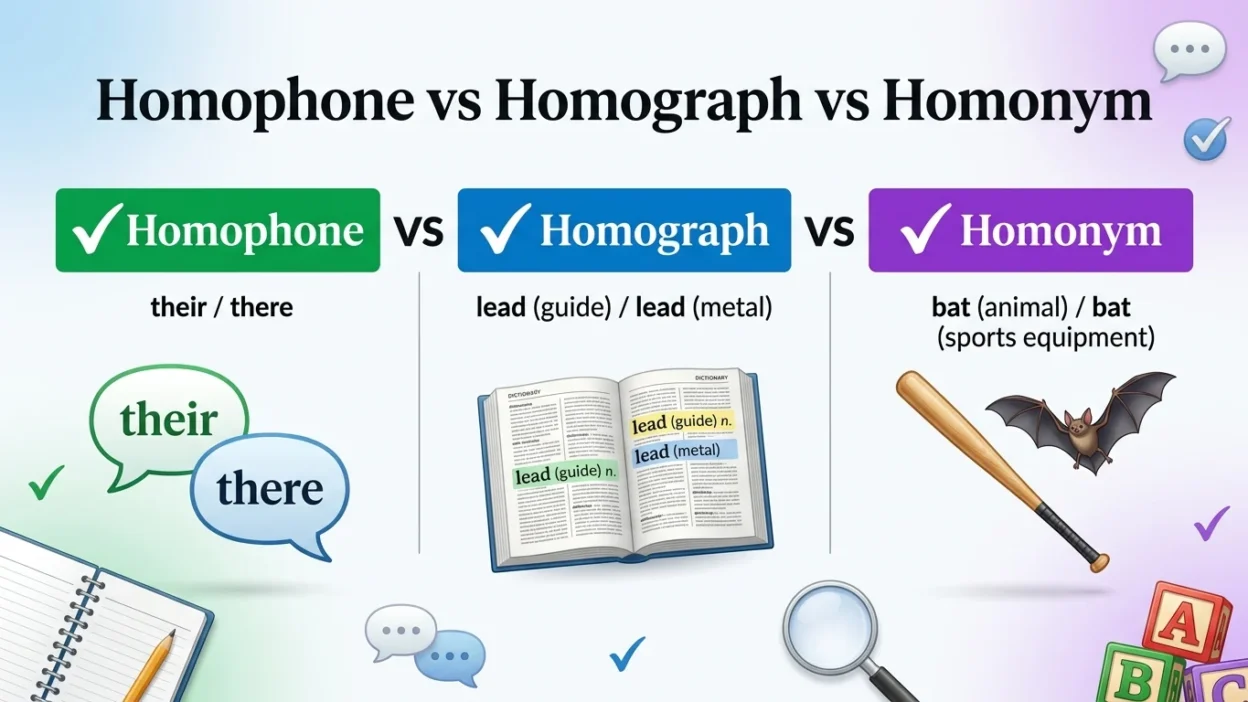
Quick Examples
- Homophone: their / there
- Homograph: lead (to guide) / lead (a metal)
- Homonym: bat (animal) / bat (sports equipment)
Although these categories overlap, knowing their differences makes English much easier to understand.
What Is a Homophone?
A homophone is a word that sounds exactly like another word but has a different meaning and usually a different spelling.
Because they sound alike, homophones are one of the biggest causes of spelling mistakes in English.
Common Homophone Examples
| Word 1 | Word 2 | Meaning Difference |
|---|---|---|
| Their | There | Possession vs place |
| Two | Too | Number vs also |
| Right | Write | Direction/correct vs record words |
| Sea | See | Ocean vs vision |
| Flour | Flower | Baking ingredient vs plant |
Example Sentences
- Their house is beautiful.
- Please put the book over there.
- I have two sisters.
- I want to come too.
Even though the words sound the same, their meanings and spellings differ.
What Is a Homograph?
A homograph is a word that is spelled the same as another word but has a different meaning. Some homographs also have different pronunciations.
Context tells you which meaning is intended.
Common Homograph Examples
| Word | Meaning 1 | Meaning 2 |
|---|---|---|
| Lead | To guide | A metal |
| Wind | Moving air | To twist |
| Tear | Rip | Drop from the eye |
| Bass | Fish | Low musical sound |
| Row | Line | Argument |
Example Sentences
- She will lead the team.
- The pipe contains lead.
- The wind is strong today.
- Please wind the clock.
Notice that some homographs are pronounced differently even though they’re spelled the same.
What Is a Homonym?
A homonym is a word that shares either the same spelling, the same pronunciation, or both with another word while having a different meaning.
Many grammar books use homonym as a broad category that includes both homophones and homographs.
Common Homonym Examples
| Word | Meaning 1 | Meaning 2 |
|---|---|---|
| Bat | Flying mammal | Baseball bat |
| Bank | Financial institution | Riverbank |
| Bark | Tree covering | Dog’s sound |
| Match | Competition | Fire starter |
| Ring | Jewelry | Telephone sound |
Example Sentences
- The bat flew out of the cave.
- He swung the bat and hit a home run.
The spelling and pronunciation are the same, but the meanings differ completely.
Homophone vs Homograph vs Homonym: Comparison Table
| Feature | Homophone | Homograph | Homonym |
|---|---|---|---|
| Same Pronunciation | ✅ Yes | Sometimes | Often |
| Same Spelling | Usually No | ✅ Yes | Sometimes |
| Different Meanings | ✅ Yes | ✅ Yes | ✅ Yes |
| Example | Their / There | Lead / Lead | Bat / Bat |
| Requires Context | Yes | Yes | Yes |
This table highlights the main differences and makes it easier to identify each type.
Why Do These Terms Matter?
Learning these word relationships improves several language skills, including:
- Reading comprehension
- Spelling accuracy
- Vocabulary development
- Writing clarity
- Listening skills
- Speaking confidence
Understanding context becomes much easier when you recognize homophones, homographs, and homonyms.
Common Examples in Everyday English
Homophones
- Knight / Night
- Hole / Whole
- Mail / Male
- Pair / Pear
- Brake / Break
Homographs
- Bow (to bend)
- Bow (front of a ship)
- Minute (tiny)
- Minute (60 seconds)
Homonyms
- Well (healthy)
- Well (water source)
- Spring (season)
- Spring (coil)
These words appear frequently in conversations, books, newspapers, and exams.
Common Mistakes to Avoid
Many English learners confuse these terms.
1. Thinking All Similar Words Are Homophones
Not every confusing word pair is a homophone.
For example:
- Lead (guide)
- Lead (metal)
These are homographs, not homophones.
2. Mixing Up Homographs and Homonyms
Remember:
Every homograph may also be considered a homonym, depending on the grammar reference you’re using.
However, not every homonym is a homograph.
3. Ignoring Pronunciation
Some homographs change pronunciation.
Example:
- Wind (moving air)
- Wind (twist)
Pay attention to context.
4. Relying Only on Spelling
Meaning always depends on the sentence.
Context is the key.
Easy Memory Tricks
These simple tricks help many learners remember the differences.
Homophone = Phone = Sound
Think of a phone.
Phones are for hearing sounds.
So:
Homophone → Same sound
Homograph = Graph = Writing
Think of graphic or graph.
Writing relates to spelling.
So:
Homograph → Same spelling
Homonym = Name
The Greek root onym means “name.”
Homonyms share the same name in pronunciation, spelling, or both.
American vs British English
The definitions of homophone, homograph, and homonym are the same in both American and British English.
However, pronunciation differences between the two dialects may affect whether certain words are considered homophones.
For example, some words that sound identical in American English may be pronounced slightly differently in British English.
Despite these pronunciation variations, the grammatical definitions remain the same.
Tips for Learning Homophones, Homographs, and Homonyms
Here are some practical strategies:
- Read regularly to see words in context.
- Keep a vocabulary notebook.
- Learn words through example sentences.
- Practice spelling exercises.
- Listen to native English speakers.
- Use flashcards for confusing word pairs.
- Review commonly confused words each week.
Consistent practice is the best way to master these concepts.
FAQs
What is the difference between homophone, homograph, and homonym?
A homophone shares pronunciation, a homograph shares spelling, and a homonym is a broader term for words with the same spelling, pronunciation, or both but different meanings.
Can a word be both a homograph and a homonym?
Yes. Words like bat are commonly considered both because they share spelling and pronunciation while having different meanings.
Are homophones always spelled differently?
Usually, yes. Words like their and there have different spellings but identical pronunciation.
Why are homographs sometimes pronounced differently?
Because English pronunciation depends on meaning and context.
For example:
- Lead (guide)
- Lead (metal)
Are homonyms difficult to learn?
Not once you understand context. Reading and listening practice make recognizing them much easier.
Is there an American and British English difference?
The definitions are the same, although some pronunciations vary slightly between dialects.
Why are homophones important?
Because they improve spelling, writing accuracy, vocabulary, and communication skills.
How can I remember the differences?
Think:
- Phone = Sound
- Graph = Writing
- Homonym = General category
These simple memory tricks are easy to remember.
Summary
Understanding homophone vs homograph vs homonym doesn’t have to be confusing.
A homophone refers to words that sound the same but usually have different spellings and meanings.
A homograph describes words that share the same spelling but differ in meaning and sometimes pronunciation.
A homonym is the broader category that includes words sharing the same spelling, pronunciation, or both while having different meanings. Recognizing these differences helps improve grammar, spelling, vocabulary, and overall communication.
If you’re preparing for an English exam, improving your writing, or simply expanding your vocabulary, mastering these word relationships will make English much easier to understand.
The more you read, write, and practice with real examples, the more naturally you’ll recognize homophones, homographs, and homonyms in everyday language.
Actionable Takeaway
The next time you encounter similar-looking or similar-sounding words, ask yourself two simple questions: Do they sound the same, are they spelled the same, or both? If they share pronunciation, they’re likely homophones. If they share spelling, they’re homographs. If they share either spelling, pronunciation, or both while having different meanings, they fall under homonyms. Keeping this simple checklist in mind will help you identify each type with confidence.