If you’ve ever paused while writing because you weren’t sure whether to use too or to, you’re certainly not alone.
These two tiny words are among the most commonly confused words in English. Since they sound exactly alike, many writers accidentally use the wrong one, especially when typing quickly.
Fortunately, once you understand their meanings and grammar rules, choosing the correct word becomes much easier.
If you’re a student, an English learner, a professional writer, or simply someone who wants to improve their grammar, understanding too vs to is essential. In this guide, you’ll learn what each word means, when to use it, how to avoid common mistakes, and plenty of real-life examples to help you remember the difference with confidence.
Quick Answer
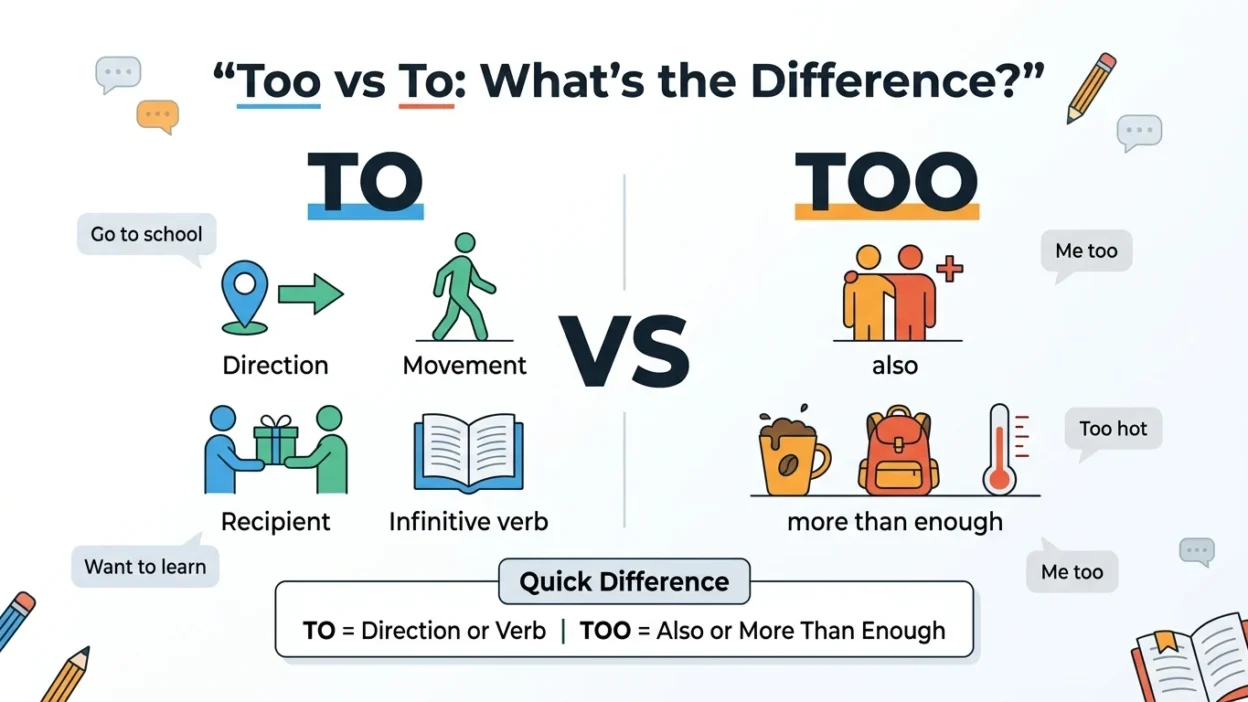
The difference between too and to is simple:
- To is mainly used as a preposition (showing direction, place, or purpose) or as part of an infinitive verb.
- Too is an adverb that means also or more than enough.
Examples
- I’m going to the library.
- She wants to become a doctor.
- I’d love to join you too.
- The soup is too hot to eat.
A quick memory trick:
- To = Direction or Verb
- Too = Also or Excessively
What Does “To” Mean?
The word to is one of the most frequently used words in English. Although it seems simple, it performs several important grammatical functions.
1. To Shows Direction or Destination
The most common use of to is to show movement toward a person, place, or thing.
Examples:
- We walked to the park.
- She drove to work.
- Please send the package to my office.
- They traveled to Japan last year.
In each sentence, to tells us where someone or something is going.
2. To Introduces an Infinitive Verb
Another common use is before the base form of a verb.
Examples include:
- I want to learn Spanish.
- She hopes to graduate next year.
- They decided to stay home.
- We need to finish the project today.
Here, to is not showing direction. Instead, it’s part of the infinitive verb.
3. To Indicates Relationships
Sometimes to connects people or things.
Examples:
- Give the book to your teacher.
- He wrote a letter to his parents.
- The answer belongs to Sarah.
In these examples, to shows the relationship between two nouns.
What Does “Too” Mean?
Unlike to, the word too has only two main meanings, making it easier to remember.
1. Too Means “Also”
When too means also, it shows addition.
Examples:
- I enjoy hiking too.
- She wants dessert too.
- They’re coming with us too.
- I’d like to participate too.
In these examples, too could often be replaced with also.
2. Too Means “More Than Enough”
The second meaning describes excess.
Examples:
- The coffee is too hot.
- This backpack is too heavy.
- You’re speaking too quietly.
- The movie was too long.
Here, too means more than necessary or more than desired.
Too vs To: Side-by-Side Comparison
| Feature | To | Too |
|---|---|---|
| Part of speech | Preposition / infinitive marker | Adverb |
| Main meaning | Direction, purpose, or verb marker | Also or excessively |
| Shows movement | ✅ Yes | ❌ No |
| Used before verbs | ✅ Yes | ❌ No |
| Means “also” | ❌ No | ✅ Yes |
| Means “more than enough” | ❌ No | ✅ Yes |
Understanding these differences will help you avoid one of the most common grammar mistakes in English.
Examples of “To” in Sentences
Seeing to in context makes its usage much easier to understand.
- I need to call my friend.
- She went to the supermarket.
- They plan to move next month.
- He handed the keys to his brother.
- We love to travel during the summer.
- The children ran to the playground.
- I’d like to improve my English.
- Please return the book to the library.
- She promised to help me.
- The train arrived to the station on time.
Notice that to either introduces a destination or appears before the base form of a verb.
Examples of “Too” in Sentences
Now let’s look at how too works in everyday English.
- I like ice cream too.
- The weather is too cold today.
- He’s working too hard.
- They’re joining us too.
- This chair is too small.
- You’re talking too fast.
- My sister enjoys reading too.
- The test was too difficult.
- We’d love to visit too.
- The music is too loud.
In each sentence, too either means also or more than enough.
When to Use “To”
Choose to whenever you’re talking about:
- Direction
- Destination
- Purpose
- Giving something
- Infinitive verbs
Examples
- Drive to the airport.
- Talk to your teacher.
- Learn to cook.
- Remember to lock the door.
- I’d like to thank everyone.
If you’re unsure, ask yourself:
“Is this showing movement or introducing a verb?”
If the answer is yes, to is usually the correct choice.
When to Use “Too”
Use too when you mean also or more than necessary. Although it has only two primary meanings, using it correctly can make your writing much clearer.
Use “Too” to Mean “Also”
When too means also, it usually appears at the end of a sentence, although it can sometimes appear after the subject for emphasis.
Examples
- I love chocolate too.
- She is joining us too.
- We’d like to help too.
- My brother enjoys football too.
- They visited the museum too.
In each example, too simply adds another person or thing to the statement.
Use “Too” to Mean “More Than Enough”
Use too before an adjective or adverb when describing something excessive.
Examples
- The coffee is too hot.
- The bag is too heavy.
- He drives too quickly.
- This room is too noisy.
- The assignment was too difficult.
Here, too suggests that something exceeds a desirable or acceptable amount.
Common Mistakes When Using Too and To
Because too and to are homophones (words that sound the same), many writers accidentally mix them up.
Mistake 1: Using “Too” Before a Verb
❌ Incorrect:
- I want too learn English.
✅ Correct:
- I want to learn English.
Remember that infinitive verbs always use to, never too.
Mistake 2: Using “To” Instead of “Too”
❌ Incorrect:
- She is to tired to walk.
✅ Correct:
- She is too tired to walk.
Since the sentence means “more than enough,” too is required.
Mistake 3: Forgetting That “Too” Means “Also”
❌ Incorrect:
- Can I come to?
✅ Correct:
- Can I come too?
Here, the speaker means “Can I come also?”
Mistake 4: Overusing “Too”
Some learners add too where it isn’t needed.
Incorrect:
- Every sentence doesn’t need too simply because another person is involved.
Always check whether also or more than enough fits naturally.
Easy Memory Tricks
Simple memory tricks can help you remember the difference every time.
Trick 1: Two O’s Mean Something Extra
The word too has two O’s.
Think of those extra letters as representing something extra:
- Extra person (also)
- Extra amount (more than enough)
Trick 2: One O Means Direction
The word to has only one O, making it the simpler choice for:
- Going to a place
- Talking to someone
- Learning to do something
Trick 3: Replace “Too” with “Also”
If also fits naturally, then too is correct.
Example:
- I’m coming too.
- I’m coming also.
Both sentences have the same meaning.
Too vs To Comparison Table
| Situation | Correct Word | Example |
|---|---|---|
| Showing direction | To | We walked to school. |
| Before a verb | To | I want to read. |
| Giving something | To | Give it to me. |
| Meaning “also” | Too | I’m excited too. |
| Meaning “more than enough” | Too | It’s too expensive. |
| Showing movement | To | Drive to the office. |
Keeping this table in mind makes choosing the correct word much easier.
Too and To in Everyday English
You’ll encounter these words countless times every day.
Everyday Examples
- I need to finish my homework.
- She’s coming too.
- Let’s go to the beach.
- It’s too cold outside.
- We hope to see you soon.
- I’d like some dessert too.
Pay attention to how native speakers use these words in books, articles, movies, and conversations.
American vs British English
One advantage of learning too and to is that there are no spelling or grammar differences between American English and British English.
American English
- I want to travel.
- I’d love to join too.
British English
- I want to travel.
- I’d love to join too.
Unlike words such as colour/color or organise/organize, too and to remain exactly the same in both varieties of English.
The pronunciation is also nearly identical across English-speaking countries, with only slight differences in accent.
FAQs
What is the difference between too and to?
The main difference is that to is used as a preposition or as part of an infinitive verb, while too is an adverb meaning also or more than enough.
Examples:
- I want to learn English.
- I want to come too.
- It’s too late to leave.
Is it “me too” or “me to”?
The correct phrase is “me too.”
Example:
- “I love coffee.”
- “Me too!”
Here, too means also.
When should I use “to”?
Use to when you are:
- Showing direction
- Talking about a destination
- Giving something to someone
- Using an infinitive verb
Examples:
- We walked to school.
- She wants to study.
- Give the keys to Alex.
When should I use “too”?
Use too when you mean:
- Also
- More than enough
Examples:
- I’d like to come too.
- The water is too cold.
Why do people confuse “too” and “to”?
These words are homophones, meaning they have the same pronunciation but different spellings and meanings. Because they sound identical, writers often choose the wrong one when typing quickly or speaking from memory.
How can I remember the difference?
A simple memory trick is:
- Too has two O’s, representing something extra.
- To has one O, making it the correct choice for direction or before a verb.
This trick helps many English learners remember the correct spelling.
Are “too” and “to” different in American and British English?
No. Both American English and British English use to and too in exactly the same way. Their spelling, meaning, and grammar rules are identical in both varieties of English.
Can “too” appear in the middle of a sentence?
Yes. Although too often appears at the end of a sentence, it can also be placed after the subject for emphasis.
Examples:
- She too agreed with the decision.
- I too believe this is the right choice.
However, in everyday conversation, placing too at the end of the sentence is much more common.
Summary
Understanding the difference between too vs to is one of the simplest ways to improve your English grammar.
Although these words sound exactly the same, they have completely different purposes.
To is used for direction, destination, relationships, and before the base form of a verb, while too means also or more than enough. Knowing which one to use will make your writing clearer, more accurate, and more professional.
The easiest way to remember the difference is to think of the extra “O” in too as meaning something extra.
If it means also or excessively, that extra letter is a helpful reminder. With regular reading, writing, and practice, choosing between to and too will soon become second nature.
Actionable Takeaway
Before you send an email, submit homework, or publish a blog post, take a few seconds to check whether you’ve used to and too correctly.
Remember these simple rules:
- ✅ To = Direction, destination, relationship, or infinitive verb
- ✅ Too = Also or more than enough
Making this quick grammar check a habit will improve your writing, reduce common mistakes, and help you communicate with greater confidence in both personal and professional situations.