
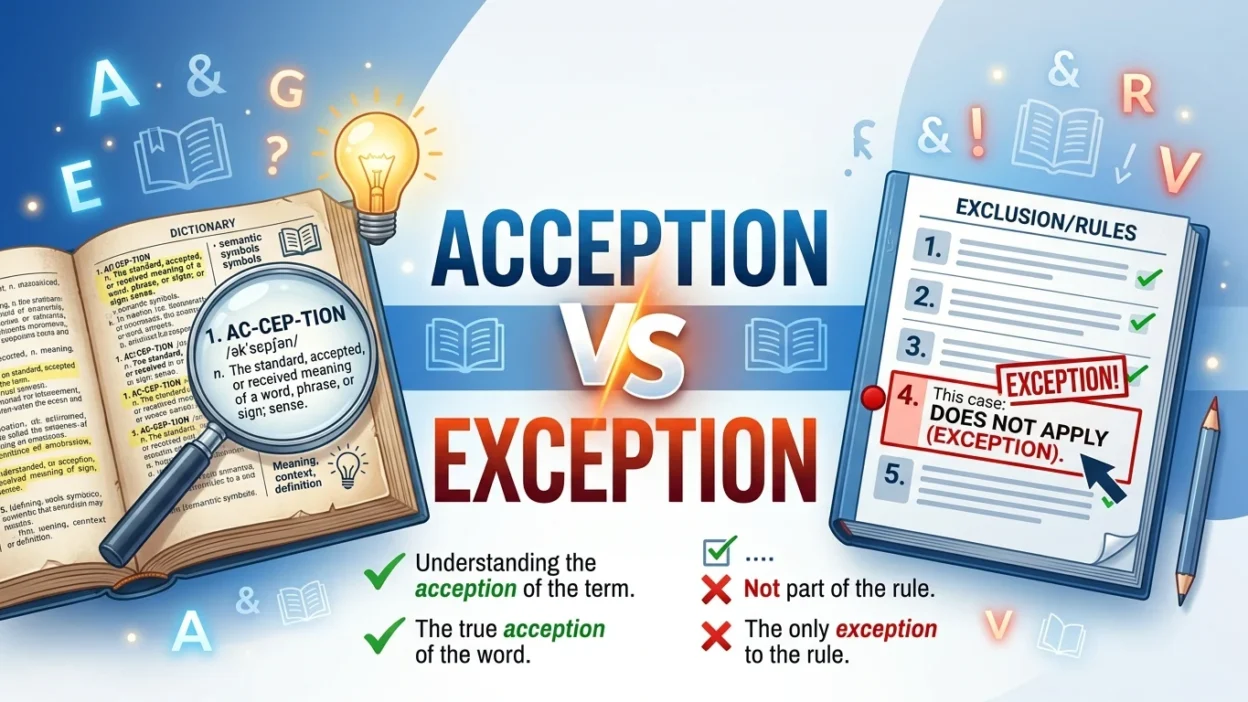
Have you ever come across the words acception and exception and wondered whether they mean the same thing?
You’re not alone. These two words look similar, but they have very different meanings and are used in completely different contexts.
Because exception is common in everyday English while acception is rare, many writers accidentally confuse them.
In this guide, you’ll learn the difference between acception vs exception, when to use each word, examples in real sentences, common mistakes to avoid, and whether American or British English treats these words differently. By the end, you’ll know exactly which word fits your sentence.
Quick Answer
The difference between acception and exception is simple:
- Acception means a particular meaning or accepted sense of a word or phrase. It is a rare and mostly linguistic or academic term.
- Exception means someone or something that does not follow a rule or general statement. It is a common word used in everyday English.
If you’re writing for a general audience, you will almost always need exception, not acception.
What Does “Acception” Mean?
Acception is a noun that refers to the accepted meaning or interpretation of a word, phrase, or expression.
Unlike acceptance, which means approval or agreement, acception specifically relates to language and semantics. It is mainly found in dictionaries, linguistic studies, and academic writing.
Because it is uncommon, many native English speakers may never encounter this word outside scholarly texts.
Examples of Acception
- In its original acception, the word had a different meaning.
- The dictionary lists several acceptions of the term.
- Scholars debated the historical acception of the phrase.
- The legal acception differs from the everyday meaning.
- The ancient text uses the word in a rare acception.
In each example, acception refers to a particular meaning rather than an exception to a rule.
What Does “Exception” Mean?
Exception is a much more common noun. It refers to someone or something that is excluded from a general rule, statement, or pattern.
You’ll see this word in conversations, schools, workplaces, legal documents, and everyday writing.
Examples of Exception
- Everyone attended the meeting, with one exception.
- There are no exceptions to the school policy.
- She rarely eats sweets, except on birthdays as an exception.
- This rule applies to everyone without exception.
- His performance was the exception, not the norm.
Unlike acception, exception has nothing to do with the meaning of words.
Acception vs Exception: Comparison Table
| Feature | Acception | Exception |
|---|---|---|
| Meaning | A particular meaning or accepted sense of a word | Something excluded from a rule |
| Part of Speech | Noun | Noun |
| Common Usage | Rare | Very common |
| Context | Linguistics, dictionaries, academic writing | Everyday English, law, education, business |
| Frequency | Uncommon | Extremely common |
| Easy Substitute | Meaning, sense, interpretation | Exclusion, special case |
When Should You Use “Acception”?
Use acception only when discussing the meaning of words or expressions.
It is appropriate in:
- Linguistics
- Lexicography
- Dictionary definitions
- Historical language studies
- Academic writing
Correct Examples
- This word has several accepted acceptions.
- The medieval acception differs from the modern one.
- The philosopher explained the original acception of the term.
If you’re not discussing language or definitions, you probably don’t need this word.
When Should You Use “Exception”?
Use exception whenever you’re talking about a rule that does not apply to someone or something.
Common situations include:
- School rules
- Company policies
- Grammar rules
- Legal regulations
- Everyday conversations
Correct Examples
- Everyone passed the exam with one exception.
- There are no exceptions to this policy.
- The weather is usually warm, but today is an exception.
- She always arrives early, with very few exceptions.
- This rule has one important exception.
Why Are These Words Confused?
The confusion happens because both words:
- Begin with similar letters
- End with “-ception”
- Are nouns
- Look nearly identical
However, their meanings are completely unrelated.
Think of it this way:
- Acception = accepted meaning
- Exception = excluded from a rule
Remembering this simple distinction makes choosing the correct word much easier.
Common Mistakes to Avoid
Many English learners and even experienced writers mix these words up. Here are the most common mistakes.
1. Using Acception Instead of Exception
❌ There is one acception to the rule.
✅ There is one exception to the rule.
Rules have exceptions—not acceptions.
2. Using Exception When Discussing Meanings
❌ The dictionary lists three exceptions of the word.
✅ The dictionary lists three acceptions of the word.
Dictionary meanings are called acceptions.
3. Confusing Acception with Acceptance
These three words are different.
- Acception = meaning of a word
- Acceptance = approval or agreement
- Exception = exclusion from a rule
4. Assuming Acception Is Common
Although correct, acception is rare. Most people simply use:
- meaning
- sense
- interpretation
- definition
These alternatives are usually clearer for general readers.
Easy Memory Trick
A simple way to remember the difference is this:
Acception = Accepted Meaning
Think of the word accept.
If you’re talking about the accepted sense of a word, use acception.
Exception = Excluded
Think of someone being excepted from a rule.
If something doesn’t follow the rule, it’s an exception.
American vs British English
There is almost no difference between American and British English regarding these words.
American English
- Exception is used frequently in everyday communication.
- Acception appears mostly in academic or linguistic writing.
British English
The usage is nearly identical.
British English also prefers exception for general communication, while acception remains a specialized scholarly term.
The only difference is that British academic writing may occasionally preserve older linguistic terminology, but this does not significantly affect modern usage.
Related Words and Synonyms
Synonyms for Acception
- Meaning
- Sense
- Interpretation
- Definition
- Significance
- Understanding
- Usage
Synonyms for Exception
- Exclusion
- Special case
- Anomaly
- Irregularity
- Departure
- Deviation
- Outlier
Choosing these alternatives can improve readability, especially if you’re writing for a broad audience.
Example Sentences
Acception
- The ancient acception differs from today’s meaning.
- Every acception listed in the dictionary is carefully explained.
- Scholars examined the earliest acception of the word.
- The legal acception is more specific.
- This rare acception appears only in historical texts.
Exception
- Every student submitted the assignment without exception.
- She is the only exception to the rule.
- Mondays are usually busy, but today is an exception.
- There were no exceptions during the inspection.
- His case became an important exception in the study.
FAQs
Is acception a real English word?
Yes. Acception is a genuine English word, but it is rare and mainly used in linguistics, lexicography, and academic writing.
What is the main difference between acception and exception?
Acception refers to the meaning of a word, while exception refers to something excluded from a rule.
Which word is more common?
Exception is far more common and appears regularly in everyday English.
Can I use acception instead of acceptance?
No. Acceptance means approval or agreement, whereas acception refers to the meaning or sense of a word.
Is acception outdated?
Not exactly. It is still correct but is considered highly specialized and uncommon outside academic contexts.
Do dictionaries include the word acception?
Yes. Most comprehensive dictionaries recognize acception, although they often label it as rare or specialized.
Are there American and British spelling differences?
No. Both American and British English use the same spellings: acception and exception.
Summary
Understanding acception vs exception becomes much easier once you know what each word represents.
Acception is a specialized term that refers to the accepted meaning or interpretation of a word, making it useful mainly in linguistics, dictionaries, and academic discussions.
Exception, on the other hand, is a common everyday word that describes something or someone excluded from a general rule or pattern.
For most writers and English learners, exception is the word you’ll use far more often. If you’re discussing language, definitions, or semantics, acception may be appropriate.
Otherwise, stick with exception to ensure your writing is clear, accurate, and easy for readers to understand.
Actionable Takeaway
Whenever you’re unsure which word to choose, ask yourself one simple question: Am I talking about the meaning of a word or a break in a rule? If it’s about a word’s meaning, use acception. If it’s about something that doesn’t follow a rule, use exception. This quick check will help you avoid one of the most common vocabulary mistakes.