
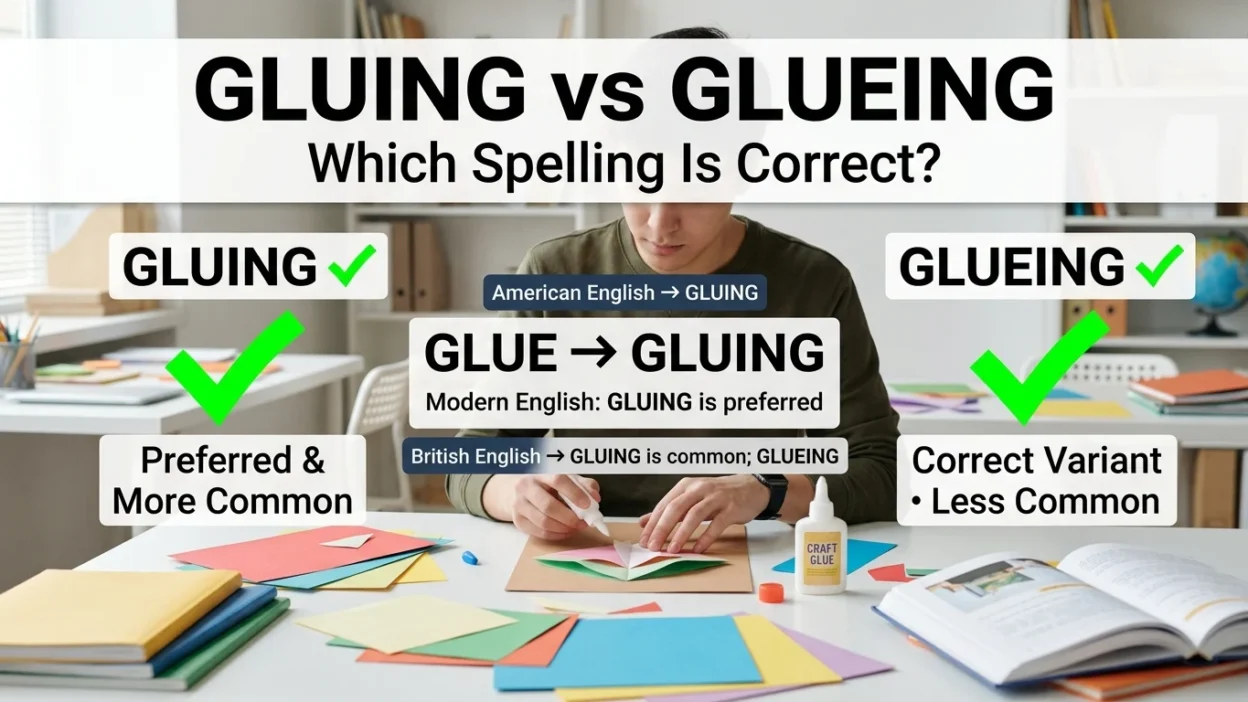
If you have ever wondered whether the correct spelling is gluing vs glueing, you are not alone. The confusion happens because the word glue ends with a vowel before the suffix -ing, and English spelling rules can sometimes feel inconsistent.
The good news is that there is a clear answer for modern English. Gluing is the standard and much more common spelling, especially in American English. Glueing is also found in some dictionaries and usage, particularly in British English, but it is less common. Knowing when to use each form can help you write naturally and avoid a common spelling mistake.
Quick Answer: Gluing vs Glueing
Gluing is generally the preferred spelling.
Glueing is a recognized variant, but it is less common.
| Form | Status | Commonness |
|---|---|---|
| Gluing | Standard and preferred | Very common |
| Glueing | Variant spelling | Less common |
Examples:
I am gluing the pieces together.
She spent the afternoon gluing pictures into her notebook.
The children are gluing paper shapes onto the card.
In most modern writing, choose gluing.
What Does Gluing Mean?
Gluing is the present participle or gerund form of the verb glue.
The verb glue means to attach something using glue or another adhesive substance.
For example:
He glued the broken pieces together.
The teacher glued the paper to the board.
When we change glue into its -ing form, we get gluing.
Gluing can describe the physical act of attaching objects with adhesive.
For example:
She is gluing the photograph to the page.
It can also be used more generally to describe something being firmly attached.
What Does Glueing Mean?
Glueing is an alternative spelling of the same -ing form of glue.
It has the same meaning as gluing.
For example:
She is glueing the pieces together.
However, glueing is much less common than gluing, particularly in modern American English.
Most readers will recognize glueing, but gluing is generally the safer choice when you want standard, widely accepted modern usage.
Gluing vs Glueing Comparison
The two forms do not represent different meanings. They are spelling variants.
| Feature | Gluing | Glueing |
|---|---|---|
| Base verb | Glue | Glue |
| Meaning | Attaching with glue | Attaching with glue |
| Spelling | Preferred | Variant |
| American English | Strongly preferred | Less common |
| British English | Common | Also found |
| Modern usage | Very common | Less common |
| Example | I am gluing the paper. | I am glueing the paper. |
The main difference is spelling preference and frequency, not meaning.
Why Is Gluing Spelled Without the E?
This is where many English learners become confused.
The base verb is:
Glue
When adding -ing, the final e is normally removed before the suffix.
This gives:
Glue + ing → Gluing
The same general spelling pattern can be seen in other English words:
Make → Making
Write → Writing
Use → Using
Take → Taking
However, English spelling rules have exceptions, which is why it can be helpful to learn common word forms individually.
Why Do Some People Write Glueing?
The spelling glueing keeps the e from the original word glue.
Some dictionaries and style traditions recognize this spelling as a variant. It can therefore appear in published writing, particularly in British English.
The spelling is understandable because the pronunciation of glue does not change dramatically when -ing is added.
However, modern usage strongly favors gluing.
If you are writing for a broad English-speaking audience, gluing is usually the better choice.
American vs British English
There is a small regional difference worth knowing.
American English
American English strongly prefers gluing.
Examples:
The children are gluing paper together.
I am gluing the pieces back together.
The students were gluing pictures onto their project.
Glueing is much less common in American writing.
British English
British English also commonly uses gluing, although glueing can be found as a variant.
Examples:
She is gluing the pieces together.
The pupils are gluing pictures into their books.
Glueing may still appear in British sources, but it is not necessary to use it.
Therefore, if you want one spelling that works naturally across both varieties, choose gluing.
Is Gluing or Glueing More Common?
Gluing is much more common.
This is especially true in:
- American English
- Online writing
- Educational material
- Technical instructions
- Product instructions
- General writing
- Modern dictionaries and style guides
For example, instructions are more likely to say:
Start gluing the pieces together.
rather than:
Start glueing the pieces together.
This makes gluing the most practical spelling to remember.
Common Examples of Gluing
Here are several natural examples:
I am gluing the cardboard pieces together.
She is gluing a photograph into her scrapbook.
The students are gluing colored paper onto the poster.
He was gluing the broken model back together.
We spent the afternoon gluing decorations onto the project.
The children are gluing shapes onto a piece of paper.
These examples all use the standard spelling gluing.
Gluing in Different Contexts
The word gluing is useful in many everyday situations.
Arts and Crafts
The children are gluing pieces of paper onto the poster.
School Projects
The students are gluing photographs into their project books.
Repairs
He is gluing the broken wooden pieces together.
Manufacturing
Workers are gluing the materials together before assembly.
Home Projects
She is gluing the decoration onto the box.
In all these contexts, gluing is the preferred spelling.
Common Mistakes With Gluing vs Glueing
Mistake 1: Assuming Glueing Is Always Wrong
Glueing is not simply a random spelling mistake. It is a recognized variant.
However, it is less common than gluing.
So the better rule is:
Glueing = accepted variant
Gluing = preferred modern spelling
Mistake 2: Using Glueing Because the Base Word Is Glue
It may seem logical to keep the e:
Glue + ing = Glueing
But standard spelling normally drops the final e before -ing in this word.
Therefore:
Glue → Gluing
is the preferred form.
Mistake 3: Thinking the Two Words Have Different Meanings
They do not.
Gluing and glueing refer to the same action.
The difference is primarily spelling preference.
Mistake 4: Writing Gluieing
A common typing error is adding extra letters.
The correct forms are:
Gluing
or
Glueing
Avoid spellings such as gluieing or glueeing.
Gluing vs Glued
Do not confuse gluing with glued.
Gluing describes an ongoing action.
She is gluing the pieces together.
Glued is the past tense or past participle.
She glued the pieces together yesterday.
The distinction is similar to:
Writing vs wrote
Making vs made
Using vs used
Gluing vs Glue
Glue is the base verb and can also be a noun.
Examples:
I need some glue.
Please glue the pieces together.
Gluing is the -ing form.
I am gluing the pieces together.
Understanding these forms makes the spelling easier to remember.
Is Glueing Acceptable in Formal Writing?
Yes, glueing can be encountered in formal and published writing because it is recognized as a variant spelling.
However, if you want the spelling that is most widely accepted and immediately familiar, use gluing.
This is especially important for:
- School assignments
- Website content
- Professional writing
- SEO articles
- Business documents
- Educational resources
Using the more common form reduces the chance that readers will think you have made a spelling mistake.
FAQs
1. Is gluing or glueing correct?
Both spellings are recognized, but gluing is the standard and much more common form in modern English.
2. Is glueing a spelling mistake?
Not necessarily. Glueing is a recognized variant spelling, although it is much less common than gluing.
3. Why is gluing spelled without the e?
The final e in glue is normally dropped before adding -ing, producing gluing.
4. Which spelling is preferred in American English?
Gluing is strongly preferred in American English.
5. Which spelling is preferred in British English?
Gluing is also common in British English, although glueing can appear as a variant.
6. Do gluing and glueing have different meanings?
No. They have the same meaning and describe the same action.
7. What is the past tense of glue?
The past tense is glued.
Example:
He glued the pieces together.
8. Should I use gluing in an SEO article?
Yes. Gluing is generally the better choice because it is more common and familiar to modern English readers.
Final Summary
The difference between gluing vs glueing is mainly a matter of spelling preference rather than meaning. Both forms come from the verb glue and describe the act of attaching something with adhesive. However, gluing is clearly the more common and preferred spelling in modern English.
Although glueing can be found in dictionaries and published writing, especially as a British English variant, there is usually no reason to choose it over gluing. If you want a spelling that works naturally for both American and British audiences, gluing is the safest option.

Liam James is a language enthusiast and content writer at Verseslay, specializing in word comparisons, grammar debates, and vocabulary insights. He helps readers understand language nuances through clear, engaging, and practical explanations.