
If the term predicate nominative sounds complicated, do not worry. It is actually a simple grammar concept once you understand what happens after a linking verb. A predicate nominative is a noun or pronoun that identifies or renames the subject of a sentence.
Understanding predicate nominatives can help you recognize sentence structure and use linking verbs correctly. In this guide, you will learn what a predicate nominative is, how to identify one, how it differs from a predicate adjective, and how to avoid common grammar mistakes.
Quick Answer: What Is a Predicate Nominative?
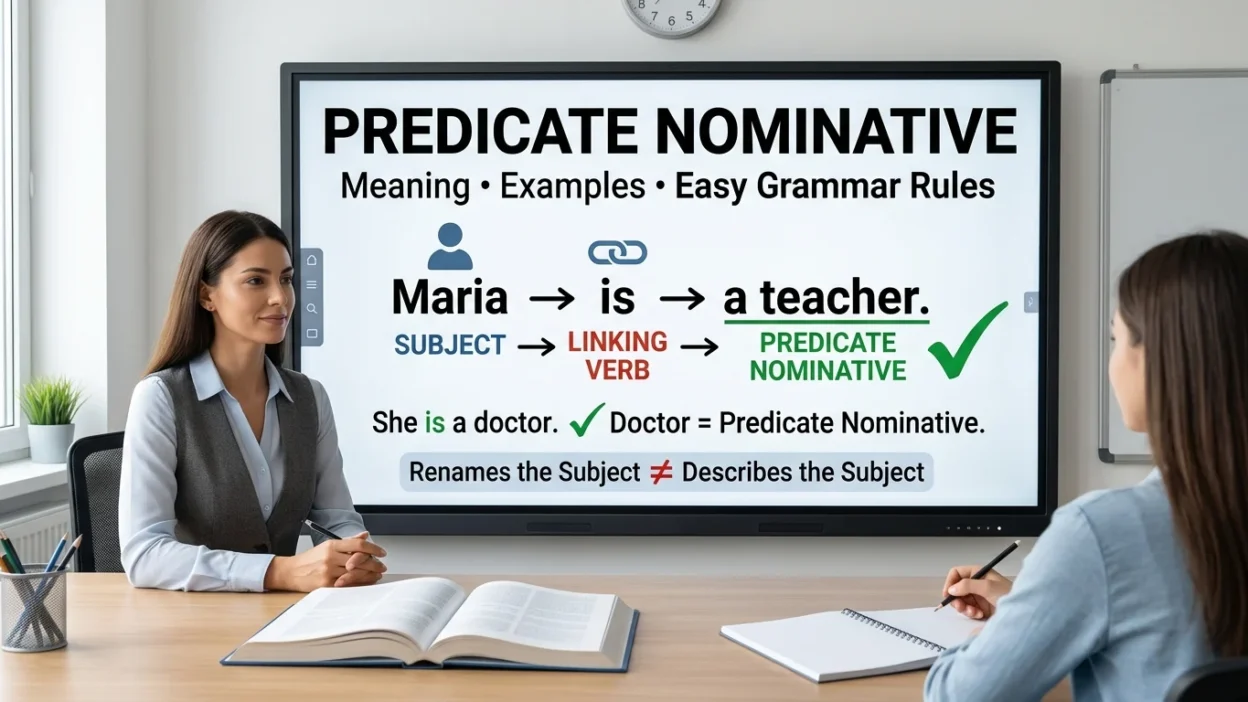
A predicate nominative is a noun or pronoun that follows a linking verb and renames or identifies the subject of a sentence.
For example:
Maria is a teacher.
In this sentence:
- Maria = subject
- is = linking verb
- teacher = predicate nominative
The word teacher identifies who Maria is, so it is a predicate nominative.
A simple formula is:
Subject + Linking Verb + Predicate Nominative
Example:
James is my brother.
James is the subject, is is the linking verb, and brother identifies James.
What Does Predicate Nominative Mean?
The term can be easier to understand when you break it into two parts.
Predicate refers to the part of the sentence that says something about the subject.
Nominative relates to a noun or pronoun used to identify or name someone or something.
Therefore, a predicate nominative is a noun or pronoun in the predicate that identifies or renames the subject.
Consider this sentence:
My sister is a doctor.
The subject is my sister.
The linking verb is is.
The noun doctor tells us who my sister is.
Therefore, doctor is the predicate nominative.
How to Identify a Predicate Nominative
Finding a predicate nominative becomes easier if you follow a few simple steps.
Step 1: Find the Subject
First, identify who or what the sentence is about.
Example:
The boy is a student.
The subject is boy.
Step 2: Find the Linking Verb
Look for a linking verb connecting the subject to additional information.
Common linking verbs include:
- Am
- Is
- Are
- Was
- Were
- Be
- Been
- Become
- Became
- Seem
- Remain
Step 3: Look for a Noun or Pronoun After the Verb
If the word after the linking verb is a noun or pronoun that identifies or renames the subject, it is a predicate nominative.
Example:
The boy is a student.
Student identifies the boy.
Therefore, student is the predicate nominative.
Predicate Nominative Examples
Here are several simple examples:
Sarah is a teacher.
Teacher identifies Sarah.
My uncle is a pilot.
Pilot identifies my uncle.
The winner was David.
David identifies the winner.
Her favorite animal is a dolphin.
Dolphin identifies the favorite animal.
That building is a school.
School identifies the building.
My best friend became a doctor.
Doctor identifies the best friend.
The person at the door is my brother.
Brother identifies the person.
In each example, the noun after the linking verb renames or identifies the subject.
Predicate Nominative vs Predicate Adjective
One of the most common sources of confusion is the difference between a predicate nominative and a predicate adjective.
Both can follow linking verbs, but they perform different jobs.
A predicate nominative is a noun or pronoun that renames or identifies the subject.
A predicate adjective is an adjective that describes the subject.
Compare:
John is a doctor.
Doctor is a noun that identifies John.
Therefore, doctor is a predicate nominative.
John is tired.
Tired is an adjective that describes John.
Therefore, tired is a predicate adjective.
Comparison Table
| Feature | Predicate Nominative | Predicate Adjective |
|---|---|---|
| Function | Renames or identifies the subject | Describes the subject |
| Usually is | Noun or pronoun | Adjective |
| Follows | Linking verb | Linking verb |
| Example | She is a doctor. | She is tired. |
| Question it answers | Who or what is the subject? | What is the subject like? |
A useful test is to ask:
Does the word rename the subject?
If yes, it may be a predicate nominative.
Does it describe the subject?
If yes, it is probably a predicate adjective.
Linking Verbs and Predicate Nominatives
Predicate nominatives typically appear after linking verbs.
The most common linking verbs are forms of be:
- Am
- Is
- Are
- Was
- Were
- Be
- Being
- Been
Other verbs can function as linking verbs depending on the sentence.
Examples include:
- Become
- Became
- Seem
- Remain
- Appear
- Feel
- Look
- Sound
- Smell
- Taste
However, these verbs do not always function as linking verbs.
For example:
She became a teacher.
Teacher identifies the subject, so it is a predicate nominative.
But in:
She looked at the teacher.
Looked is functioning as an action verb, not a linking verb.
This is why you should consider the meaning and structure of the complete sentence.
Predicate Nominative With Pronouns
A predicate nominative can also be a pronoun.
For example:
The winner was she.
In traditional formal grammar, she is treated as the predicate nominative because it identifies the subject.
Another example is:
The person responsible was I.
Here, I identifies the person responsible.
However, natural modern English often uses object-form pronouns in these constructions, especially in everyday conversation.
For example, many speakers naturally say:
The winner was her.
This reflects the difference between traditional grammatical rules and common modern usage.
Predicate Nominative vs Direct Object
Another common mistake is confusing a predicate nominative with a direct object.
A direct object receives the action of an action verb.
A predicate nominative follows a linking verb and identifies the subject.
Compare:
James became a teacher.
Teacher identifies James, so it is a predicate nominative.
James met a teacher.
Teacher receives the action of met, so it is a direct object.
The verbs make the difference.
Became connects James with teacher.
Met describes an action performed by James.
Common Mistakes With Predicate Nominatives
Mistake 1: Thinking Every Word After a Verb Is a Predicate Nominative
This is not true.
A predicate nominative normally follows a linking verb and identifies or renames the subject.
Example:
Maria is a student.
Student is a predicate nominative.
But:
Maria reads a book.
Book is a direct object, not a predicate nominative.
Mistake 2: Confusing a Predicate Nominative With an Adjective
Consider:
The soup is delicious.
Delicious describes the soup.
It is a predicate adjective, not a predicate nominative.
Now consider:
The soup is dinner.
Dinner identifies what the soup represents in the sentence, making it a predicate nominative.
Mistake 3: Forgetting the Linking Verb
A predicate nominative normally depends on a linking relationship between the subject and the noun or pronoun.
For example:
Michael is a student.
Is connects Michael and student.
Mistake 4: Assuming Predicate Nominatives Are Always People
They can identify objects, animals, places, ideas, or other nouns.
Examples:
That animal is a dog.
This building is a museum.
Her goal is success.
The predicate nominative does not have to describe a person.
Why Predicate Nominatives Matter
Predicate nominatives are useful because they show how English sentences identify people and things.
They appear frequently in:
- School writing
- Academic grammar
- Formal writing
- Descriptive sentences
- Definitions
- Explanations
- Everyday English
For example:
A triangle is a shape.
The word shape identifies what a triangle is.
My brother is an engineer.
Engineer identifies the brother.
Understanding this structure makes it easier to analyze complicated sentences.
American vs British English
There is no major difference between American and British English regarding the basic definition of a predicate nominative.
The grammatical concept is used in both varieties.
One area where usage can differ is with pronouns after linking verbs.
Traditional grammar may prefer:
It was I.
However, everyday American and British English commonly use:
It was me.
Both forms can be understood, but It was me is very common in ordinary modern conversation.
For school assignments or formal grammar exercises, follow the style or grammatical rules your teacher or institution expects.
FAQs
1. What is a predicate nominative?
A predicate nominative is a noun or pronoun that follows a linking verb and identifies or renames the subject.
2. What is an example of a predicate nominative?
In the sentence She is a teacher, the word teacher is the predicate nominative because it identifies the subject she.
3. What is the difference between a predicate nominative and a predicate adjective?
A predicate nominative is a noun or pronoun that identifies the subject. A predicate adjective is an adjective that describes the subject.
4. Can a predicate nominative be a pronoun?
Yes. A predicate nominative can be a noun or pronoun.
5. Does a predicate nominative always follow the verb to be?
No. It commonly follows forms of be, but other linking verbs such as become and seem can also introduce predicate nominatives.
6. Is a direct object the same as a predicate nominative?
No. A direct object receives the action of an action verb, while a predicate nominative identifies or renames the subject after a linking verb.
7. Can a predicate nominative describe an object?
Yes. A predicate nominative can identify people, animals, objects, places, ideas, and other nouns.
8. Is a predicate nominative always a noun?
It is usually a noun or pronoun that identifies or renames the subject.
Final Summary
A predicate nominative is a noun or pronoun that follows a linking verb and identifies or renames the subject. In a sentence such as Maria is a teacher, teacher is the predicate nominative because it tells us who Maria is. The concept becomes much easier when you look for the combination of a subject, linking verb, and identifying noun or pronoun.
The most important distinction to remember is between a predicate nominative and a predicate adjective. A predicate nominative identifies or renames the subject, while a predicate adjective describes the subject. Once you learn to ask whether the word tells you who or what the subject is, rather than what the subject is like, identifying predicate nominatives becomes much easier.