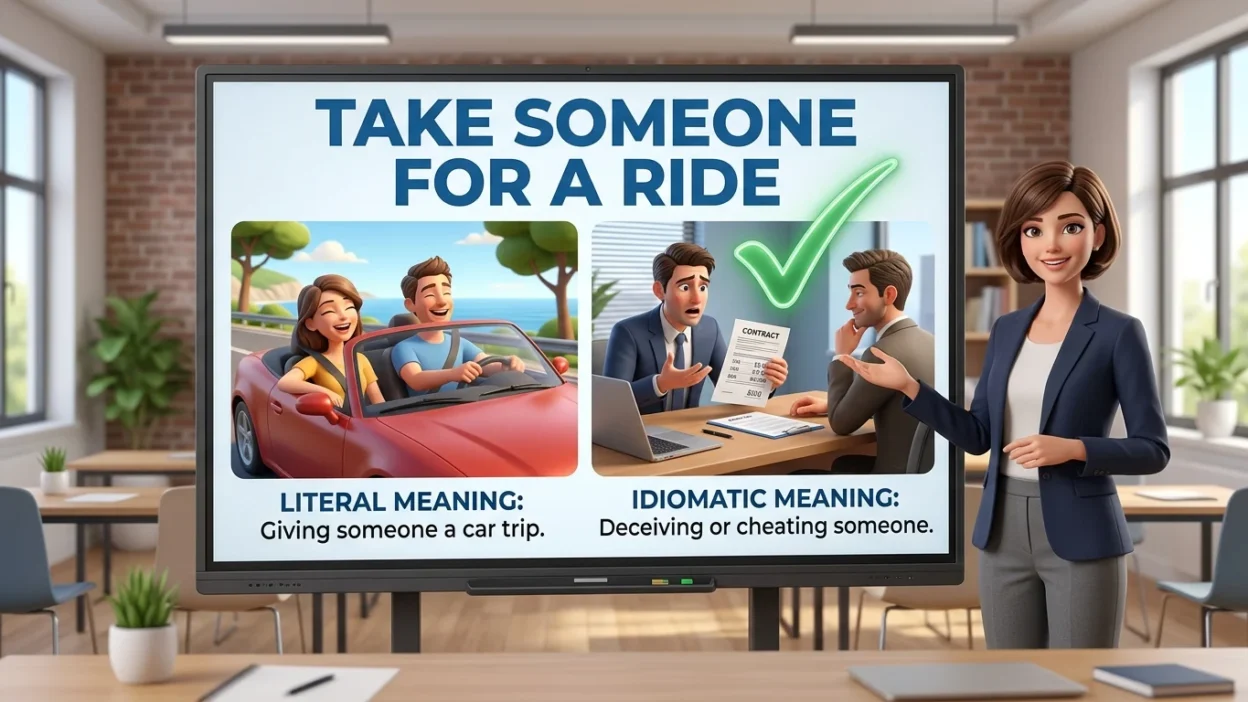
Have you ever heard someone say, take someone for a ride, and wondered whether they were talking about an actual trip or something completely different? This common English idiom can be confusing because its literal meaning involves traveling in a car, while its figurative meaning has nothing to do with transportation.
Take someone for a ride can mean to deceive, trick, or cheat someone, especially by making them believe something that is not true. It can also be used literally when someone takes another person somewhere in a vehicle. Understanding the context is the key to knowing which meaning is intended.
Quick Answer
Take someone for a ride has two main meanings:
- Literal meaning: To take someone somewhere in a vehicle.
- Idiomatic meaning: To deceive, trick, or take advantage of someone.
Examples
- Literal: My brother took me for a ride around the city.
- Idiomatic: That salesman tried to take me for a ride.
In the second sentence, the speaker means that the salesman tried to cheat or deceive them.
Take Someone for a Ride Meaning
The idiom take someone for a ride usually means to deceive, trick, cheat, or exploit someone for personal benefit.
It is often used when someone is being dishonest about money, a deal, a promise, or a situation.
For example:
The mechanic took me for a ride and charged me much more than the repair was worth.
Here, the person was not literally taken somewhere in a car. The speaker means the mechanic overcharged or deceived them.
The expression can also suggest that someone is making another person look foolish or leading them to believe something untrue.
Literal Meaning of Take Someone for a Ride
Before understanding the idiomatic meaning, it helps to understand the literal one.
To take someone for a ride can simply mean to drive someone somewhere for enjoyment, transportation, or a casual trip.
For example:
My father took me for a ride after dinner.
Here, there is no deception involved. The sentence simply means that the father drove the speaker somewhere.
Another example:
Would you like me to take you for a ride around town?
This is a straightforward offer to drive someone around.
The context determines whether the expression is literal or figurative.
Idiomatic Meaning: To Deceive or Cheat
When used as an idiom, take someone for a ride means to fool, deceive, cheat, or take advantage of them.
It is often used when someone realizes that another person was not being honest.
For example:
I think the contractor took us for a ride.
This could mean that the contractor charged an unfair amount or deliberately misled the customers.
Another example:
Don’t let them take you for a ride.
This means:
Don’t let them deceive or exploit you.
Take Someone for a Ride Examples
Here are several examples showing the idiomatic meaning:
- The company took customers for a ride by charging hidden fees.
- I realized that the seller had taken me for a ride.
- Don’t let anyone take you for a ride.
- He took his clients for a ride and disappeared with their money.
- The dishonest dealer tried to take us for a ride.
- She felt that the repair shop had taken her for a ride.
- We paid far too much; I think we were taken for a ride.
- The salesman tried to take me for a ride, but I checked the price first.
In each example, the phrase suggests some form of dishonesty, deception, unfair treatment, or exploitation.
Take Someone for a Ride in a Sentence
The expression can be used in different grammatical forms.
Present
They are trying to take me for a ride.
This means they are trying to deceive or cheat me.
Past
They took me for a ride.
This means they deceived or cheated me.
Passive
I was taken for a ride.
This means someone deceived or cheated me.
Negative
Don’t let them take you for a ride.
This means don’t allow them to deceive or exploit you.
Question
Do you think he is taking us for a ride?
This asks whether someone is being dishonest or trying to fool you.
Taken for a Ride Meaning
You will often hear the expression taken for a ride rather than take someone for a ride.
Taken for a ride means that someone has been deceived, cheated, or exploited.
For example:
I paid $500 for the repair, but the actual cost was much lower. I was taken for a ride.
The speaker means they believe they were treated unfairly or cheated.
Another example:
We trusted him, but he took advantage of us and we were taken for a ride.
This is the passive form of the idiom.
Take Someone for a Ride vs Take Someone for a Drive
These expressions can look similar, but their meanings are different.
Take someone for a drive normally means to drive someone somewhere, often for transportation or enjoyment.
Take someone for a ride can have the same literal meaning, but it can also have the figurative meaning of deceiving or cheating someone.
Compare:
I took my friend for a drive.
This clearly describes driving.
I took my friend for a ride.
This can mean a drive, depending on context.
But:
The salesman took me for a ride.
This almost certainly means the salesman deceived or cheated me.
Is Take Someone for a Ride Always Negative?
No. The phrase is not always negative.
When used literally, take someone for a ride can be completely positive or neutral.
For example:
My uncle took the children for a ride in his new car.
This simply means he drove them around.
The idiomatic meaning, however, is generally negative because it involves deception, cheating, or taking advantage of someone.
So, always consider the surrounding words and situation before deciding what the speaker means.
Common Situations Where the Idiom Is Used
You may hear take someone for a ride in conversations about:
- Money
- Business deals
- Car repairs
- Shopping
- Contracts
- Services
- Sales
- Dishonest transactions
- Unfair prices
- False promises
For example:
The dealer tried to take me for a ride by charging twice the normal price.
This sentence clearly suggests an unfair or dishonest transaction.
Common Mistakes
1. Assuming It Always Means a Car Ride
The literal meaning is only one possibility.
If someone says:
That company took me for a ride.
They probably do not mean that the company drove them somewhere. They mean they were deceived or treated unfairly.
2. Confusing It With Take Someone for a Drive
Although both expressions can describe traveling in a vehicle, take someone for a ride has an additional idiomatic meaning that take someone for a drive usually does not.
3. Using It Without Context
Because the phrase has both literal and figurative meanings, context is important.
He took me for a ride.
This could mean he drove you somewhere or deceived you.
Adding context removes the ambiguity:
He took me for a ride around the lake.
This is clearly literal.
He charged me twice the normal price. He really took me for a ride.
This is clearly idiomatic.
4. Thinking It Always Means Serious Fraud
The idiom can describe serious deception, but it can also refer to relatively minor situations.
Someone might say:
That shop took me for a ride.
Simply because they believe they were overcharged.
The seriousness depends on the context.
Synonyms for Take Someone for a Ride
Depending on the situation, several expressions have a similar meaning.
- Deceive someone
- Cheat someone
- Trick someone
- Fool someone
- Take advantage of someone
- Rip someone off
- Con someone
- Mislead someone
- Exploit someone
However, these expressions are not always exact replacements.
For example, rip someone off often focuses on charging someone too much, while deceive someone has a broader meaning.
Take Someone for a Ride vs Rip Someone Off
These two expressions are sometimes used in similar situations.
Take someone for a ride can mean to deceive or exploit someone.
Rip someone off usually means to charge someone an unfairly high price or provide poor value.
For example:
The mechanic took me for a ride.
This could mean the mechanic deceived or exploited the customer.
The mechanic ripped me off.
This more directly suggests that the mechanic charged too much.
FAQs
What does take someone for a ride mean?
As an idiom, take someone for a ride means to deceive, trick, cheat, or take advantage of someone. Literally, it can simply mean to drive someone somewhere.
Is take someone for a ride an idiom?
Yes. Take someone for a ride is a common English idiom when it is used to mean deceive, cheat, or exploit someone.
What does I was taken for a ride mean?
I was taken for a ride means that someone believes they were deceived, cheated, or treated unfairly.
Is take someone for a ride always negative?
No. The literal meaning can be neutral or positive. For example, taking a friend for a ride can simply mean driving them somewhere for enjoyment.
What is another word for take someone for a ride?
Depending on the context, alternatives include deceive, trick, cheat, fool, mislead, exploit, take advantage of, and rip off.
What does don’t let them take you for a ride mean?
It means don’t allow them to deceive, cheat, or take advantage of you.
What is the difference between take someone for a ride and take someone for a drive?
Take someone for a drive normally means to drive someone somewhere. Take someone for a ride can have the same literal meaning, but it can also mean to deceive or cheat someone.
Can take someone for a ride mean to overcharge someone?
Yes. In many contexts, the expression can suggest that someone has been overcharged or treated unfairly, especially in a financial transaction.
Summary
The phrase take someone for a ride has both a literal and an idiomatic meaning. Literally, it can mean to take someone somewhere in a vehicle, such as going for a ride around town. Figuratively, it means to deceive, cheat, trick, or take advantage of someone. Context is what tells you which meaning is intended.
When you hear phrases such as I was taken for a ride or Don’t let them take you for a ride, the speaker is usually talking about deception or unfair treatment rather than an actual journey. Once you recognize this figurative meaning, the idiom becomes much easier to understand and use naturally.
Actionable Takeaway
Remember the two meanings: take someone for a ride can mean giving someone a literal ride, or it can mean deceiving or cheating them. Look at the context to determine the intended meaning.
Easy rule: A vehicle can give you a ride, but a dishonest person can also take you for a ride.