Someone vs somebody is a common English usage question because both words mean almost exactly the same thing. Whether you are writing an email, having a conversation, or learning English grammar, you may wonder if one is more correct or more natural than the other.
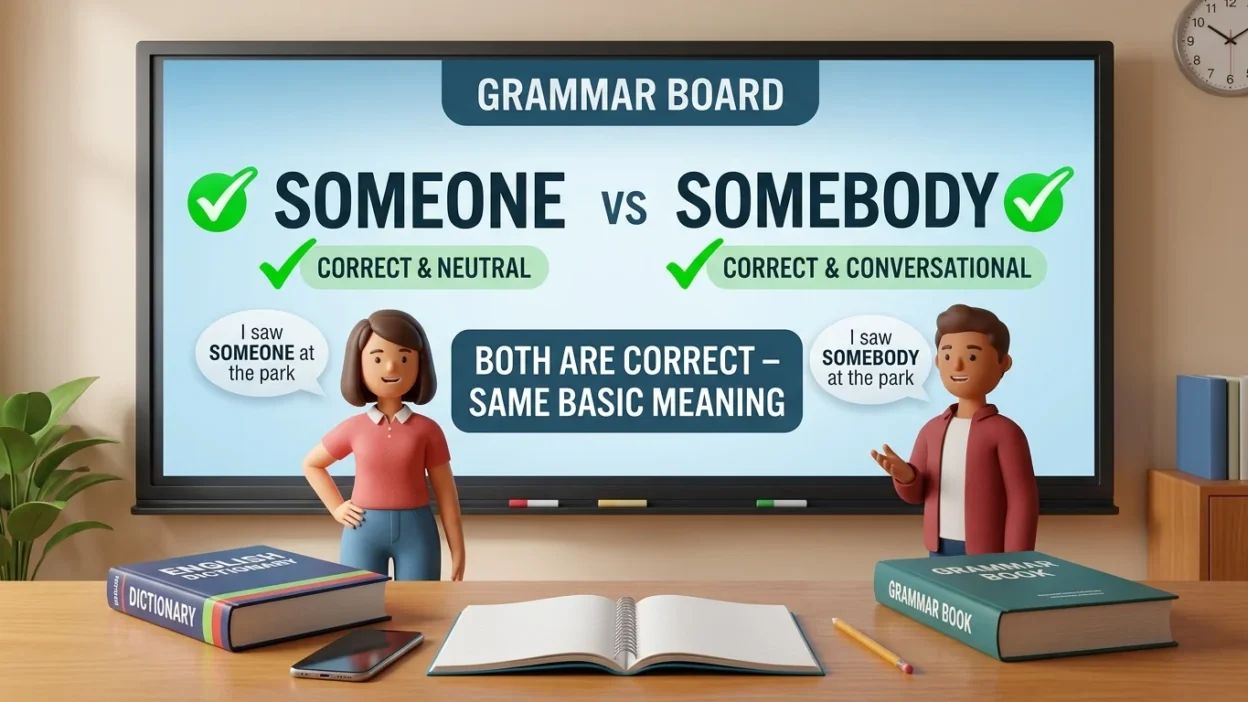
The good news is that both someone and somebody are correct. They are indefinite pronouns used to refer to an unspecified person. In most sentences, you can replace one with the other without changing the basic meaning. The main difference is usually related to tone, style, and context, rather than grammar.
Quick Answer
Someone and somebody both mean an unspecified person and are grammatically correct.
- Someone = an unspecified person
- Somebody = an unspecified person
Examples:
- Someone left a message for you.
- Somebody left a message for you.
Both sentences are correct and have essentially the same meaning.
In modern English, someone can sound slightly more neutral or formal, while somebody can sometimes sound a little more conversational. However, the difference is small, and both are widely used.
What Does Someone Mean?
Someone is an indefinite pronoun that means some person or an unspecified person.
You use it when you know that a person exists but you do not identify exactly who that person is.
Examples:
- Someone is waiting outside.
- Someone called you this morning.
- Someone needs to clean the room.
- Someone took my pen.
- I need someone to help me.
The identity of the person is either unknown, unimportant, or intentionally not mentioned.
What Does Somebody Mean?
Somebody has the same basic meaning as someone.
It refers to an unspecified person.
Examples:
- Somebody is waiting outside.
- Somebody called you this morning.
- Somebody needs to clean the room.
- Somebody took my pen.
- I need somebody to help me.
These sentences communicate essentially the same information as the examples using someone.
Someone vs Somebody: Main Difference
The biggest point to remember is that there is no important difference in basic meaning.
| Word | Meaning | Tone | Example |
|---|---|---|---|
| Someone | An unspecified person | Neutral, slightly more formal | Someone called me. |
| Somebody | An unspecified person | Neutral, sometimes more conversational | Somebody called me. |
| Anyone | Any person | General/open | Anyone can join. |
| Anybody | Any person | General, conversational | Anybody can join. |
| No one | Not a single person | Neutral/formal | No one knows. |
| Nobody | Not a single person | Conversational | Nobody knows. |
Someone and somebody belong to the same general group of indefinite pronouns.
Are Someone and Somebody Interchangeable?
In most everyday sentences, yes.
Consider:
Someone is at the door.
and
Somebody is at the door.
Both mean that an unidentified person is at the door.
Another example:
Someone helped me with my homework.
Somebody helped me with my homework.
Again, there is no meaningful difference in the basic message.
However, choosing one over the other can sometimes change the feel or tone of the sentence.
Someone vs Somebody in Formal Writing
When writing something formal, someone may sometimes be the preferred choice because it has a slightly more neutral and polished feel.
For example:
Someone from our management team will contact you shortly.
This sounds natural in a professional email.
You could also write:
Somebody from our management team will contact you shortly.
This is grammatically correct, but someone may sound slightly more professional in this particular context.
That does not mean somebody is incorrect or unsuitable for formal writing. It simply means that someone is often a safer neutral choice.
Someone vs Somebody in Everyday Conversation
In casual speech, both words are extremely natural.
For example:
Somebody left their phone on the table.
This can sound very natural and conversational.
You could also say:
Someone left their phone on the table.
That is equally correct.
Your choice may depend on personal speaking style, regional preference, or the rhythm of the sentence.
Someone or Somebody: Which Is More Common?
Both are common, but someone is often preferred in neutral and formal contexts.
You may see someone frequently in:
- Professional emails
- Academic writing
- Business communication
- Instructions
- General informational writing
Somebody is also common, especially in:
- Everyday conversation
- Informal writing
- Friendly communication
- Casual questions and statements
The difference should not be exaggerated. Native speakers commonly use both.
Examples of Someone and Somebody
Here are some examples showing how naturally the two words can replace each other.
Example 1
Someone is calling you.
Somebody is calling you.
Both are correct.
Example 2
I need someone to help me.
I need somebody to help me.
Both mean that the speaker needs an unspecified person to provide help.
Example 3
Someone forgot their umbrella.
Somebody forgot their umbrella.
Both sentences are natural.
Example 4
Did someone tell you the news?
Did somebody tell you the news?
Both questions are grammatically correct.
Example 5
Someone has left a package at the door.
Somebody has left a package at the door.
Again, the meaning is essentially identical.
Someone vs Somebody With Singular Verbs
An important grammar point is that someone and somebody are grammatically singular indefinite pronouns.
Therefore, they normally take a singular verb.
Correct:
- Someone is waiting outside.
- Somebody has called.
- Someone wants to speak with you.
- Somebody knows the answer.
Incorrect:
- Someone are waiting outside.
- Somebody have called.
- Someone want to speak with you.
Although modern English commonly uses they/their as gender-neutral pronouns after someone or somebody, the verb remains singular.
Example:
Someone left their phone on the desk.
Here, someone takes the singular verb left, while their is used as a gender-neutral possessive pronoun.
Someone vs Somebody With Possessive Pronouns
Both words can naturally be followed by their when the person’s gender is unknown or irrelevant.
Examples:
- Someone forgot their keys.
- Somebody forgot their keys.
- Someone should check their email.
- Somebody should check their email.
Both forms are common in modern English.
Common Mistakes
Mistake 1: Thinking Somebody Is Incorrect
Some learners believe somebody is grammatically wrong because someone sounds more formal.
That is incorrect.
Somebody is a standard English word and is completely correct.
Mistake 2: Assuming Someone Is Always Better
Someone may be a good choice in formal writing, but that does not make it universally better.
For example:
Somebody told me a funny story yesterday.
There is nothing wrong with this sentence.
Mistake 3: Using a Plural Verb
Because someone and somebody refer to people, learners sometimes incorrectly use plural verbs.
Incorrect:
Somebody are waiting outside.
Correct:
Somebody is waiting outside.
Mistake 4: Confusing Someone With Anyone
Someone generally refers to an unspecified person.
Anyone means any person and is often used in questions, negatives, or general statements.
Compare:
Someone called you.
This means an unspecified person called you.
Did anyone call you?
This asks whether any person called you.
Someone vs Somebody vs Anyone vs Anybody
These words are closely related but should not be treated as identical.
Someone and somebody
Both generally mean an unspecified person.
Someone is in the kitchen.
Somebody is in the kitchen.
Anyone and anybody
Both generally mean any person, often without specifying who.
Anyone can learn English.
Anybody can learn English.
No one and nobody
Both mean not a single person.
No one knows the answer.
Nobody knows the answer.
The same pattern appears across these indefinite pronouns:
someone / somebody
anyone / anybody
no one / nobody
American vs British English
There is no major difference between American and British English in the meaning or grammatical correctness of someone and somebody.
Both varieties use both words.
American English may commonly use someone in neutral and professional contexts, while somebody remains perfectly natural in everyday speech.
British English also uses both forms naturally.
Therefore, you do not need to treat one as American and the other as British.
Which One Should You Use?
If you are unsure which word to choose, someone is a very safe option.
Use someone when you want a:
- Neutral tone
- Professional tone
- Formal or semi-formal style
- General reference to an unspecified person
Use somebody when you want a:
- Conversational tone
- Friendly tone
- Casual style
- Natural spoken expression
But remember that these are tendencies, not strict grammar rules.
A Simple Memory Trick
Think of the endings -one and -body as two different ways of referring to a person.
Someone = some person
Somebody = some person
Both point to an unidentified person.
The easiest rule is:
Someone and somebody have the same basic meaning. Choose according to tone and personal style.
FAQs
1. Is someone or somebody correct?
Both someone and somebody are correct. They generally have the same meaning and can often be used interchangeably.
2. What is the difference between someone and somebody?
There is very little difference in meaning. Someone can sound slightly more neutral or formal, while somebody can sometimes sound more conversational.
3. Is someone more formal than somebody?
Usually, someone has a slightly more neutral or formal feel, especially in professional writing. However, somebody is also standard and correct English.
4. Can someone and somebody be used interchangeably?
Yes. In most sentences, you can replace one with the other without changing the basic meaning.
5. Is somebody grammatically correct?
Yes. Somebody is a standard English indefinite pronoun and is completely grammatically correct.
6. Does someone take a singular verb?
Yes. Someone is grammatically singular and normally takes a singular verb.
Example: Someone is waiting outside.
7. Does somebody mean one person?
Yes. Somebody generally refers to an unspecified person, although the exact identity is unknown or unimportant.
8. Which is better in formal writing, someone or somebody?
Someone may be the better neutral choice for formal writing, but somebody is not grammatically wrong. Both are acceptable.
Summary
Someone vs somebody is not really a question of right versus wrong. Both words are correct indefinite pronouns meaning an unspecified person, and in most situations they can be used interchangeably. The main difference is one of tone: someone often feels slightly more neutral or polished, while somebody can feel a little more conversational.
For professional writing, academic work, and formal communication, someone is often a safe and natural choice. In everyday conversation, both someone and somebody sound completely normal. Neither word is incorrect, and American and British English both use them.
Actionable Takeaway
Remember this simple rule:
Someone = some person
Somebody = some person
If you need a neutral choice, use someone. If you are speaking casually or want a conversational tone, somebody works perfectly well. Most importantly, do not worry about choosing the wrong word—both are standard English.