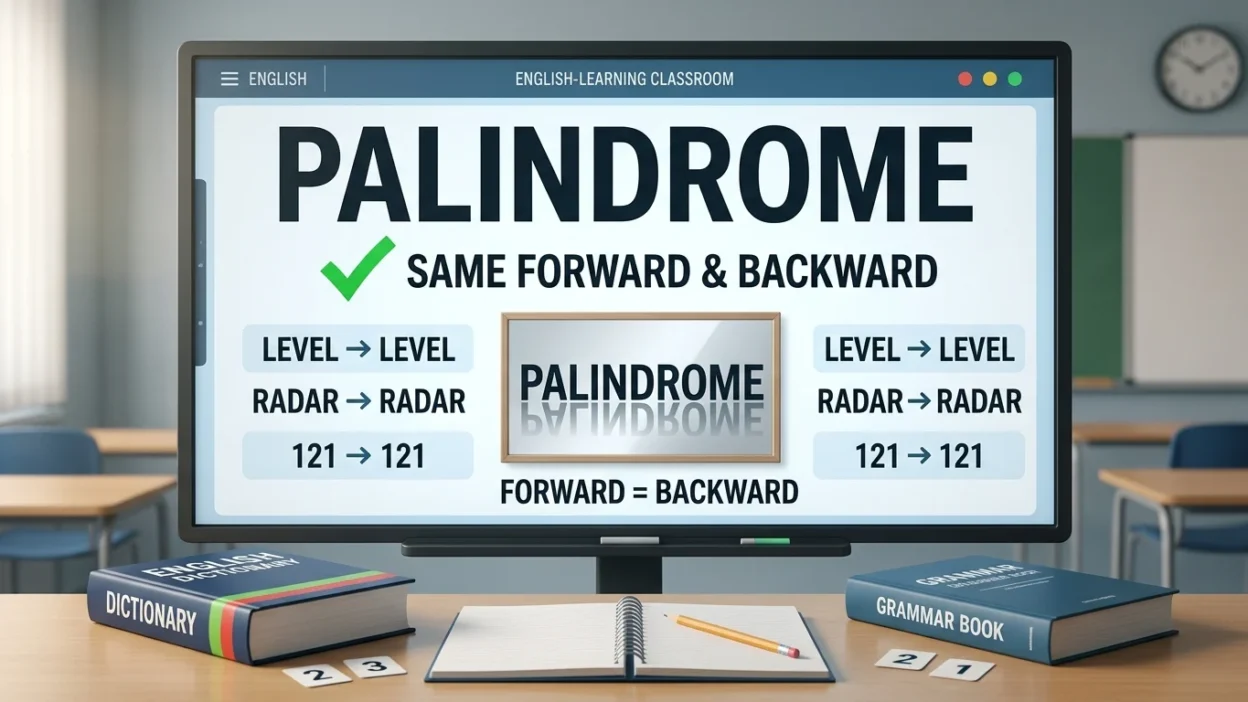
Have you ever come across a word or number that looks exactly the same when read backward? Words such as level, radar, and madam are simple examples. These unusual patterns are called palindromes, and they are a fascinating part of English language, mathematics, and wordplay.
The palindrome meaning is quite simple: a palindrome is a word, number, phrase, or sequence that reads the same forward and backward, usually when spaces, punctuation, and capitalization are ignored. In this article, we will explain what a palindrome is, provide plenty of examples, explore different types, and show you an easy way to recognize one.
Quick Answer
A palindrome is a word, number, phrase, or sequence that reads the same from left to right and right to left.
Examples include:
- level
- radar
- madam
- civic
- racecar
- 121
- 1331
For example, level remains level when its letters are reversed.
In simple terms:
Palindrome = something that reads the same forward and backward.
What Does Palindrome Mean?
The word palindrome refers to something that has the same sequence when read in reverse order.
The term is most commonly used for words and phrases, but it can also describe numbers, dates, and other sequences.
For example:
level
Read normally:
l-e-v-e-l
Read backward:
l-e-v-e-l
The result is exactly the same, so level is a palindrome.
Another example is:
radar
Forward:
r-a-d-a-r
Backward:
r-a-d-a-r
Again, the sequence does not change.
Palindrome Examples
There are many familiar palindrome words in English.
Common palindrome words
- level
- radar
- civic
- madam
- racecar
- rotor
- kayak
- refer
- noon
- deed
- stats
- reviver
- redder
- wow
These words are useful examples because their letters form symmetrical patterns.
Palindrome Numbers
Palindromes are not limited to words. Numbers can also be palindromes.
Examples include:
- 11
- 22
- 101
- 121
- 131
- 202
- 1111
- 1221
- 1331
- 2002
Take 1221.
Forward:
1-2-2-1
Backward:
1-2-2-1
Because the sequence remains unchanged, 1221 is a palindrome number.
Palindrome Phrases
Some phrases can also be palindromes.
When checking a phrase, spaces, punctuation, and capitalization are generally ignored.
One famous example is:
A man, a plan, a canal, Panama!
When the spaces and punctuation are removed, the letters form the same sequence in reverse.
Another well-known example is:
Was it a rat I saw?
The phrase reads the same backward when spaces and punctuation are ignored.
These examples show why palindromes can be more complicated than simply finding a word such as level.
How to Identify a Palindrome
Finding a palindrome is easier when you follow a simple process.
Step 1: Write the word or sequence
For example:
racecar
Step 2: Reverse it
Read it from the last letter to the first:
racecar
Step 3: Compare the two versions
Original:
racecar
Reversed:
racecar
They are identical, so the word is a palindrome.
This method works for words, numbers, and phrases.
Palindrome vs Regular Word
Not every word has to be symmetrical.
Compare these examples:
| Word | Reversed | Palindrome? |
|---|---|---|
| level | level | Yes |
| radar | radar | Yes |
| civic | civic | Yes |
| apple | elppa | No |
| house | esuoh | No |
| table | elbat | No |
| banana | ananab | No |
The key test is simple: Does the reversed version exactly match the original?
Even-Length and Odd-Length Palindromes
Palindromes can have either an odd or even number of characters.
Odd-length palindromes
These have a central character.
Examples:
- level
- radar
- civic
- madam
- racecar
In level, the middle letter is v.
Even-length palindromes
These have no single middle character.
Examples:
- noon
- deed
- 1221
- 1331
- 2112
In noon, the two middle letters are o and o.
Both types are genuine palindromes.
Why Are Palindromes Interesting?
Palindromes are interesting because they create a form of symmetry in language.
They can be used for:
- Word games
- Puzzles
- Brain teasers
- Language learning
- Creative writing
- Mathematics
- Computer programming
- Educational activities
They are also useful for helping students think about spelling, sequence, patterns, and letters.
Palindrome Meaning in Mathematics
In mathematics, a palindrome is generally a number or sequence that remains unchanged when its digits are reversed.
For example:
1221
Reverse the digits:
1221
Therefore, 1221 is a palindrome.
By contrast:
1234
becomes:
4321
Since the two numbers are different, 1234 is not a palindrome.
Palindrome numbers are often used in mathematical puzzles and programming exercises because checking whether a number is symmetrical is a straightforward logical problem.
Palindrome in Computer Programming
The concept of a palindrome is also common in computer science.
A programming exercise may ask you to determine whether a particular string is a palindrome.
For example, a program could receive:
level
It would reverse the string and compare it with the original.
If both are identical, the program identifies it as a palindrome.
This makes palindromes a popular beginner programming problem because they teach concepts such as:
- Strings
- Reversing data
- Comparison
- Loops
- Conditional statements
- Algorithms
Palindrome vs Anagram
Palindromes are sometimes confused with anagrams, but they are different.
A palindrome reads the same forward and backward.
Example:
radar
An anagram is created by rearranging the letters of a word or phrase to form another word or phrase.
For example, listen can be rearranged to make silent.
The letters are the same, but the order is different.
| Term | Meaning | Example |
|---|---|---|
| Palindrome | Same forward and backward | level |
| Anagram | Letters rearranged to form another word or phrase | listen → silent |
Common Mistakes About Palindromes
Mistake 1: Thinking Only Words Can Be Palindromes
Palindromes can be words, phrases, numbers, and other sequences.
For example:
121 is a palindrome number.
Mistake 2: Forgetting to Ignore Spaces in Phrases
A phrase palindrome may contain spaces and punctuation.
When checking it, these are generally ignored.
Mistake 3: Confusing Palindromes With Anagrams
An anagram only requires the same letters in a different arrangement. A palindrome specifically requires the sequence to remain the same when reversed.
Mistake 4: Thinking Capitalization Matters
Capitalization is generally ignored when checking a phrase palindrome.
For example, Madam can be treated as a palindrome when capitalization is ignored.
American vs British English
There is no major difference between American and British English in the meaning or spelling of palindrome.
Both varieties use the same word:
palindrome
The pronunciation and usage are also essentially the same.
The term is used in English language education, mathematics, puzzles, and computer science in both American and British English.
Palindrome Synonyms and Related Terms
There is no perfect everyday synonym for palindrome, but several related expressions can help explain the idea.
- Symmetrical word
- Reversible word
- Mirror word
- Palindromic sequence
- Palindromic number
- Word symmetry
- Reversible sequence
The adjective palindromic means having the characteristics of a palindrome.
For example:
121 is a palindromic number.
Level is a palindromic word.
A Simple Way to Remember Palindrome Meaning
Think of a mirror.
A palindrome behaves like a word or number looking into a mirror: the sequence appears the same in reverse.
For example:
LEVEL
The left and right sides mirror each other.
Another easy memory trick is:
Palindrome = same backward as forward.
Once you remember this rule, identifying palindromes becomes very easy.
FAQs
1. What does palindrome mean?
A palindrome is a word, phrase, number, or sequence that reads the same forward and backward.
2. What is an example of a palindrome?
Common examples include level, radar, civic, madam, racecar, noon, and 121.
3. Is level a palindrome?
Yes. Level reads the same from left to right and right to left.
4. Is 121 a palindrome?
Yes. When 121 is reversed, it remains 121, so it is a palindrome number.
5. What is a palindrome phrase?
A palindrome phrase is a phrase that reads the same backward when spaces, punctuation, and capitalization are generally ignored.
6. What is the opposite of a palindrome?
There is no specific standard opposite term. A normal non-palindromic word or sequence simply does not remain the same when reversed.
7. What is the difference between palindrome and anagram?
A palindrome reads the same forward and backward, while an anagram uses the same letters in a different arrangement to form another word or phrase.
8. What is the adjective form of palindrome?
The adjective is palindromic. For example, racecar is a palindromic word.
Summary
The palindrome meaning is simple: a palindrome is a word, phrase, number, or sequence that remains the same when read forward and backward. Familiar examples include level, radar, madam, civic, racecar, and 121. Palindromes can have either an odd or even number of characters and can appear in language, mathematics, puzzles, and computer programming.
The easiest way to recognize a palindrome is to reverse the word, number, or sequence and compare it with the original. If both are identical, you have a palindrome. Remember the simple rule: same forward and backward. Once you understand this pattern, you can quickly identify palindromes and distinguish them from related concepts such as anagrams.
Actionable Takeaway
When you see a word, phrase, or number, simply reverse it and compare it with the original. If both are identical, it is a palindrome. Remember: palindrome = same forward and backward.