
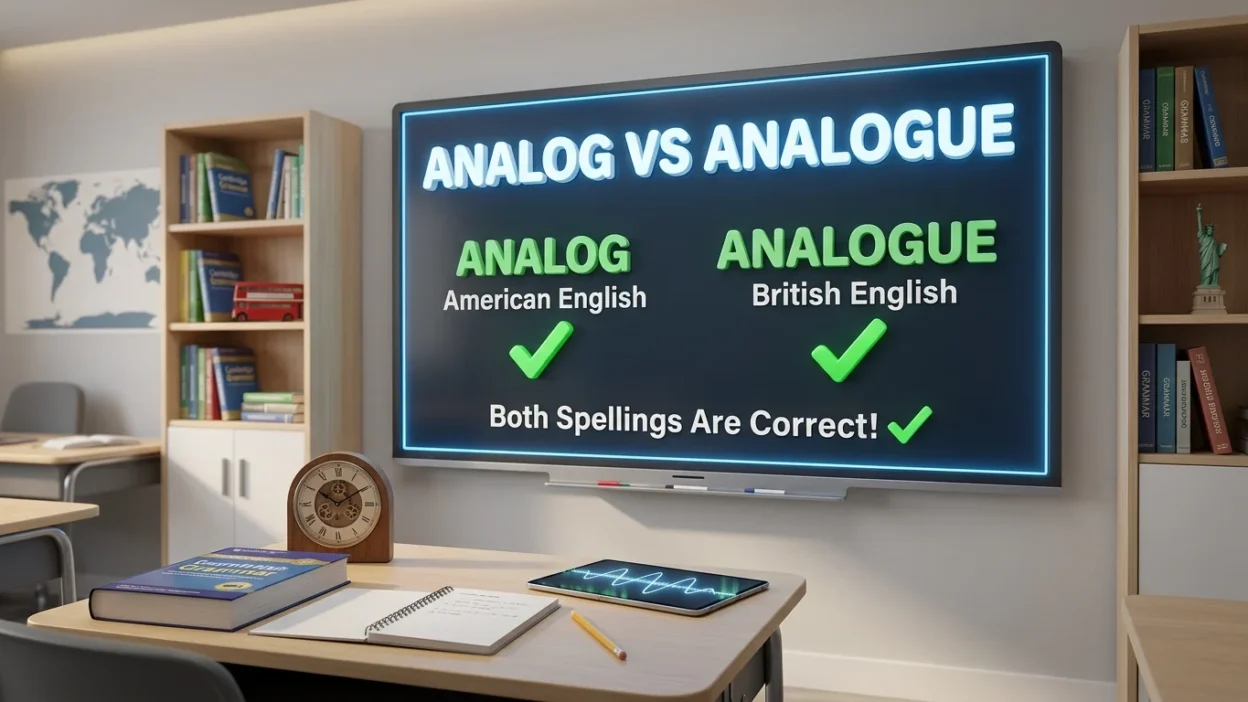
If you have ever wondered whether the correct spelling is analog or analogue, you are not alone. Both forms are correct, and the difference mainly depends on which variety of English you are using. The two words generally have the same meaning, but one spelling is more common in American English while the other is preferred in British English.
Understanding analog vs analogue is especially useful when writing about technology, electronics, signals, devices, or comparisons between digital and non-digital systems. Once you know the regional preference, choosing the right form becomes simple.
Quick Answer
Analog and analogue are both correct spellings.
- Analog is the preferred spelling in American English.
- Analogue is the preferred spelling in British English and is also common in other varieties influenced by British English.
- Both words can describe something that represents information through continuously varying physical quantities.
- In technology, you will commonly see phrases such as analog signal, analog device, analog clock, and analog technology in American English.
- In British English, these are commonly written as analogue signal, analogue device, analogue clock, and analogue technology.
So, neither spelling is wrong. Your choice should depend on your audience and the style of English you are following.
Analog vs Analogue Meaning
The word analog or analogue refers to something that corresponds to or represents another thing in a continuous or comparable way.
In technology, an analog system represents information using continuously changing physical quantities. For example, a traditional clock with hands represents time through the continuous movement of its hands.
The word can also be used more broadly to describe something that is comparable to another thing.
For example:
- An analog clock displays time with moving hands.
- An analogue clock uses a traditional face and hands rather than digital numbers.
- An analog signal changes continuously over time.
- An analogue device may process information using continuously varying signals.
In everyday language, analogue can also mean a counterpart or something comparable to another thing, particularly in British English.
What Does Analog Mean?
Analog is the standard American English spelling.
It is especially common in technical and scientific contexts involving electronics, computing, sound, communication, and measurement.
Examples include:
- analog signal
- analog technology
- analog electronics
- analog device
- analog clock
- analog audio
- analog recording
- analog data
- analog computer
The term is often contrasted with digital.
For example, an analog audio recording stores sound as a continuously varying signal, while digital audio represents sound using numerical data.
What Does Analogue Mean?
Analogue is the standard British English spelling of the same word.
It has the same basic meaning as analog, but the spelling includes the final -ue.
You may commonly encounter it in British, Australian, and other forms of English that follow British spelling conventions.
Examples include:
- analogue signal
- analogue technology
- analogue electronics
- analogue clock
- analogue audio
- analogue recording
- analogue device
If you are writing for a British audience, analogue will usually look more natural and consistent.
Analog vs Analogue: Comparison Table
| Feature | Analog | Analogue |
|---|---|---|
| Meaning | Same | Same |
| Main English variety | American English | British English |
| Common in the US | Yes | Less common |
| Common in the UK | Less common | Yes |
| Technical use | Very common | Very common |
| Example | Analog signal | Analogue signal |
| Correct spelling | Yes | Yes |
| The key difference is regional spelling, not meaning. |
Analog vs Analogue in Technology
The spelling difference becomes particularly noticeable when discussing technology.
An analog signal varies continuously. Examples include traditional audio signals, radio signals, and measurements from certain sensors.
A digital signal, by contrast, represents information using discrete numerical values.
This is why you may see phrases such as:
- analog electronics
- analogue electronics
- analog-to-digital converter
- analogue-to-digital converter
- analog audio
- analogue audio
- analog sensor
- analogue sensor
In American technical writing, analog is overwhelmingly the usual choice. In British technical writing, analogue is generally preferred.
Analog Clock vs Analogue Clock
One of the most familiar examples is the traditional clock.
An analog clock shows time using hands that move around a numbered face. In American English, this spelling is standard.
An analogue clock means exactly the same thing, but it is the preferred British spelling.
For example:
- The classroom has an analog clock on the wall.
- The classroom has an analogue clock on the wall.
Both sentences are grammatically correct. The preferred spelling depends on the variety of English being used.
Analog Signal vs Analogue Signal
Another common pair is analog signal and analogue signal.
An analog or analogue signal carries information through continuous changes. Sound waves, temperature readings, and certain electrical signals can be represented in this way.
American English:
The microphone converts sound into an analog signal.
British English:
The microphone converts sound into an analogue signal.
Again, the meaning does not change.
Analog vs Analogue in Everyday English
Although the word is strongly associated with technology, analog/analogue can have a broader meaning.
In some contexts, an analogue is something that serves as a counterpart or comparison to another thing.
For example:
- The new system has no direct analogue in older technology.
- Scientists searched for an analogue of the newly discovered material.
In American English, analog can also be used in these contexts, although the exact preference may depend on the field and publication style.
Common Mistakes with Analog vs Analogue
Mistake 1: Thinking one spelling is always wrong
A common misconception is that analogue is incorrect because American English commonly uses analog.
That is not true. Both spellings are established and correct.
Mistake 2: Mixing spelling styles
If you are writing an article in American English, consistently use analog. If your document follows British English, consistently use analogue.
Avoid switching between the two without a reason.
For example, using analog signal in one paragraph and analogue signal in the next can make your writing look inconsistent.
Mistake 3: Assuming the meaning is different
The spelling does not create a meaningful difference in the basic concept.
Analog and analogue generally refer to the same idea.
Mistake 4: Using analog when discussing only digital information
Analog and digital are not interchangeable terms.
An analog system generally represents information continuously, whereas digital systems represent information using discrete values.
Choosing the correct technical term matters more than choosing between the two spellings.
American vs British English: Analog or Analogue?
The most important difference between analog vs analogue is regional spelling.
American English:
American writers generally use analog. This form is especially common in technology, electronics, engineering, and computing.
British English:
British writers generally use analogue. This spelling is also widely seen in other English varieties that follow British conventions.
This pattern is similar to other spelling differences such as:
- color vs colour
- favorite vs favourite
- center vs centre
- analog vs analogue
If you are writing for an international audience, either spelling can work, but consistency is important.
Which Spelling Should You Use?
Choose the spelling based on your audience.
Use analog if:
- You are writing in American English.
- Your website follows US spelling.
- Your readers are primarily in the United States.
- You are following an American style guide.
Use analogue if: - You are writing in British English.
- Your publication follows UK spelling.
- Your readers are primarily in the UK.
- You are following a British style guide.
For SEO, you do not need to awkwardly repeat both spellings throughout an article. Explain the difference naturally and use the spelling that matches your target audience.
Easy Way to Remember the Difference
A simple memory trick is:
American English → Analog
British English → Analogue
Think of the extra ue in analogue as part of the traditional British spelling pattern.
Once you connect analog = US and analogue = UK, the difference becomes much easier to remember.
Related Words and Phrases
If you are researching analog vs analogue, you may also encounter these related terms:
- analog technology
- analogue technology
- analog system
- analogue system
- analog signal
- analogue signal
- analog device
- analogue device
- analog electronics
- analogue electronics
- analog audio
- analogue audio
- analog clock
- analogue clock
- analog recording
- analogue recording
- analog data
- analogue data
These phrases are useful when discussing traditional technology, continuous signals, electronics, audio systems, and digital transformation.
FAQs
Is analog or analogue correct?
Both are correct. Analog is preferred in American English, while analogue is preferred in British English.
Is analogue British or American?
Analogue is primarily the British English spelling. It is also used in other varieties of English influenced by British spelling conventions.
Is analog American English?
Yes. Analog is the standard American English spelling.
Do analog and analogue mean the same thing?
Yes. In most contexts, they have the same meaning. The main difference is spelling preference between English varieties.
Is it analog clock or analogue clock?
Both are correct. Analog clock is standard in American English, while analogue clock is standard in British English.
Is it analog signal or analogue signal?
Both are correct. American English normally uses analog signal, while British English generally uses analogue signal.
Should I use analog or analogue in an American English article?
Use analog if you are following American English conventions. Consistent spelling throughout the article is recommended.
Can analogue be used in American English?
Yes, but it is less common than analog in modern American usage, especially in technical contexts.
Summary
The analog vs analogue difference is much simpler than it may initially seem. Both spellings are correct and generally have the same meaning. The main distinction is regional: analog is the standard American English spelling, while analogue is the standard British English spelling.
This difference is especially noticeable in technology-related expressions such as analog signal, analogue signal, analog clock, analogue clock, analog audio, and analogue electronics. When choosing between them, focus on your audience, follow the appropriate style guide, and remain consistent throughout your writing.
Actionable Takeaway
Remember this simple rule: Analog = American English; Analogue = British English. Choose the spelling that matches your target readers and use it consistently.

Liam James is a language enthusiast and content writer at Verseslay, specializing in word comparisons, grammar debates, and vocabulary insights. He helps readers understand language nuances through clear, engaging, and practical explanations.