
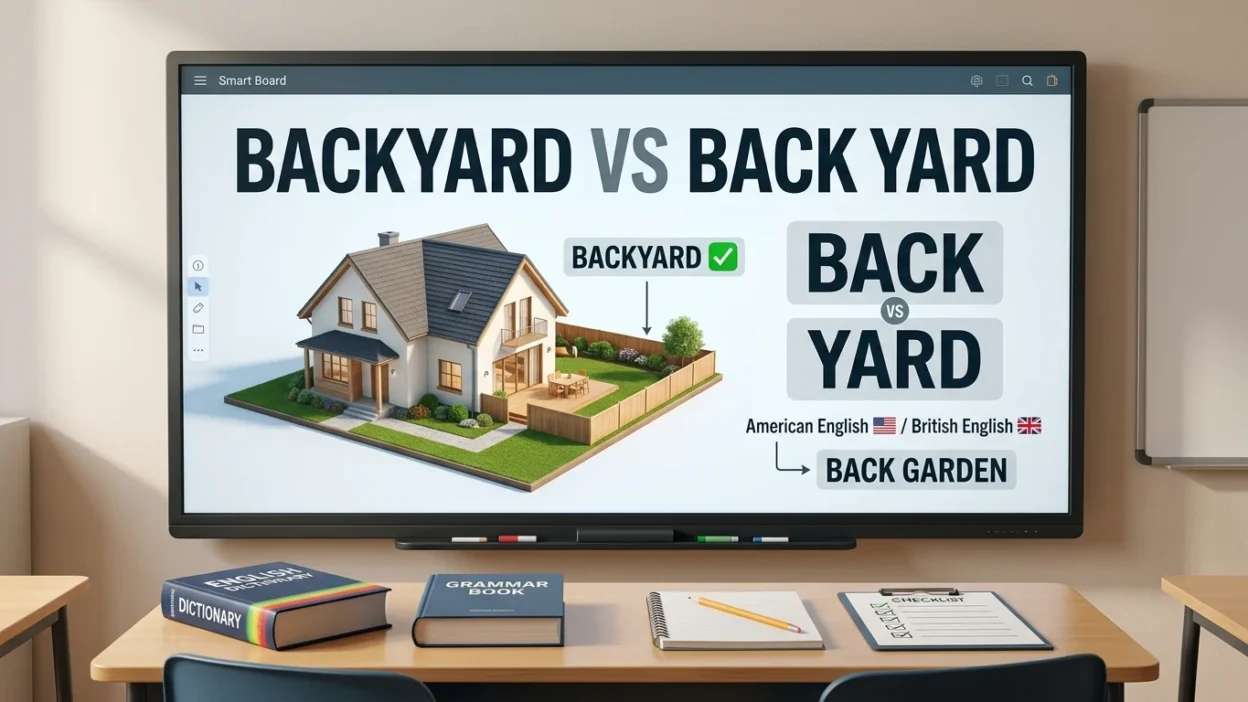
If you have ever wondered whether you should write backyard or back yard, you are not alone. Both forms can appear in English, but they do not always work in exactly the same way. The key difference is usually grammatical: backyard is commonly used as a noun or adjective, while back yard is a two-word phrase used when back and yard function separately.
Understanding backyard vs back yard can help you avoid a small but noticeable writing mistake. Whether you are describing a garden, talking about outdoor space, or writing about a house, knowing when to use the one-word and two-word forms makes your English more natural and polished.
Quick Answer
Backyard is generally the standard and most common spelling when referring to the outdoor area behind a house.
- Backyard = usually a noun or adjective.
- Back yard = a two-word phrase in which back modifies yard separately.
- In modern American English, backyard is very common.
- British English also uses back garden much more often than backyard when referring to the garden behind a house.
Examples: - We had a barbecue in the backyard.
- The children are playing in the backyard.
- They built a backyard swimming pool.
The two-word back yard can still be grammatically possible when the context treats back and yard as separate words, but it is much less common in ordinary modern usage.
Backyard Meaning
Backyard is a noun that usually means the area of land directly behind a house or other building.
It may contain grass, plants, trees, a patio, garden furniture, a play area, or other outdoor features.
For example:
- We planted flowers in the backyard.
- The children were playing in the backyard.
- Our backyard has several fruit trees.
In American English, backyard is a very familiar word for the outdoor space behind a home.
The word can also have a broader figurative meaning. In expressions such as in your own backyard, it can refer to a person’s local area or community.
For example:
The company opened a new store in our own backyard.
Here, the phrase does not necessarily mean the literal land behind someone’s house. It can mean nearby or within someone’s local area.
Back Yard Meaning
Back yard consists of two separate words: back and yard.
Historically and grammatically, it is possible to describe a yard as being at the back of something using the two-word construction.
However, when you simply mean the outdoor area behind a house, backyard is now the much more established spelling in American English.
Compare:
- We relaxed in the backyard.
- We relaxed in the back yard.
The first sentence is the normal modern spelling for the intended meaning.
The second may be understood, but it looks less natural to many contemporary readers when referring to a home’s outdoor area.
Backyard vs Back Yard Comparison Table
| Feature | Backyard | Back yard |
|---|---|---|
| Form | Compound word | Two separate words |
| Common meaning | Area behind a house | Yard described as being at the back |
| Modern everyday use | Very common | Less common |
| American English | Standard/common | Uncommon for the usual meaning |
| British English | Used, but less common than back garden | Possible depending on construction |
| Example | We played in the backyard. | The back yard was separated from the front yard. |
| Best choice for ordinary use | Usually yes | Usually no |
| The important point is that backyard has become an established compound word in modern English. |
When to Use Backyard
Use backyard when you mean the outdoor area behind a home or building.
As a noun
This is the most common use.
- The dog is sleeping in the backyard.
- We cleaned the backyard yesterday.
- There is a large tree in our backyard.
- The backyard needs some maintenance.
As an adjective
Backyard can also describe something associated with or located in a backyard.
Examples include:
- backyard garden
- backyard barbecue
- backyard pool
- backyard playground
- backyard chickens
- backyard party
- backyard shed
For example:
They installed a backyard swimming pool.
Here, backyard modifies swimming pool, so it functions as an adjective.
Common Examples of Backyard
Here are some natural examples you may encounter in everyday English:
- My children love playing in the backyard.
- We are planning a backyard barbecue this weekend.
- The house has a beautiful backyard.
- She planted vegetables in her backyard garden.
- We built a small playground in the backyard.
- Their backyard overlooks the lake.
- The dog spends most of the afternoon in the backyard.
- They installed lights around the backyard patio.
These examples show why backyard is usually the preferred form when referring to a home’s outdoor space.
Backyard as an Adjective
One useful point about backyard is that it can appear before another noun.
For example:
- backyard garden
- backyard pool
- backyard party
- backyard wedding
- backyard wildlife
- backyard activities
In these combinations, backyard acts as a compound modifier.
For example:
They organized a backyard wedding.
This means the wedding took place in a backyard or was designed around that setting.
Writing back yard wedding would generally look incorrect or unnatural in this context.
Common Mistakes with Backyard vs Back Yard
Mistake 1: Always writing back yard
A common mistake is assuming that because the phrase describes a yard at the back, it must always be written as two words.
Modern English has many compound words that originally developed from separate words. Backyard is one of them.
For ordinary references to the area behind a home, backyard is generally the better choice.
Mistake 2: Assuming back yard is never possible
The opposite mistake is believing that back yard can never occur.
English allows back to function as an adjective modifying yard in certain constructions. Context matters.
For example:
The back yard was smaller than the front yard.
Here, the writer may be deliberately contrasting the back yard with the front yard as two distinct locations.
However, for ordinary modern usage, backyard remains much more common.
Mistake 3: Confusing backyard with back garden
British English often prefers back garden for the area behind a house.
So an American writer might say:
The children are playing in the backyard.
A British writer might naturally say:
The children are playing in the back garden.
Neither expression is inherently wrong; they reflect different regional preferences.
Mistake 4: Using inconsistent spelling
If you choose backyard in an article, maintain that spelling unless a specific quotation, title, or stylistic reason requires something else.
Consistency helps your writing look professional.
American vs British English
The difference between backyard vs back yard is not as straightforward as some US-versus-UK spelling pairs because backyard is also recognized in British English.
However, British speakers commonly use back garden for the garden or outdoor area behind a house.
American English:
We spent the afternoon in the backyard.
British English:
We spent the afternoon in the back garden.
In American English, yard commonly refers to the outdoor area around a house, while British English often uses garden for a similar residential space.
This distinction is useful if you are writing specifically for American or British readers.
Backyard vs Back Garden
These expressions can refer to similar residential spaces, but their typical usage differs by region.
| Term | Typical usage |
|---|---|
| Backyard | Especially common in American English |
| Back garden | Especially common in British English |
| Back yard | Less common as the standard compound noun |
| Garden | Often refers to a cultivated outdoor area |
| In American English, a backyard does not necessarily need to contain plants or flowers. It can simply be the outdoor area behind a house. | |
| In British English, a back garden often suggests a residential garden area behind the home. |
Is Backyard One Word or Two?
When you mean the outdoor area behind a house, backyard is generally written as one word.
This is the standard compound form in modern American English.
Correct:
We have a large backyard.
Less usual:
We have a large back yard.
The one-word form is especially appropriate in articles, websites, advertisements, and everyday American writing.
Is Backyard Hyphenated?
No. The standard spelling is backyard, not back-yard.
You should normally avoid writing:
back-yard
Use:
backyard
The compound has become sufficiently established that a hyphen is unnecessary.
Synonyms and Related Terms
Depending on the context, several words and phrases can describe a backyard or a similar outdoor area:
- rear yard
- outdoor space
- garden
- back garden
- outdoor area
- residential yard
- garden area
- patio area
- lawn
Keep in mind that these terms are not always exact synonyms.
For example, a patio is a specific paved or constructed outdoor area, while a backyard can include a lawn, patio, garden, trees, and other features.
FAQs
Is backyard one word or two?
When referring to the outdoor area behind a house, backyard is generally written as one word.
Is back yard grammatically correct?
It can be grammatically possible when back and yard function separately, but backyard is the much more common modern form for the usual meaning.
Is backyard American or British English?
Backyard is especially common in American English. British English also recognizes the word, but back garden is often more natural for the outdoor area behind a home.
Should I write backyard or back yard?
For ordinary modern usage, especially when referring to the area behind a house, use backyard.
Is backyard hyphenated?
No. The standard spelling is backyard, without a hyphen.
What is the British word for backyard?
Back garden is a very common British English expression for the area behind a house.
Can backyard be used as an adjective?
Yes. Examples include backyard garden, backyard pool, backyard barbecue, and backyard wedding.
What is the difference between backyard and back garden?
They generally refer to similar residential outdoor spaces, but backyard is particularly common in American English, while back garden is particularly common in British English.
Summary
The backyard vs back yard question is mainly about modern compound-word usage. When you mean the outdoor area behind a house, backyard is generally the standard one-word form, especially in American English. It can function as a noun, as in The children are playing in the backyard, or as a modifier, as in backyard garden.
Back yard can occur when the words are being treated separately, but it is less common for the ordinary meaning of a home’s rear outdoor area. If you are writing for British readers, remember that back garden is often the more natural expression. For clear, modern everyday English, however, backyard is usually the safest choice when you mean the space behind a house.

Liam James is a language enthusiast and content writer at Verseslay, specializing in word comparisons, grammar debates, and vocabulary insights. He helps readers understand language nuances through clear, engaging, and practical explanations.