
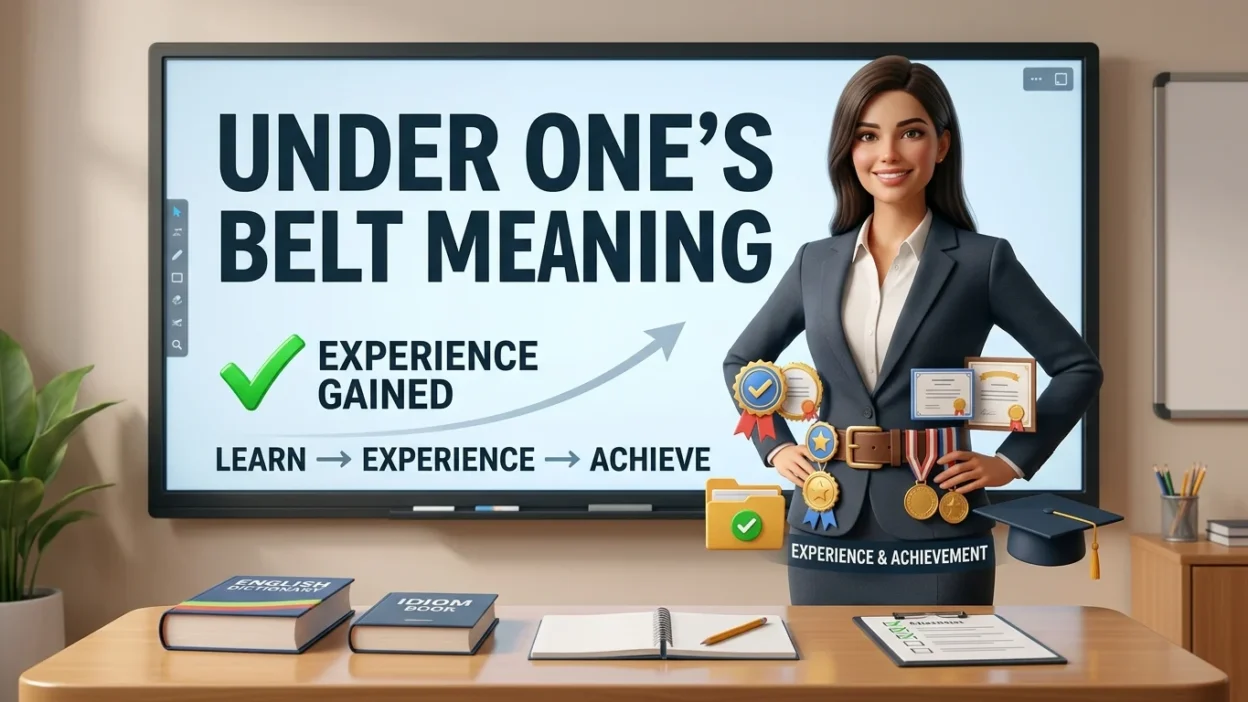
Have you ever accomplished something, gained valuable experience, or achieved an important goal and wanted to describe it in a simple, natural way? The expression under one’s belt is a useful English idiom for exactly this kind of situation. It refers to something you have successfully achieved, experienced, learned, or acquired, especially something that adds to your knowledge or experience.
If you are searching for the under one’s belt meaning, you may also be wondering how to use this expression correctly in everyday English. The good news is that the idiom is quite flexible. It can describe qualifications, achievements, work experience, skills, victories, or even a number of completed tasks. Let’s explore its meaning, examples, grammar, common mistakes, synonyms, and natural usage.
Quick Answer
Under one’s belt means successfully achieved, completed, experienced, or acquired as part of someone’s knowledge or experience.
For example:
- She already has five years of teaching experience under her belt.
- He has several successful projects under his belt.
- After two weeks of training under his belt, he felt much more confident.
In simple words, if you have something under your belt, you have gained it through experience, achievement, or completion.
Under One’s Belt Meaning
The idiom under one’s belt is used when someone has gained an accomplishment, experience, skill, qualification, or completed task.
The possessive changes according to the person:
- under my belt
- under your belt
- under his belt
- under her belt
- under our belt
- under their belt
For example:
I have several years of experience under my belt.
This means the speaker has accumulated several years of experience.
Similarly:
She has three successful presentations under her belt.
This means she has successfully completed or delivered three presentations.
The expression often emphasizes that previous experience makes someone more capable or confident.
What Does Under One’s Belt Mean in Simple English?
In simple English, under one’s belt means:
Something you have already achieved, learned, completed, or experienced.
Think of it as adding another useful achievement or experience to your personal record.
For example, if someone says:
He has two marathons under his belt.
They mean he has already completed two marathons.
If someone says:
She has several years of management experience under her belt.
They mean she has already gained that experience.
How to Use Under One’s Belt
The phrase is commonly used after the thing someone has achieved or gained.
Common structures include:
have + achievement/experience + under one’s belt
Examples:
- I have several successful projects under my belt.
- She has ten years of experience under her belt.
- He has two degrees under his belt.
- They have several major victories under their belt.
It can also be used with verbs such as get or put in certain contexts: - Get some experience under your belt.
- Put another successful project under your belt.
The exact wording depends on the situation, but the central idea remains the same: gaining something valuable through experience or achievement.
Examples of Under One’s Belt
Example 1: Work Experience
She has five years of marketing experience under her belt.
This means she has accumulated five years of practical marketing experience.
Example 2: Education
He has two professional qualifications under his belt.
He has successfully earned two qualifications.
Example 3: Projects
The developer has several successful apps under his belt.
He has already created and successfully completed several apps.
Example 4: Sports
The young player has three international matches under her belt.
She has already gained experience by playing three international matches.
Example 5: Public Speaking
After several presentations under his belt, he became much more confident.
His previous presentations gave him useful experience.
Example 6: Travel
She has several solo trips under her belt.
She has already completed several solo journeys and gained experience from them.
Example 7: Teaching
The new teacher already has a year of classroom experience under her belt.
The teacher has gained practical experience in the classroom.
Example 8: Personal Achievement
He has completed his first marathon and now has one major achievement under his belt.
The completed marathon is being treated as an accomplishment added to his record.
Under One’s Belt vs In One’s Experience
These expressions are related but not identical.
Under one’s belt is an idiomatic and conversational way of emphasizing accumulated achievements or experience.
In one’s experience is more general and often refers to knowledge gained through life or work.
| Expression | Meaning | Typical use |
|---|---|---|
| Under one’s belt | Successfully gained or completed | Achievements, skills, experience |
| In one’s experience | Based on what someone has experienced | Knowledge, observations |
| Have experience | Possess practical knowledge | Work and skills |
| Accomplished | Successfully completed something | Goals and achievements |
| Completed | Finished something | Tasks and projects |
| For example: | ||
| She has several successful projects under her belt. | ||
| This highlights her accomplishments. | ||
| In my experience, this method works well. | ||
| This emphasizes personal knowledge or observation. |
Under One’s Belt vs Under the Belt
A common question is whether the expression can simply be written as under the belt.
The answer is that the idiom normally uses a possessive pronoun or another appropriate determiner when referring to someone’s achievements.
Natural examples include:
- under my belt
- under your belt
- under his belt
- under her belt
- under their belt
You may also see expressions such as under his belt or under her belt.
The phrase should be connected clearly to the person whose experience or achievement is being discussed.
Is Under One’s Belt Always About Achievements?
No. It can refer to more than awards or major accomplishments.
The expression can describe:
- experience
- skills
- completed projects
- qualifications
- performances
- victories
- journeys
- training
- practical knowledge
- completed tasks
For example:
After a few months of training under his belt, he was ready for the competition.
Here, the training itself is the valuable experience.
The phrase can therefore be used for both formal achievements and valuable life experiences.
Common Mistakes
Mistake 1: Taking the idiom literally
Under one’s belt does not usually mean physically placing something underneath a belt.
It is a figurative expression about achievements or experience.
Mistake 2: Using the wrong possessive
The possessive should match the person.
Correct:
She has three years of experience under her belt.
Not:
She has three years of experience under his belt.
unless the person being discussed is male.
Mistake 3: Using it for future achievements
The idiom generally refers to something already accomplished, experienced, or acquired.
For a future achievement, use a different expression.
For example:
She will have three years of experience under her belt next year.
This works because the expression refers to the experience she will have accumulated by that future point.
Mistake 4: Assuming it always means success
The phrase usually has a positive or neutral sense, but the thing under someone’s belt does not have to be a prestigious achievement.
It can simply be useful experience.
Mistake 5: Confusing it with wear something under your belt
The idiom is figurative. The context normally makes it clear that the phrase refers to experience or achievement rather than clothing.
American vs British English
Under one’s belt is widely used in both American English and British English.
There is no significant difference in spelling or meaning between the two varieties.
You can naturally encounter it in:
- American English
- British English
- Canadian English
- Australian English
- International English
The phrase is particularly common in informal and semi-formal conversation and writing.
For highly formal academic or technical writing, a more direct expression such as gained experience, completed, or achieved may sometimes be preferable.
Synonyms for Under One’s Belt
Several expressions can communicate a similar idea, depending on the context.
Have experience
This is one of the simplest alternatives.
She has five years of experience.
Have achieved
Useful when talking specifically about accomplishments.
He has achieved several major goals.
Have accomplished
Emphasizes successful completion.
She has accomplished several important tasks.
Have under your control
This is different in meaning and should not be treated as a direct synonym. It relates to control rather than accumulated experience.
Add to one’s experience
A natural alternative when describing something that increases practical knowledge.
Have a track record
This emphasizes a history of achievements or successful performance.
For example:
The company has a strong track record of successful projects.
Origin of Under One’s Belt
The exact development of the idiom is associated with the idea of storing or securing something under a belt. Food and possessions were historically carried or held around the waist, and the expression eventually developed figurative associations with having something safely acquired or possessed.
Over time, under one’s belt became strongly associated with experience, achievements, and things a person had successfully gained.
Today, the phrase is primarily understood figuratively rather than literally.
When Should You Use Under One’s Belt?
This idiom works particularly well when talking about someone’s accumulated experience or accomplishments.
You can use it in:
- job interviews
- workplace conversations
- biographies
- sports discussions
- education
- career advice
- personal achievements
- informal writing
For example:
With several years of teaching under my belt, I feel prepared to take on this new role.
This sounds natural because the speaker is emphasizing experience gained over time.
FAQs
What is the under one’s belt meaning?
Under one’s belt means having successfully gained, completed, experienced, or achieved something, especially something that adds to a person’s experience.
What does it mean to have something under your belt?
It means that you have already achieved, completed, learned, or experienced something valuable.
Is under one’s belt an idiom?
Yes. Under one’s belt is a common English idiom referring to accumulated experience, achievements, or completed activities.
Can under one’s belt mean experience?
Yes. Experience is one of the most common things described as being under one’s belt.
Can I use under one’s belt for qualifications?
Yes. You can say someone has degrees, certificates, qualifications, or professional achievements under their belt.
Is under one’s belt American or British English?
The idiom is common in both American and British English, with no significant difference in spelling or meaning.
What is another way to say under one’s belt?
Depending on the context, you can use have experience, have accomplished, have achieved, have a track record, or have gained experience.
Is under one’s belt formal?
It is standard English but has a conversational, idiomatic tone. In very formal writing, a direct phrase such as gained experience may be more appropriate.
Summary
The under one’s belt meaning is connected to something a person has already gained through experience, achievement, learning, or completion. It is often used for professional experience, successful projects, qualifications, sports achievements, training, and other accomplishments. For example, having several years of work experience under your belt means that you have accumulated those years of practical experience.
The expression is widely understood in both American and British English and does not have a major regional spelling difference. Remember that it is normally figurative rather than literal, and make sure the possessive pronoun matches the person you are describing. Once you understand the basic idea of accumulated experience or achievement, this idiom becomes easy to use naturally.
Actionable Takeaway
Think of under one’s belt as meaning already gained or accomplished. Use it when you want to highlight experience, skills, qualifications, completed projects, or achievements.

Liam James is a language enthusiast and content writer at Verseslay, specializing in word comparisons, grammar debates, and vocabulary insights. He helps readers understand language nuances through clear, engaging, and practical explanations.