
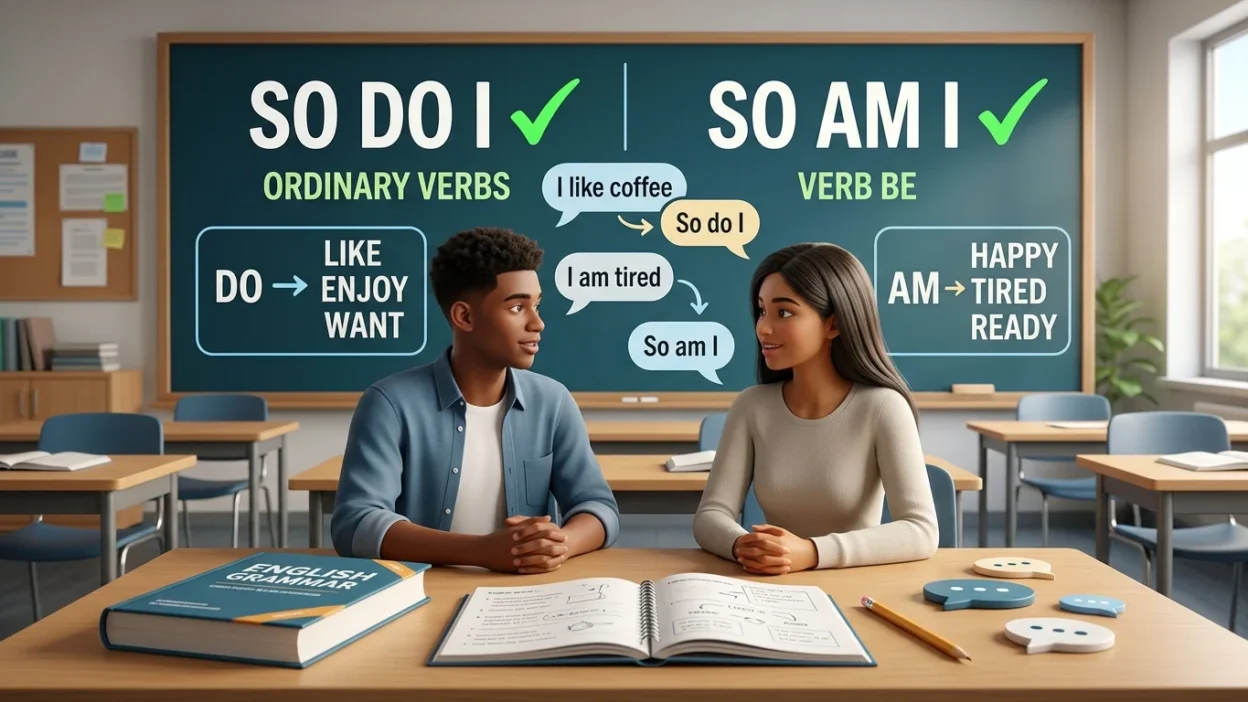
English learners often get confused when they want to agree with someone using phrases like so do I and so am I. Both expressions are correct, but they are not interchangeable. The right choice depends on the verb used in the original statement.
Understanding so do I vs so am I becomes much easier when you focus on the main verb in the sentence. If the first speaker uses the verb be, you generally use so am I when agreeing with a statement about yourself. If the statement uses another verb, an appropriate auxiliary verb is normally used instead.
Quick Answer: So Do I vs So Am I
So do I and so am I both mean that you agree with a positive statement about yourself, but they are used with different verbs.
- So do I = used when the original sentence uses do or another ordinary verb that takes do as its auxiliary.
- So am I = used when the original sentence uses the verb be and the subject is I.
Compare:
I like coffee. — So do I.
I am tired. — So am I.
A simple rule is:
Match the auxiliary verb to the original sentence.
What Does So Do I Mean?
So do I is used to agree with a positive statement when the main verb is an ordinary verb such as like, enjoy, work, study, play, or want.
For example:
I love reading.
So do I.
The first speaker says that they love reading. The second speaker uses so do I to say that they also love reading.
The word do works as an auxiliary verb in the response.
What Does So Am I Mean?
So am I is used when agreeing with a positive statement that uses the verb be with I.
For example:
I am tired.
So am I.
The first speaker says they are tired, and the second person says they are tired too.
Here, am is the correct form of the verb be for the subject I.
You would not normally say so do I in this situation because the original sentence is built around be.
So Do I vs So Am I: Main Difference
The main difference is the auxiliary verb.
So do I is connected to ordinary verbs that use do-support.
So am I is connected to the verb be.
| Expression | Used With | Example |
|---|---|---|
| So do I | Ordinary verbs | I like tea. So do I. |
| So am I | Be + adjective/noun/state | I am tired. So am I. |
| So can I | Can | I can swim. So can I. |
| So will I | Will | I will attend. So will I. |
| So have I | Have as auxiliary | I have finished. So have I. |
| So did I | Past simple | I watched it. So did I. |
| The important lesson is that so + auxiliary verb + subject is the basic pattern. |
How Does the So + Auxiliary Structure Work?
English commonly uses the structure:
So + auxiliary verb + subject
This structure is used to agree with a positive statement.
For example:
I enjoy football.
So do I.
I am hungry.
So am I.
I can drive.
So can I.
I have finished my homework.
So have I.
I went to Lahore yesterday.
So did I.
The auxiliary verb changes according to the tense and grammar of the original statement.
Examples of So Do I
Here are some natural examples:
Example 1
I like chocolate.
So do I.
Example 2
I enjoy playing badminton.
So do I.
Example 3
I want to visit London.
So do I.
Example 4
I study English every day.
So do I.
Example 5
I watch movies on weekends.
So do I.
In each example, the original verb is not be, so do is used in the response.
Examples of So Am I
Use so am I when the original statement uses am.
Example 1
I am happy today.
So am I.
Example 2
I am ready.
So am I.
Example 3
I am tired after work.
So am I.
Example 4
I am interested in English grammar.
So am I.
Example 5
I am excited about the trip.
So am I.
Here, am matches the verb in the original statement.
So Do I vs So Am I in Conversations
These expressions are especially common in natural conversations.
Consider this dialogue:
A: I am tired.
B: So am I.
Now compare:
A: I like this movie.
B: So do I.
The response changes because the verb changes.
This is why simply memorizing one expression is not enough. You need to look at the verb used by the first speaker.
Common Mistakes
Mistake 1: Saying So Do I After I Am
A common mistake is:
I am hungry.
So do I.
This is incorrect in standard English.
The natural response is:
I am hungry.
So am I.
Mistake 2: Saying So Am I With an Ordinary Verb
Another mistake is:
I like coffee.
So am I.
This is incorrect because the original sentence uses like, not be.
The correct response is:
I like coffee.
So do I.
Mistake 3: Using Do With Every Sentence
English learners sometimes think so do I works for every positive statement.
It does not.
The auxiliary verb must match the grammar of the original sentence.
Mistake 4: Forgetting Other Auxiliary Verbs
Do and am are not the only possibilities.
You can also say:
- So can I.
- So will I.
- So have I.
- So did I.
- So should I.
- So would I.
This is why learning the complete pattern is more useful than memorizing isolated phrases.
So Do I vs Me Too
Me too is another common way to agree with a positive statement.
For example:
I love coffee.
Me too.
I love coffee.
So do I.
Both are natural, but they have slightly different styles.
Me too is very common in casual conversation and is simple and flexible.
So do I follows a grammatical auxiliary-verb structure and can sound slightly more structured.
For everyday conversation, both are perfectly natural.
So Am I vs Me Too
The same idea applies to so am I.
For example:
I am excited.
Me too.
I am excited.
So am I.
Both responses mean that the second speaker is also excited.
The choice depends partly on style and context.
So Do I vs I Do Too
Another common expression is I do too.
For example:
I like this song.
I do too.
This has essentially the same meaning as:
I like this song.
So do I.
However, so do I is part of the inverted agreement structure, while I do too uses a normal subject-auxiliary order.
Both are correct.
So Am I vs I Am Too
Similarly:
I am tired.
I am too.
means approximately the same thing as:
I am tired.
So am I.
Both are grammatically correct.
The first uses the adverb too, while the second uses the so + auxiliary + subject construction.
Negative Statements: Neither Do I and Neither Am I
One important point is that so do I and so am I are normally used after positive statements.
For negative statements, English commonly uses neither or nor.
For example:
I don’t like coffee.
Neither do I.
I am not tired.
Neither am I.
Notice how the auxiliary verb still matches the original sentence.
Positive:
I like coffee.
So do I.
Negative:
I don’t like coffee.
Neither do I.
Positive:
I am tired.
So am I.
Negative:
I am not tired.
Neither am I.
American English vs British English
There is no significant difference between American and British English when it comes to the basic grammar of so do I and so am I.
Both varieties use these structures naturally.
For example:
American English: I am tired. So am I.
British English: I am tired. So am I.
The grammar is essentially the same.
Differences may occur in pronunciation, vocabulary, or conversational preferences, but the basic rule for choosing the auxiliary verb remains consistent.
Synonyms and Related Expressions
Several expressions can communicate agreement with another person’s statement.
Useful alternatives include:
- Me too
- I do too
- I am too
- I also do
- I also am
- Same here
- Neither do I
- Neither am I
- Nor do I
The best choice depends on whether the original statement is positive or negative and which auxiliary verb is required.
A Simple Trick to Remember the Difference
Here is an easy rule:
Look at the verb in the first sentence and use the matching auxiliary in your response.
If someone says:
I am happy.
Think:
am → so am I
If someone says:
I like music.
Think:
do → so do I
If someone says:
I can swim.
Think:
can → so can I
If someone says:
I have finished.
Think:
have → so have I
This method works for many different English sentences.
Why Do We Say So Do I Instead of So I Do?
The structure is:
So + auxiliary + subject
Therefore:
So do I.
Not:
So I do.
The second form can occur in other grammatical contexts, but it does not normally function as the standard agreement structure.
This inversion is similar to the word order found in questions.
For example:
Do I?
So do I.
The auxiliary comes before the subject.
FAQs
Is it correct to say so do I?
Yes. So do I is correct when agreeing with a positive statement that uses an ordinary verb requiring do as the auxiliary.
Example:
I like tea.
So do I.
Is it correct to say so am I?
Yes. So am I is correct when agreeing with a statement using the verb be with I.
Example:
I am tired.
So am I.
What is the difference between so do I and so am I?
So do I is used with ordinary verbs, while so am I is used with the verb be.
I like music. So do I.
I am happy. So am I.
Can I use me too instead?
Yes. Me too is a common and natural alternative in casual conversation.
I love football.
Me too.
What do I say after I can?
Use the matching modal auxiliary:
I can swim.
So can I.
Not so do I.
What do I say after I have?
If have is being used as an auxiliary, use:
I have finished.
So have I.
What is the negative form of so do I?
The common negative equivalent is neither do I or nor do I.
For example:
I don’t eat meat.
Neither do I.
What is the negative form of so am I?
Use neither am I or nor am I.
For example:
I am not ready.
Neither am I.
Summary
The difference between so do I vs so am I becomes simple once you focus on the auxiliary verb in the original sentence. So do I is normally used when agreeing with a positive statement containing an ordinary verb, while so am I is used when the original statement uses the verb be with I.
The same pattern extends to other auxiliary and modal verbs. You can say so can I, so will I, so have I, or so did I, depending on the original sentence. The key is not to memorize every expression separately but to identify the auxiliary verb and use the appropriate one in the response.

Liam James is a language enthusiast and content writer at Verseslay, specializing in word comparisons, grammar debates, and vocabulary insights. He helps readers understand language nuances through clear, engaging, and practical explanations.