Have you ever worked hard on something, only to face a setback that forces you to start again? That frustrating situation is exactly where the idiom back to square one fits naturally. It is a common English expression used when progress is lost and someone has to return to the beginning.
Understanding the back to square one meaning can help you recognize this phrase in conversations, books, movies, workplace discussions, and everyday English. Although the expression can sound literal, it is actually an idiom describing a return to the starting point after a failure, problem, or unexpected setback.
Quick Answer: What Does Back to Square One Mean?
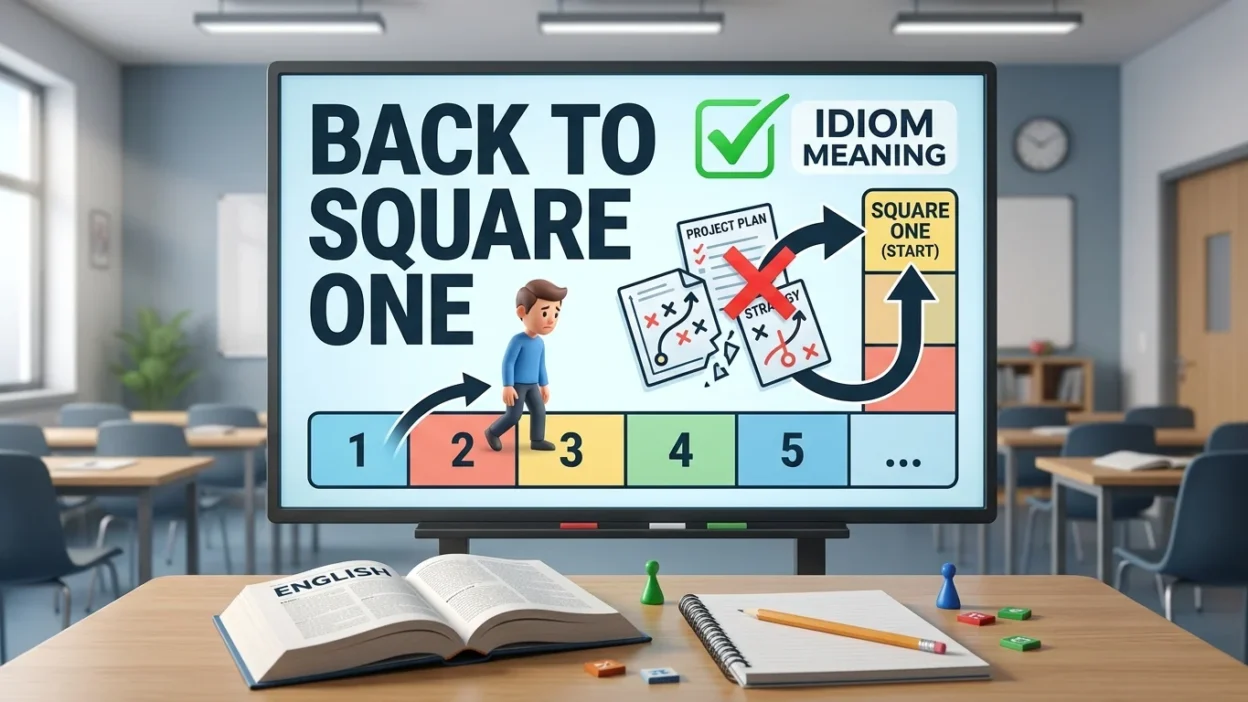
Back to square one means returning to the beginning because a plan, attempt, or process has failed or a setback has erased previous progress.
In simple English:
Back to square one = starting again from the beginning.
For example:
We lost all our research when the computer crashed, so we’re back to square one.
The sentence means that the people must begin the process again because their previous progress has been lost.
Back to Square One Meaning in Simple English
The phrase back to square one describes a situation where you have to start over after making progress.
It is commonly used when:
- A plan fails
- An attempt does not work
- A project encounters a major setback
- A solution creates another problem
- Previous progress is lost
- A person must reconsider the entire approach
The expression often carries a feeling of frustration or disappointment, but it does not always have a completely negative tone.
Sometimes going back to the beginning gives someone an opportunity to find a better solution.
What Is the Origin of Back to Square One?
The exact origin of back to square one is uncertain, and several theories have been proposed.
One popular theory connects the expression with board games, where players move across numbered squares and may be forced to return to the beginning after losing or making a mistake.
Another theory connects it with radio sports broadcasting, particularly football commentary. Some explanations suggest that radio commentators divided a playing field into numbered sections to help listeners follow the action, although the historical evidence for this theory is not completely conclusive.
Another proposed connection involves children’s games or hopscotch-style diagrams.
Because the precise origin remains uncertain, it is better to focus on the established modern meaning rather than treating one origin story as proven fact.
How to Use Back to Square One in a Sentence
The idiom can be used in several grammatical structures.
With Be
- We are back to square one.
- The project is back to square one.
- After the experiment failed, the scientists were back to square one.
With Go
- We may have to go back to square one.
- If this plan fails, we’ll go back to square one.
With Put
- The new problem put us back to square one.
This structure emphasizes that something caused the person or group to lose progress.
Back to Square One Examples
Example 1: A Failed Project
The company spent months developing the product, but the design failed the final test. Now the team is back to square one.
The team must reconsider the project and possibly restart the development process.
Example 2: Learning Something New
I thought I understood the math problem, but I got every answer wrong. Now I’m back to square one.
Here, the speaker feels that their previous understanding was not enough and they need to start learning again.
Example 3: Solving a Technical Problem
We tried five different solutions, but none worked. We’re back to square one.
The team has not necessarily lost everything, but it has not found a successful solution and must rethink the problem.
Example 4: Planning a Trip
Our hotel canceled our reservation, so we’re back to square one with our travel plans.
The original arrangement is no longer available, so the planning process must begin again.
Example 5: Job Hunting
I thought I had finally found the right job, but the company canceled the position. I’m back to square one.
The speaker must resume searching for employment.
Back to Square One vs Start Over
These expressions are closely related, but there is a small difference.
Start over is a general expression meaning to begin again.
Back to square one often suggests that previous progress has been lost because of a setback or failure.
| Expression | Meaning | Typical Feeling |
|---|---|---|
| Back to square one | Return to the beginning after a setback | Often frustration |
| Start over | Begin again | Neutral |
| Begin again | Start another attempt | Neutral |
| Start from scratch | Build something from the beginning | Often suggests little or no existing work |
| Back to the drawing board | Return to planning after an idea fails | Often frustration |
| For example, if you simply decide to rewrite a paragraph, you can say you are starting over. | ||
| If your entire project fails and you have to rethink the original plan, back to square one is more expressive. |
Back to Square One vs Back to the Drawing Board
These two idioms are sometimes confused.
Back to square one means returning to the beginning.
Back to the drawing board means returning to the planning stage because an idea or design has failed.
For example:
The machine didn’t work, so we’re back to square one.
The machine design failed, so the engineers went back to the drawing board.
The expressions can overlap, but back to the drawing board focuses more specifically on redesigning or replanning.
Back to Square One vs Start From Scratch
Start from scratch means creating something from the very beginning, often without using previous work or resources.
Back to square one focuses more strongly on losing progress or having to return to an earlier stage.
For example:
We decided to build the website from scratch.
The original website caused too many problems, so we’re back to square one.
The first sentence does not necessarily imply failure. The second usually suggests a setback.
Is Back to Square One Negative?
The phrase often has a negative or frustrated feeling because people generally use it after something has gone wrong.
For example:
After three months of negotiations, the deal collapsed, and we’re back to square one.
However, the expression itself is not always negative.
Going back to the beginning can sometimes be useful. A failed attempt can teach you what does not work and help you develop a stronger plan.
Therefore, the emotional meaning depends on context.
Common Mistakes When Using Back to Square One
Mistake 1: Taking the Phrase Literally
Back to square one is an idiom. It usually does not mean physically returning to a numbered square.
Mistake 2: Saying Back at Square One in Every Situation
Back to square one is the standard expression.
For example:
We are back to square one.
Mistake 3: Using It for Every Kind of Repetition
Repeating an activity does not automatically mean you are back to square one.
The phrase usually implies that progress has been lost or a setback has occurred.
Mistake 4: Confusing It With Start From Scratch
These expressions overlap, but they are not identical. Back to square one often emphasizes returning to an earlier point after a setback.
Mistake 5: Assuming It Always Means Complete Failure
Sometimes a person may say they are back to square one even though they learned useful lessons during the process.
The phrase describes the position they are in, not necessarily everything they gained from the experience.
Is Back to Square One Formal or Informal?
Back to square one is a common idiom that works in both casual and professional English.
You can hear it in:
- Everyday conversations
- Business meetings
- News reports
- Academic discussions
- Workplace communication
- Books and articles
It is generally acceptable in professional communication when used naturally.
For highly formal writing, a more precise expression such as return to the initial stage or resume the process from the beginning may sometimes be preferable.
American English vs British English
There is no major difference in the meaning of back to square one between American and British English.
The idiom is understood and used in both varieties.
American English:
We are back to square one.
British English:
We are back to square one.
The wording, spelling, and basic meaning remain the same.
However, regional preferences for related idioms can vary. British speakers may also use expressions such as back to the drawing board, depending on the situation.
Synonyms and Related Expressions
Several expressions have a similar meaning to back to square one:
- Start over
- Begin again
- Return to the beginning
- Start from scratch
- Go back to the beginning
- Back to the drawing board
- Restart the process
- Try again
- Reconsider the plan
- Return to the starting point
These expressions are not always interchangeable because each has a slightly different emphasis.
How to Remember the Meaning
A simple memory trick is:
Square one = the starting point.
Therefore:
Back to square one = back to the starting point.
Imagine working through a long process and reaching the end, only to discover that something went wrong. You may have to return to the beginning and try another approach.
That is the central idea behind the idiom.
Why This Idiom Is So Common
Back to square one is popular because it describes a situation that almost everyone experiences.
Students fail tests, businesses change plans, engineers redesign products, programmers fix bugs, and people rethink personal decisions.
The phrase communicates all of this frustration in just four words.
It is also useful because it does not necessarily mean that every previous effort was completely wasted. Someone can return to the beginning while still carrying lessons learned from earlier attempts.
FAQs
What does back to square one mean?
Back to square one means returning to the beginning after a setback, failure, or problem has caused someone to lose progress.
What is another way to say back to square one?
You can say start over, begin again, return to the beginning, or go back to the starting point. Start from scratch is also related but can imply creating something from the very beginning.
Is back to square one an idiom?
Yes. Back to square one is a common English idiom. Its meaning is figurative rather than a literal reference to a physical square.
Is back to square one negative?
It often expresses frustration or disappointment because it usually follows a setback. However, it can also describe a neutral decision to reconsider an approach.
What is the difference between back to square one and back to the drawing board?
Back to square one means returning to the beginning, while back to the drawing board specifically emphasizes returning to planning or redesign after an idea fails.
Is back to square one used in American English?
Yes. The expression is common and natural in American English and is also widely understood in British English.
Can I use back to square one in professional writing?
Yes. It is commonly used in workplace and professional communication, although very formal writing may sometimes benefit from a more literal expression.
Does back to square one mean starting from scratch?
Not always. Both expressions involve beginning again, but back to square one usually emphasizes returning to an earlier point after a setback, while starting from scratch can imply having no usable previous work.
Summary
The back to square one meaning is simple: it means returning to the starting point after a setback, failure, or problem has stopped your progress. It is a common English idiom that can describe projects, studies, business plans, technical problems, relationships, travel arrangements, and many other situations.
The expression is closely related to start over, start from scratch, and back to the drawing board, but each phrase has its own emphasis. Back to square one is especially useful when you want to communicate the frustration of having to return to an earlier stage after something has gone wrong.

Liam James is a language enthusiast and content writer at Verseslay, specializing in word comparisons, grammar debates, and vocabulary insights. He helps readers understand language nuances through clear, engaging, and practical explanations.