
If you have ever wondered about unorganized vs disorganized, you are not alone. These two words look almost identical and are often used to describe messy spaces, poorly planned work, confusing information, or people who struggle to keep things in order.
Although unorganized and disorganized can sometimes be used interchangeably, there is a subtle difference in usage and emphasis. Understanding that difference can help you choose the more natural word in everyday English and professional writing.
Quick Answer: Unorganized vs Disorganized
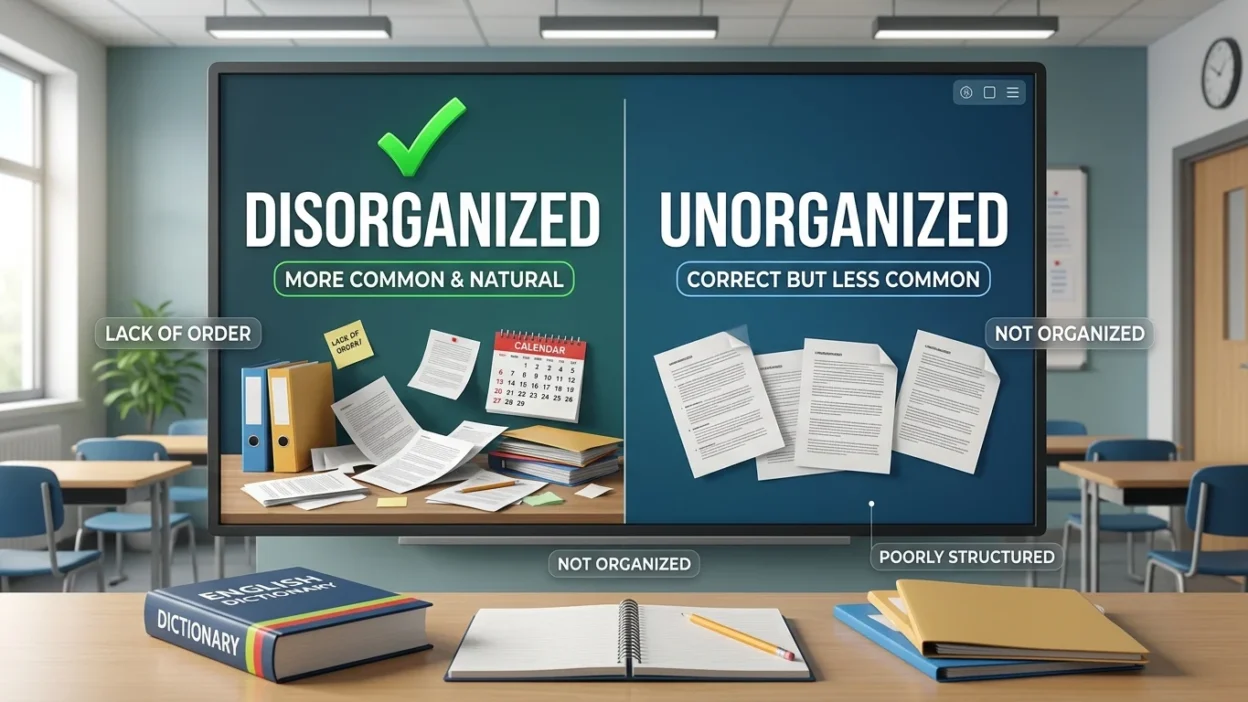
Both unorganized and disorganized can describe something that lacks order, structure, or proper arrangement. However, disorganized is generally more common and natural when describing a person, system, process, workplace, or situation that lacks organization.
Unorganized can also mean not organized, but it may emphasize the absence of organization rather than a state of disorder.
Quick rule:
- Disorganized = lacking order, structure, or organization; often suggests disorder or poor arrangement.
- Unorganized = not organized; simply lacking organization.
In many everyday situations, disorganized is the safer and more commonly used choice.
What Does Disorganized Mean?
Disorganized is an adjective used to describe someone or something that lacks order, structure, planning, or organization.
For example:
- My desk is disorganized.
- The office has a disorganized filing system.
- He is very disorganized at work.
- The meeting became disorganized after several people started talking at once.
The word can describe both physical and abstract situations.
A disorganized room may contain things scattered everywhere. A disorganized project may lack a clear plan, schedule, or system.
The word can also describe a person’s habits or working style.
What Does Unorganized Mean?
Unorganized generally means not organized or without organization.
It can be used when something has not been arranged, structured, or organized.
For example:
- The documents were still unorganized.
- The files remained unorganized after the office move.
- The group was unorganized and had no clear leader.
In some contexts, unorganized simply describes the absence of organization without strongly suggesting that something is chaotic or messy.
This makes the distinction subtle because the two words overlap considerably.
Unorganized vs Disorganized: The Main Difference
The easiest way to understand the difference is to think about absence versus disorder.
Unorganized often focuses on something not being organized.
Disorganized often suggests that something is poorly organized, disorderly, confused, or lacking an effective system.
For example, imagine a box containing documents that have never been sorted. You could describe the documents as unorganized.
If the documents are scattered across several folders, mixed together, incorrectly labeled, and difficult to find, disorganized may be more appropriate.
The difference is not absolute, however. Native speakers may use the words interchangeably in many situations.
Unorganized vs Disorganized Comparison Table
| Feature | Unorganized | Disorganized |
|---|---|---|
| Basic meaning | Not organized | Lacking order or organization |
| Suggests disorder | Sometimes | Often |
| Common in everyday English | Less common | More common |
| Describes people | Possible | Very common |
| Describes messy spaces | Possible | Very common |
| Describes systems | Yes | Yes |
| Describes chaotic situations | Less natural | Very natural |
| Tone | Neutral in many contexts | Often suggests a problem |
Examples of Disorganized
Here are some natural examples using disorganized:
- Her workspace is extremely disorganized.
- The company has a disorganized management system.
- I became disorganized after changing my daily routine.
- The teacher noticed that the students’ notes were disorganized.
- His thoughts seemed disorganized during the presentation.
- The event was disorganized because nobody had a clear schedule.
- My email inbox is completely disorganized.
These examples show that disorganized works naturally with people, places, information, thoughts, systems, and events.
Examples of Unorganized
Here are examples where unorganized can work:
- The data is still unorganized.
- The files are unorganized and need to be sorted.
- The group was unorganized from the beginning.
- These notes are unorganized, so I need to arrange them.
- The information remains unorganized.
In these examples, the focus is often on the fact that organization has not been established.
Is Disorganized More Common Than Unorganized?
Yes, disorganized is generally the more common choice in standard everyday English.
When native speakers describe someone who frequently loses things, forgets appointments, or struggles to plan tasks, disorganized sounds particularly natural.
For example:
- She is very disorganized.
- He has a disorganized approach to work.
Saying someone is unorganized is understandable, but it may sound less natural depending on the context.
This is especially important for learners of English who want their writing to sound natural and fluent.
When Should You Use Unorganized?
Use unorganized when you want to emphasize that something simply has not been organized or arranged.
For example:
- The survey responses are unorganized.
- The material is currently unorganized.
- The records were left unorganized.
It can be useful when describing a temporary state before something is properly arranged.
However, if you are describing ongoing disorder, confusion, poor planning, or a person’s organizational habits, disorganized is usually the better choice.
When Should You Use Disorganized?
Use disorganized when something lacks a clear system or appears messy, confused, poorly planned, or disorderly.
It is particularly natural when describing:
- People
- Workplaces
- Offices
- Schedules
- Projects
- Files
- Meetings
- Thoughts
- Events
- Management systems
- Daily routines
For example:
The project was disorganized from the beginning.
This suggests more than simply a lack of organization. It suggests that the project was poorly structured or managed.
Common Mistakes
Mistake 1: Assuming Only One Word Is Correct
Both words are legitimate English adjectives. The issue is usually which word sounds more natural in a particular context.
Mistake 2: Always Using Unorganized
English learners sometimes choose unorganized because the prefix un- seems to mean not.
Although the logic makes sense, native English usage often favors disorganized for people, messy situations, and poorly structured systems.
Mistake 3: Thinking Disorganized Always Means Physically Messy
Disorganized does not only describe physical mess.
You can have:
- Disorganized thoughts
- A disorganized schedule
- A disorganized company
- A disorganized argument
- A disorganized project
Mistake 4: Confusing Disorganized With Unprofessional
Calling someone disorganized describes their habits or approach. It does not necessarily mean they are lazy, careless, or unprofessional.
People can become disorganized because of stress, changing routines, too many responsibilities, or a lack of effective systems.
Disorganized vs Messy
These words are related but not identical.
Messy usually describes physical untidiness.
Disorganized has a broader meaning and can describe physical spaces as well as plans, systems, information, and behavior.
For example:
- My room is messy.
- My schedule is disorganized.
You could also say a room is disorganized, but messy focuses more directly on its physical appearance.
Disorganized vs Unstructured
Unstructured means lacking a clear structure or framework.
Disorganized means lacking effective organization or order.
For example:
- The discussion was unstructured.
- The discussion was disorganized.
The first suggests that there was no clear format. The second may suggest confusion or poor management.
American English vs British English
There is no major spelling difference between unorganized and disorganized in American and British English. Both forms can be understood in both varieties.
However, disorganized is widely used and generally more natural in both American and British English when describing disorder, poor planning, or a lack of organization.
British English also commonly uses disorganised with an s instead of the American spelling disorganized.
For example:
- American English: disorganized
- British English: disorganised
The pronunciation and basic meaning remain essentially the same.
Synonyms for Unorganized and Disorganized
Depending on the context, useful synonyms include:
- Disorderly
- Messy
- Chaotic
- Unstructured
- Untidy
- Confused
- Unsystematic
- Unplanned
- Scattered
- Uncoordinated
- Haphazard
- Unsorted
Be careful when choosing synonyms because they do not all have exactly the same meaning.
For example, chaotic is stronger than unorganized, while untidy usually focuses more on physical appearance.
How to Remember the Difference
A simple memory trick can make the distinction easier:
Unorganized = not organized.
Disorganized = organization is lacking or has broken down, often resulting in disorder.
When talking about a person who frequently struggles to keep things in order, disorganized is usually the most natural choice.
When simply describing information or materials that have not yet been arranged, unorganized may work well.
FAQs
Is unorganized or disorganized correct?
Both are correct English words. However, disorganized is generally more common and natural when describing people, messy situations, poor planning, or systems lacking order.
Is unorganized a real word?
Yes. Unorganized is a valid English adjective meaning not organized. It is less common than disorganized in many everyday contexts.
Is disorganized more common than unorganized?
Yes. Disorganized is generally more frequently used, especially for people, workplaces, schedules, projects, and situations involving disorder.
Can I use unorganized for a person?
Yes, but disorganized usually sounds more natural when describing someone’s habits, planning, or ability to keep things in order.
What is the difference between unorganized and disorganized?
Unorganized often emphasizes that something has not been organized, while disorganized commonly suggests a lack of effective order, structure, or planning.
Is disorganized the same as messy?
Not exactly. Messy usually refers to physical untidiness, while disorganized can describe physical spaces, people, systems, schedules, thoughts, and projects.
Is disorganised British English?
Yes. Disorganised is the common British spelling, while disorganized is the standard American spelling. Both have the same basic meaning.
Which word should I use in professional writing?
In most professional contexts, disorganized is the more natural choice when describing poor organization or disorder. For a neutral description of materials that simply have not been arranged, unorganized can also be appropriate.
Summary
When comparing unorganized vs disorganized, both words can mean that something lacks organization, but disorganized is usually the more natural and widely used choice. It can describe a person, workspace, project, schedule, system, meeting, or even someone’s thoughts. It often carries the additional idea of disorder, confusion, or ineffective organization.
Unorganized is still correct and useful, particularly when you simply want to say that something has not been organized yet. The distinction is subtle rather than absolute, and context determines which word sounds best. For everyday English, especially when describing a person’s organizational habits or a situation that has become chaotic, disorganized is generally the safer choice.