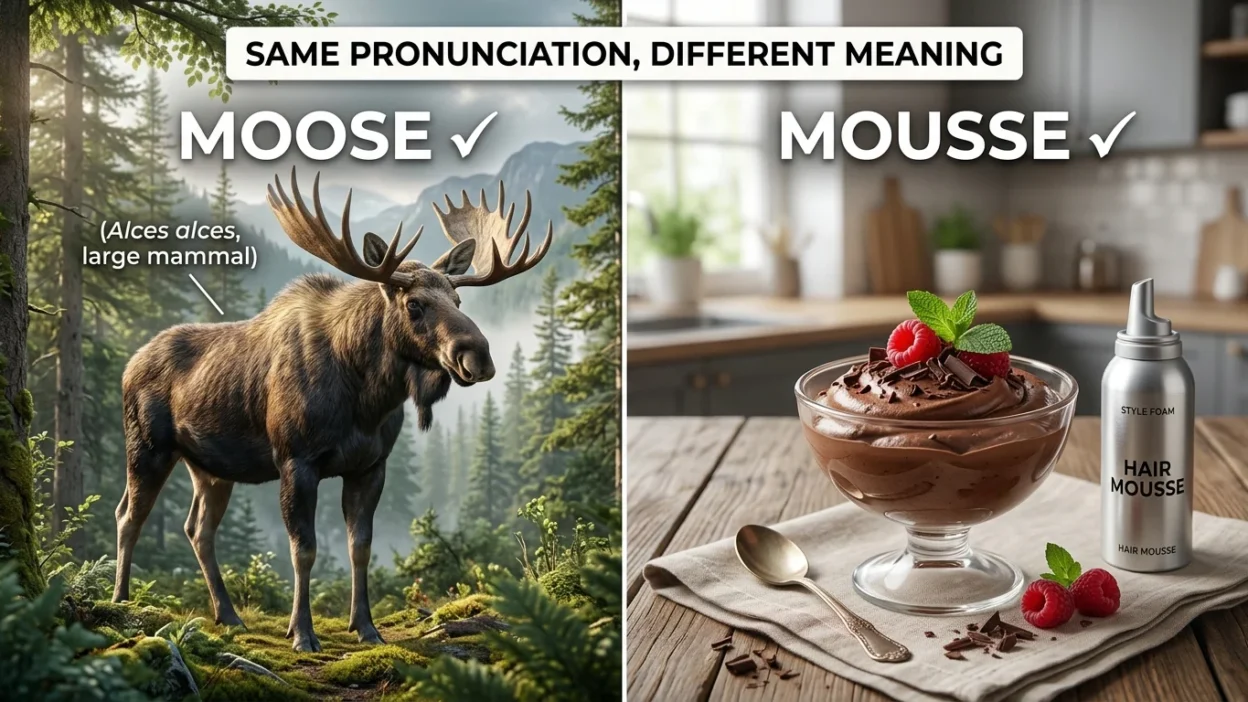
The words moose and mousse look and sound similar, but they refer to completely different things. One is a large wild animal, while the other can describe a light, creamy food or a styling product for hair. This makes moose vs mousse a common spelling and vocabulary question for English learners.
Although the pronunciation can be confusing, learning the meaning and spelling of each word makes the difference easy to remember. In this guide, we will explain moose vs mousse, their meanings, pronunciation, examples, common mistakes, American and British English usage, and a simple memory trick to help you never confuse them again.
Quick Answer
Moose is a large deer-like animal found mainly in northern regions of North America, Europe, and Asia.
Mousse is a light, soft food or a foamy hair-styling product.
Simple difference:
Moose = animal 🫎
Mousse = food or hair product
Examples:
- We saw a moose in the forest.
- She ordered chocolate mousse for dessert.
- He uses hair mousse to style his hair.
What Does Moose Mean?
A moose is a very large member of the deer family. It is known for its enormous size, long legs, broad body, and large antlers in males.
Moose are especially associated with cold and northern environments.
They can be found in regions such as:
- Canada
- Alaska
- Northern United States
- Scandinavia
- Russia
- Other northern parts of Europe and Asia
A male moose is particularly recognizable because of its large, flattened antlers.
Example sentences
- We saw a moose while driving through the forest.
- The moose was standing near the lake.
- A large moose crossed the road.
- Moose are adapted to cold climates.
- The wildlife photographer captured a beautiful picture of a moose.
What Does Mousse Mean?
Mousse is a completely different word.
It can refer to a light, airy food made by incorporating air into ingredients, often creating a soft and creamy texture.
A famous example is chocolate mousse.
For example:
We had chocolate mousse after dinner.
The word can also refer to a foamy hair-styling product that is applied to the hair to provide volume, texture, hold, or definition.
For example:
She applied hair mousse before styling her hair.
So, mousse commonly has two everyday meanings:
- A light, airy dessert or food
- A foamy hair-styling product
Moose vs Mousse Comparison
| Word | Meaning | Category | Example |
|---|---|---|---|
| Moose | A large deer-like animal | Animal/noun | We saw a moose in the woods. |
| Mousse | A light, airy food | Food/noun | The chocolate mousse was delicious. |
| Mousse | A foamy hair product | Beauty/product/noun | She used mousse on her hair. |
The easiest way to remember the difference is to associate moose with an animal and mousse with food or hair.
Moose vs Mousse Pronunciation
The pronunciation of these words can be especially confusing because they sound very similar.
Moose is pronounced approximately:
moos
Mousse is also commonly pronounced approximately:
moos
So, in standard English pronunciation, the two words are essentially homophones.
That means they sound the same but have different meanings and spellings.
The context tells you which word someone means.
For example:
I saw a moose.
The context clearly indicates an animal.
I ordered chocolate mousse.
The word chocolate tells you that the speaker means a dessert.
Why Are Moose and Mousse Confused?
There are several reasons English learners confuse these words.
Similar pronunciation
Both words are commonly pronounced like moos.
Similar spelling
Both begin with m and contain similar vowel sounds.
Different origins
Despite their similar sound, the words have completely different meanings and linguistic histories.
Context matters
Because the pronunciation does not provide much help, you need to understand the surrounding sentence.
Moose in Sentences
Here are more examples using moose:
- The moose walked through the forest.
- We spotted a moose near the river.
- A male moose can have enormous antlers.
- The children were excited to see a moose.
- The park is home to several moose.
- We were careful while driving because a moose could cross the road.
Notice that all these examples refer to the animal.
Mousse in Food Sentences
When mousse refers to food, it is usually associated with a light and airy texture.
Examples:
- The chocolate mousse was delicious.
- She ordered a strawberry mousse.
- The chef prepared a rich chocolate mousse.
- We served lemon mousse for dessert.
- The mousse had a smooth and creamy texture.
The word is particularly common in descriptions of desserts.
Mousse in Hair Care
Mousse can also refer to a lightweight, foamy hair product.
Examples:
- She applied mousse to her hair.
- This mousse gives my hair more volume.
- He uses styling mousse before blow-drying his hair.
- The hair mousse helps define the curls.
- Apply a small amount of mousse to damp hair.
In this context, the word has nothing to do with food.
Moose vs Deer
A moose is a type of deer, but it is much larger than most animals people commonly associate with the word deer.
The term deer refers to a broader family of hoofed mammals.
A moose is one particular species within that family.
For example:
A moose is a type of deer.
But:
Not every deer is a moose.
This distinction can help you understand the animal-related meaning of moose.
Moose vs Elk
Moose and elk are also different animals, although both belong to the deer family.
Moose are generally recognized by their very large bodies, long legs, and broad, flattened antlers in males.
Elk have a different body shape and typically have long, branching antlers.
Both animals are commonly associated with forests and northern environments, but they are not the same species.
Common Mistakes With Moose and Mousse
Mistake 1: Writing Mousse for the Animal
Incorrect:
We saw a mousse in the forest.
Correct:
We saw a moose in the forest.
Use moose when you mean the animal.
Mistake 2: Writing Moose for the Dessert
Incorrect:
The chocolate moose was delicious.
Correct:
The chocolate mousse was delicious.
Use mousse when referring to the dessert.
Mistake 3: Confusing Mousse With Mouse
Another common spelling problem is confusing mousse with mouse.
Mouse refers to a small rodent or a computer input device.
Mousse refers to a food or hair product.
Compare:
- mouse → animal or computer device
- mousse → dessert or hair product
- moose → large deer-like animal
These three words can create confusion for English learners because of their similar spelling and pronunciation.
Moose, Mousse, and Mouse Comparison
| Word | Pronunciation | Meaning |
|---|---|---|
| Moose | moos | Large deer-like animal |
| Mousse | moos | Dessert or hair-styling product |
| Mouse | mows | Small rodent or computer device |
This three-word comparison is an excellent way to avoid spelling mistakes.
American vs British English
The basic meanings of moose and mousse are the same in American and British English.
Moose refers to the large deer-like animal.
Mousse can refer to a light food preparation or a hair-styling product.
There is, however, an interesting regional vocabulary point involving the animal.
In British English, the animal commonly called a moose in North America is also called a moose. The word is therefore understood in both varieties.
The food and hair-product meanings of mousse are also widely recognized in both American and British English.
Is Moose Singular or Plural?
One interesting grammar point is that moose has the same form for singular and plural in standard English.
You can say:
I saw one moose.
You can also say:
I saw five moose.
You generally do not need to add -s.
Incorrect:
five mooses
Standard:
five moose
This is a useful vocabulary fact to remember.
Is Mousse Countable or Uncountable?
The answer depends on how you use the word.
When referring to the food as a general substance or dish, mousse is often treated as uncountable.
For example:
I love chocolate mousse.
When referring to separate servings or varieties, you may see countable uses.
For example:
The restaurant offers several different mousses.
The exact usage depends on context.
How to Remember Moose vs Mousse
Here is a simple memory trick:
Moose = animal
Think of the extra e at the end of moose as part of the animal’s name.
MOOS + E = MOOSE 🫎
Mousse = food or hair product
Think of mousse as the word associated with something soft, creamy, or foamy.
Mousse = dessert or styling foam
Another simple rule:
Moose lives in the forest.
Mousse belongs in the kitchen or bathroom.
This makes the distinction easy to remember.
FAQs About Moose vs Mousse
1. What is the difference between moose and mousse?
Moose is a large deer-like animal. Mousse is a light, airy food or a foamy hair-styling product.
2. Are moose and mousse pronounced the same?
Yes. In standard English, moose and mousse are commonly pronounced the same, making them homophones.
3. Is chocolate moose correct?
No, if you mean the dessert. The correct spelling is chocolate mousse.
4. Is a moose a type of deer?
Yes. A moose is a member of the deer family and is one of its largest members.
5. What is hair mousse?
Hair mousse is a lightweight, foamy styling product used to add volume, texture, hold, or definition to hair.
6. What is the plural of moose?
The plural of moose is normally moose.
Example:
We saw three moose in the park.
7. Is mousse only a dessert?
No. Mousse can also refer to a hair-styling product. In food, it can describe different sweet or savory light preparations.
8. What is the difference between mouse, moose, and mousse?
Mouse means a small rodent or computer device. Moose means a large deer-like animal. Mousse means a light food or hair-styling product.
Summary
The difference between moose vs mousse is mainly about meaning and spelling. Moose refers to a large animal from the deer family, while mousse usually refers to a light, airy food or a foamy hair-styling product. Although the two words have different spellings and meanings, they are commonly pronounced the same, making them homophones.
The easiest way to remember them is to connect moose with the outdoors and wildlife, while connecting mousse with food or hair care. Also remember that moose has the same form for singular and plural, so you can say one moose or several moose. Both words are used in American and British English with essentially the same meanings.
Actionable Takeaway
Remember these three words:
Moose 🫎 = large animal
Mousse 🍫 = dessert or hair product
Mouse 🐭 = small animal or computer device
If you are talking about an animal in a forest, use moose. If you are talking about a creamy dessert or styling foam, use mousse.
A simple memory sentence is:
A moose lives in the forest, while mousse can be served for dessert or used on your hair.
Meta Description: Learn moose vs mousse with clear meanings, pronunciation, examples, spelling differences, common mistakes, and American and British English usage.

Liam James is a language enthusiast and content writer at Verseslay, specializing in word comparisons, grammar debates, and vocabulary insights. He helps readers understand language nuances through clear, engaging, and practical explanations.