If you have ever written dammit and wondered whether damnit is actually correct, you are not alone. These two spellings look almost identical and are often used in the same situations, which makes the difference confusing for English learners and even native speakers.
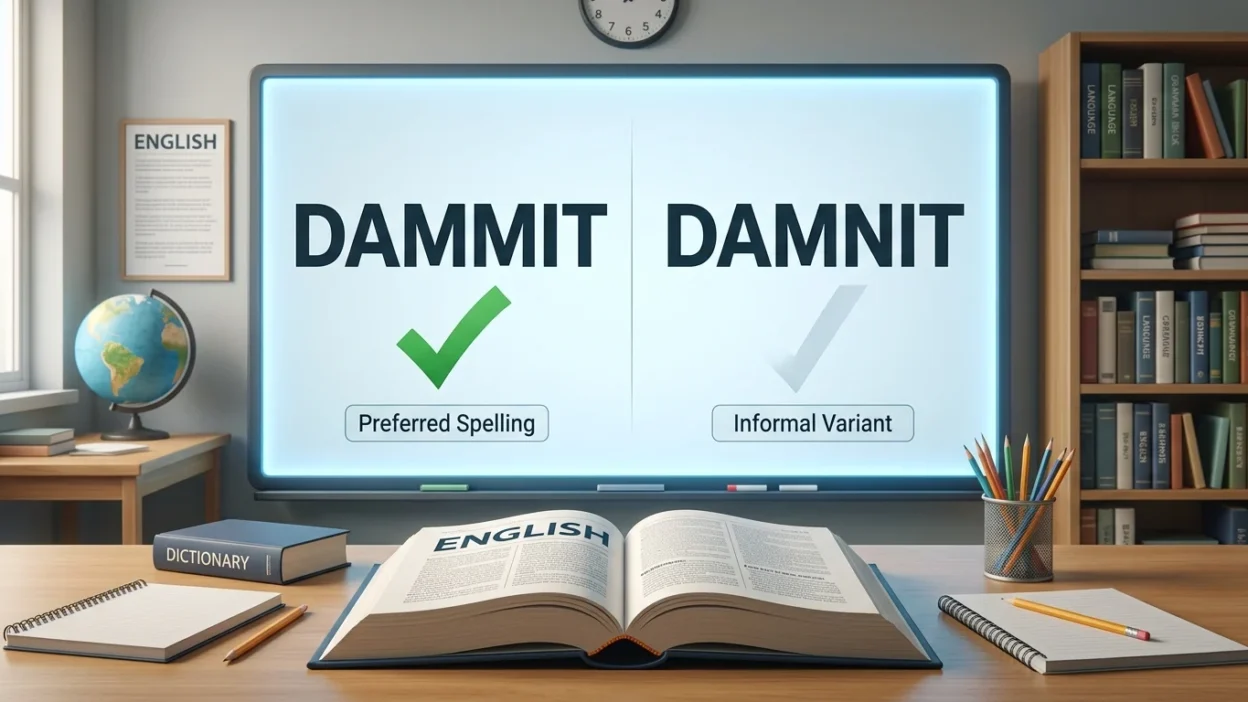
The good news is that both dammit and damnit are recognized informal spellings. However, dammit is the more established and widely preferred spelling, while damnit is generally treated as a less common variant. Both are informal expressions used to show annoyance, frustration, anger, disappointment, or irritation.
Quick Answer: Dammit vs Damnit
Dammit is generally the preferred spelling, while damnit is an accepted informal variant.
| Word | Usage | Meaning | Commonness |
|---|---|---|---|
| Dammit | Informal | Expression of anger, annoyance, or frustration | More common |
| Damnit | Informal | Same meaning as dammit | Less common |
The simple rule
- Use dammit if you want the more common spelling.
- Damnit can also be found in informal writing.
- Neither word is appropriate for most formal or professional writing.
- Both expressions are generally pronounced similarly.
- Both are derived from the expression damn it.
If you are unsure which one to choose, dammit is usually the safer choice.
What Does Dammit Mean?
Dammit is an informal exclamation used to express strong annoyance, frustration, anger, or disappointment.
It developed as a written form of the spoken expression damn it. Over time, the words became commonly written together as dammit.
For example, someone who drops their phone might say:
- Dammit, I dropped my phone again.
- Dammit, I forgot my keys.
- Dammit, the computer stopped working.
- Dammit, we missed the bus.
The exact emotion depends on the context. It can express mild irritation in one situation and much stronger anger in another.
Because it is an informal exclamation, dammit is much more common in casual conversations, fiction, dialogue, social media, and informal writing than in formal documents.
What Does Damnit Mean?
Damnit has essentially the same meaning as dammit. It is another informal spelling of the expression damn it.
People may use damnit when they want to represent the way the phrase sounds in rapid speech. However, it is less common than dammit in standard written usage.
Examples include:
- Damnit, I left my wallet at home.
- Damnit, that was my last chance.
- Damnit, I made the same mistake again.
- Damnit, why isn’t this working?
The meaning remains the same: the speaker is expressing frustration, irritation, anger, or disappointment.
Dammit vs Damnit: Comparison Table
| Feature | Dammit | Damnit |
|---|---|---|
| Meaning | Frustration, anger, annoyance, or disappointment | Same |
| Formality | Very informal | Very informal |
| Commonness | More common | Less common |
| Origin | Damn it | Damn it |
| Pronunciation | Usually similar | Usually similar |
| Standard choice | Generally preferred | Informal variant |
| Suitable for formal writing? | No | No |
| Used in dialogue? | Yes | Yes |
| Used online? | Yes | Yes |
The most important difference is frequency and conventional spelling, rather than meaning.
Is Dammit or Damnit Correct?
This is where things can become confusing.
Dammit is generally the more established spelling and is the better choice when you want to write the expression as one word. Damnit also appears in informal writing, but it is less common.
The original expression is damn it, consisting of two words. In informal writing, it can be written as dammit, and damnit is sometimes used as a variant spelling.
So, if someone asks which spelling you should use, the practical answer is:
Dammit is the preferred choice.
However, calling damnit simply a spelling mistake can be misleading because it is used as an informal variant.
Dammit vs Damn It
There is another important distinction between dammit and damn it.
Damn it is the original two-word expression.
Dammit is the informal one-word form.
Compare these:
- Damn it, I forgot my appointment.
- Dammit, I forgot my appointment.
Both communicate frustration.
The one-word version is especially common in casual writing and fictional dialogue. The two-word version can sometimes look more deliberate or closer to the original expression.
Examples of Dammit in Sentences
Here are some natural examples:
- Dammit, I left my keys in the car.
- I missed the deadline, dammit.
- Dammit! The train has already left.
- She whispered dammit when she realized her mistake.
- Dammit, I thought I had saved the file.
- He shouted dammit after dropping the box.
- I knew I had forgotten something. Dammit!
The word can appear at the beginning, middle, or end of a sentence.
Examples of Damnit in Sentences
Because damnit is an informal variant, you may encounter it in similar contexts:
- Damnit, I forgot to charge my phone.
- I can’t believe I did that, damnit.
- Damnit! We are going to be late.
- He muttered damnit under his breath.
- Damnit, I made another mistake.
- She said damnit after realizing what had happened.
The meaning does not significantly change when the spelling changes from dammit to damnit.
American vs British English: Is There a Difference?
Unlike many spelling differences between American and British English, dammit vs damnit is not primarily a US-versus-UK spelling distinction.
You may find dammit and damnit in informal English on both sides of the Atlantic. The main difference is that dammit is more widely established and recognizable as the standard informal spelling.
This is different from clear regional spelling pairs such as:
- color / colour
- center / centre
- favorite / favourite
- organize / organise
Therefore, you should not assume that dammit is American English and damnit is British English. That would be an oversimplification.
For either American or British English, dammit is generally the more natural choice when you need the one-word informal form.
Is Dammit a Curse Word?
Dammit is generally considered a mild swear word or profanity.
It comes from damn it, which uses the word damn, an expression traditionally associated with condemnation or religious language.
Its strength varies depending on the speaker, situation, and audience. In modern everyday English, it is often used as a relatively mild expression of frustration.
For example, someone might say:
- Dammit, I forgot my password.
This may simply communicate irritation rather than serious anger.
Nevertheless, it is still informal and potentially offensive in certain settings.
Where should you avoid using dammit?
It is better to avoid it in:
- Formal academic writing
- Professional reports
- Job applications
- Business correspondence
- Official documents
- School assignments
- Formal presentations
- Communication with people who may find profanity inappropriate
For formal writing, use alternatives such as:
- Unfortunately
- What a disappointment
- That is frustrating
- I made a mistake
- This is quite unfortunate
Common Mistakes With Dammit and Damnit
Mistake 1: Thinking Damnit Is the Standard Spelling
Although damnit is used, dammit is generally the more common and established spelling.
If you need to choose one, choose dammit.
Mistake 2: Assuming They Have Different Meanings
They generally do not.
Dammit and damnit are used to express essentially the same emotions, including frustration, annoyance, anger, and disappointment.
Mistake 3: Using Them in Formal Writing
Both forms are highly informal.
Even though you may see them frequently in movies, novels, online conversations, and social media, that does not make them suitable for professional writing.
Mistake 4: Confusing Dammit With Damn
Damn can function as an exclamation, adjective, adverb, noun, or verb depending on the sentence.
Dammit, on the other hand, is primarily an exclamation expressing frustration or annoyance.
Mistake 5: Believing Damnit Is British English
There is no simple American-versus-British rule here.
Both variants can appear in informal English regardless of whether the writer uses American or British English.
Synonyms and Alternatives for Dammit
If you want to express frustration without using profanity, there are many alternatives.
Informal alternatives
- Oh no!
- Seriously?
- Come on!
- Ugh!
- For goodness’ sake!
- What a pain!
- This is frustrating!
More polite alternatives
- Unfortunately!
- That’s frustrating.
- What a disappointment.
- I can’t believe that happened.
- This is really unfortunate.
- I made a mistake.
Choosing an alternative depends on the situation and the audience.
When Should You Use Dammit?
Use dammit when you are writing informal dialogue or communicating strong frustration in a casual setting.
It can work particularly well in:
- Fiction
- Movie or TV dialogue
- Casual text messages
- Informal social media posts
- Personal conversations
- Character-driven writing
For example:
Dammit, I thought we had more time.
This sounds natural as informal dialogue.
However, if you are writing an academic essay, a business email, or an official report, a more neutral expression would be appropriate.
FAQs
Is dammit or damnit correct?
Both spellings are used informally, but dammit is generally the more common and preferred spelling. Damnit is a less common variant.
Is damnit a real word?
Yes. Damnit is used as an informal spelling variant of dammit, although it is less common. It is not normally preferred in formal writing.
Are dammit and damnit pronounced the same?
They are generally pronounced the same or very similarly. The difference is mainly in spelling.
Is dammit a bad word?
Dammit is considered mild profanity or a swear word. Its offensiveness varies by context and audience, but it is generally unsuitable for formal situations.
Is dammit American or British?
Dammit is not exclusively American or British. It is an informal English expression used in different varieties of English. Damnit is also found in informal writing.
What is the difference between damn it and dammit?
Damn it is the original two-word expression, while dammit is a common informal one-word spelling. They generally have the same meaning.
Can I use dammit in formal writing?
It is best to avoid it in formal writing. Use a neutral expression such as unfortunately, that is frustrating, or what a disappointment instead.
Which spelling should I use: dammit or damnit?
If you need the one-word informal form, dammit is the safer and more widely recognized choice.
Final Summary
The difference between dammit vs damnit is mainly about spelling and usage rather than meaning. Both are informal expressions used to show frustration, annoyance, anger, or disappointment. Dammit is the more common and established spelling, while damnit is a less common informal variant.
Neither spelling should be treated as a major American-versus-British English distinction. Both can appear in informal English, although dammit is generally the better choice when you want the most familiar one-word spelling. Remember that both forms are informal and may be considered profanity, so they should be used carefully depending on your audience and situation.
Actionable Takeaway
When you are unsure, remember this simple rule:
Damn it → original two-word expression
Dammit → preferred informal one-word spelling
Damnit → less common informal variant
For everyday informal writing, dammit is usually your best choice. For professional, academic, or polite communication, avoid both and choose a more appropriate expression of frustration