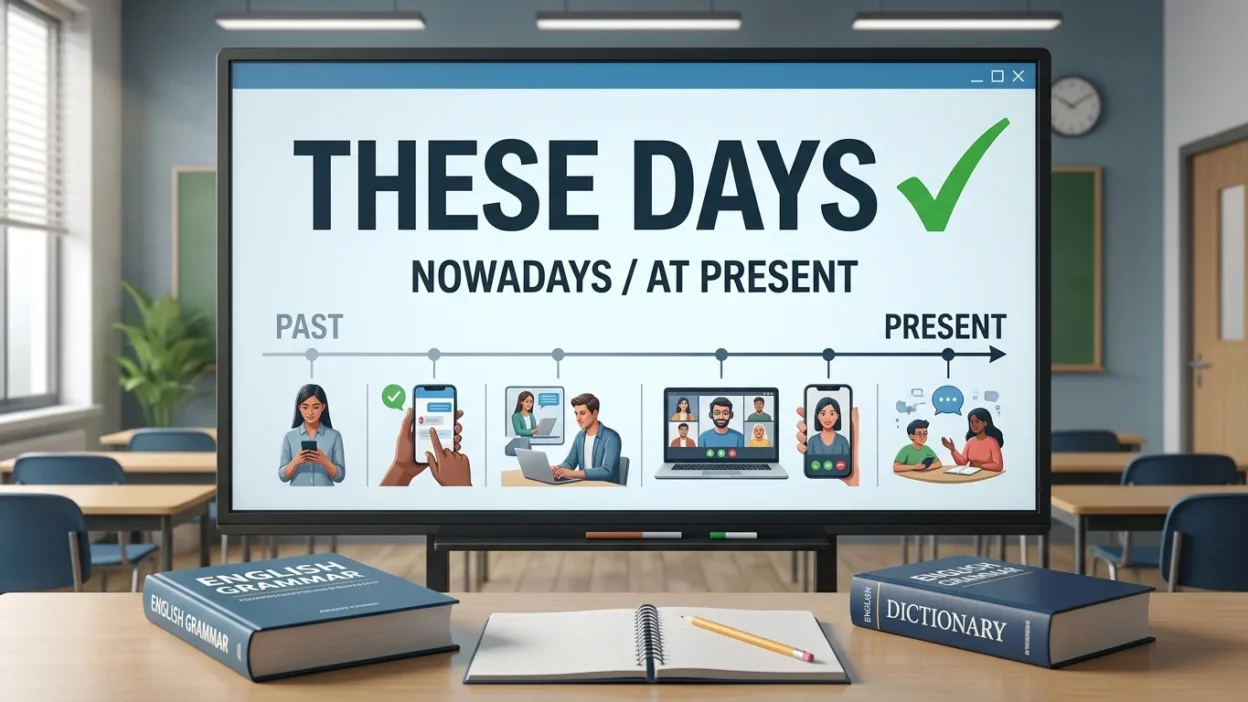
If you have ever wondered how to use these days correctly in an English sentence, you are not alone. This simple expression appears frequently in everyday conversations, articles, social media, and informal writing, but learners sometimes become confused about its meaning, tense, and position in a sentence.
The good news is that these days is easy to understand once you know what it refers to. It generally means at the present time, nowadays, or during the current period. It is commonly used when comparing life now with how things were in the past. In most situations, it works naturally with the present simple or present continuous, depending on the meaning you want to express.
Quick Answer: These Days Usage
These days means nowadays, at the present time, or during the period we are currently living in.
It is usually used to talk about a current habit, situation, trend, or change.
Examples:
- I work from home these days.
- People use smartphones for almost everything these days.
- She is studying a lot these days.
- These days, many people prefer online shopping.
Simple rule
Use these days when talking about:
- Current habits
- Present situations
- Recent changes
- Modern lifestyles
- Current trends
- Things happening around the present time
It often suggests a contrast with the past.
What Does These Days Mean?
The phrase these days means nowadays or at the present time.
For example:
I don’t watch television much these days.
This means that the person does not watch much television nowadays, perhaps compared with the past.
Another example:
These days, children spend a lot of time online.
Here, these days refers to the current period or modern times.
The expression does not usually refer to one specific day. Instead, it describes a general period around the present.
These Days vs Nowadays
These days and nowadays are very close in meaning and can often be used interchangeably.
| Expression | Meaning | Style | Example |
|---|---|---|---|
| These days | At the present time | Natural and conversational | I exercise more these days. |
| Nowadays | At the present time | Slightly more formal or general | Nowadays, people shop online. |
In everyday conversation, these days often sounds more natural.
For example:
I don’t eat much fast food these days.
This sounds very natural and conversational.
Nowadays, people communicate through social media.
This also works well, particularly when making a broad observation about modern life.
How to Use These Days in a Sentence
These days can appear at the beginning or end of a sentence. It can sometimes appear in the middle, depending on the sentence structure.
At the beginning
- These days, I spend more time with my family.
- These days, many students study online.
- These days, people rely heavily on technology.
A comma is commonly used when these days begins the sentence as an introductory expression.
At the end
- I don’t drink coffee much these days.
- She works from home these days.
- We rarely go to the cinema these days.
- He seems happier these days.
This position is extremely common in everyday English.
These Days With the Present Simple
The present simple is very common with these days when describing a current habit, routine, preference, or general situation.
Examples:
- I walk to work these days.
- She exercises regularly these days.
- We eat at home more often these days.
- He doesn’t play cricket these days.
- People spend more time online these days.
The present simple works particularly well when the situation is a general or repeated pattern.
These Days With the Present Continuous
You can also use these days with the present continuous when describing something happening around the current period.
Examples:
- I am working from home these days.
- She is studying for her exams these days.
- They are spending more time with their children these days.
- He is looking for a new job these days.
The present continuous can emphasize a temporary or changing situation.
Compare:
I work from home these days.
This sounds like a current routine.
I am working from home these days.
This can emphasize that the arrangement is temporary or part of the current period.
Both can be correct depending on the intended meaning.
These Days and the Past
One of the most useful features of these days is its ability to create a contrast between the present and the past.
For example:
I used to play football every weekend, but I don’t play much these days.
The phrase makes the change over time clear.
Other examples:
- I used to travel a lot, but I stay home more these days.
- We didn’t have smartphones when I was young, but almost everyone uses them these days.
- She used to work in an office, but she works remotely these days.
- People once relied heavily on newspapers, but many get their news online these days.
This is why these days is especially useful when discussing changing habits and modern trends.
These Days vs In These Days
A common mistake is saying in these days when you mean these days.
Usually, you should simply say:
These days, people use the internet for almost everything.
Not:
In these days, people use the internet for almost everything.
The expression these days does not normally require the preposition in.
However, in these days can occur in unusual or literary contexts when days refers to a particular historical period, but that is not the normal everyday expression.
For modern English, remember:
These days = nowadays
These Days vs Nowadays vs Today
These expressions are related but not always interchangeable.
These days
Refers to the current period or recent times.
I don’t watch much TV these days.
Nowadays
Means generally at the present time.
Nowadays, many people work online.
Today
Usually refers to the current day, although it can sometimes mean the modern era in broader contexts.
I’m working from home today.
This means specifically on the current day.
Compare:
I’m working from home these days.
This suggests a current period or routine, not necessarily just today.
Common Mistakes With These Days
Mistake 1: Using These Day
The correct expression is these days, with the plural noun.
Incorrect:
I don’t go there these day.
Correct:
I don’t go there these days.
Mistake 2: Adding In Unnecessarily
Incorrect in ordinary usage:
In these days, people use smartphones everywhere.
Natural:
These days, people use smartphones everywhere.
Mistake 3: Using It for One Specific Day
These days normally refers to a period, not one particular day.
If you mean the current day, use today.
Incorrect meaning:
I am tired these days because I slept badly last night.
If you mean only today, say:
I am tired today because I slept badly last night.
Mistake 4: Confusing These Days With Nowadays
Both expressions can mean the present period, so learners sometimes worry that one is incorrect.
They are both correct.
- These days = nowadays
- Nowadays = these days
The difference is mainly style and sentence flow.
Mistake 5: Overusing These Days
Although the expression is useful, repeating it too frequently can make writing sound repetitive.
Depending on the context, alternatives include:
- Nowadays
- Currently
- At present
- In recent years
- In modern times
- Today
American vs British English Differences
There is no major American vs British English difference in the meaning or grammar of these days.
The expression is natural in both varieties.
Examples:
American English:
People spend more time online these days.
British English:
People spend more time online these days.
Both are completely natural.
The same is true of nowadays, although individual speakers may have personal preferences about which expression sounds more natural.
Synonyms and Related Expressions
Several expressions can communicate a similar idea.
Common alternatives
- Nowadays
- Currently
- At present
- At the moment
- In recent times
- In recent years
- Today
- In modern times
However, they are not always exact replacements.
For example, at the moment often refers to something happening right now, while these days can refer to a broader period.
Compare:
I am busy at the moment.
This suggests right now.
I am very busy these days.
This suggests a current period lasting days or weeks.
Why These Days Is Useful
The expression these days is especially useful because it allows speakers and writers to discuss changes over time naturally.
It can introduce observations about:
- Technology
- Education
- Work
- Family life
- Shopping
- Transportation
- Communication
- Entertainment
- Health and fitness
- Social trends
For example:
These days, many businesses allow employees to work remotely.
The expression immediately tells the reader that the statement concerns the current period rather than the distant past.
FAQs
What does these days mean?
These days means nowadays, at present, or during the current period. It is commonly used to describe current habits, situations, and trends.
Is these days grammatically correct?
Yes. These days is a standard and very common English expression.
Should I use these days or nowadays?
Both are correct. These days often sounds more conversational, while nowadays can sound slightly more formal or general.
Can I use these days with the present simple?
Yes. The present simple is very common with these days when describing current habits, routines, and general situations.
Example:
I exercise more these days.
Can these days be used with the present continuous?
Yes. It can be used with the present continuous to describe a temporary or changing situation.
Example:
I am studying a lot these days.
Is these days American or British English?
It is used naturally in both American and British English. There is no important regional difference in its meaning or basic usage.
Can I say in these days?
Usually, no, when you mean nowadays. In normal modern English, simply use these days.
Example:
These days, people communicate online.
What is the difference between these days and today?
Today usually refers to the current day, while these days refers to a broader current period.
I am working today refers to one day.
I am working from home these days refers to a current period or routine.
Final Summary
These days is a common English expression meaning nowadays, at present, or during the current period. It is especially useful for describing current habits, routines, trends, and changes compared with the past. It commonly appears with the present simple and present continuous, depending on whether you are describing a general habit or a temporary situation.
There is no significant American-versus-British English difference in its usage. The most important things to remember are that these days is normally written without in, it refers to a period rather than one specific day, and it can often be replaced by nowadays when the context allows. Using it correctly will make your English sound natural and fluent.