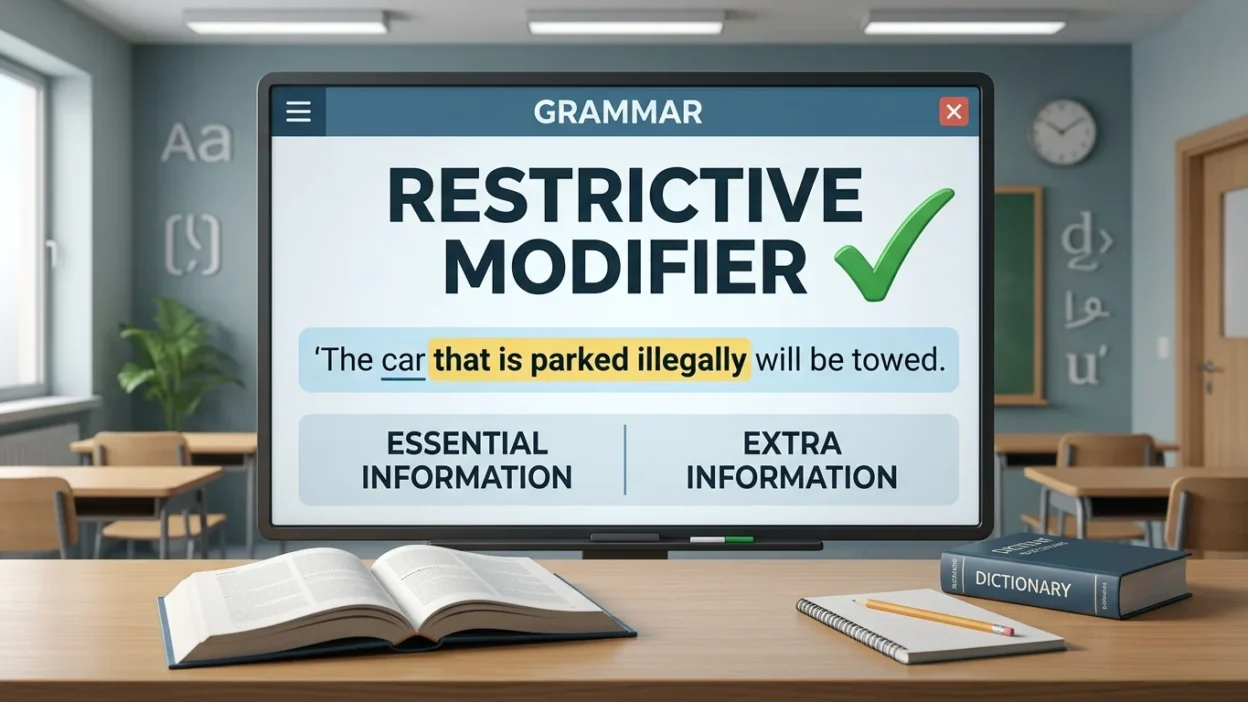
A restrictive modifier is a word, phrase, or clause that provides information essential to identifying or limiting the meaning of another part of a sentence. If you remove a restrictive modifier, the sentence may become unclear or change its intended meaning. Understanding this concept can make your writing more precise and help you avoid punctuation mistakes.
Restrictive modifiers can be confusing because they are closely related to nonrestrictive modifiers, which provide extra information rather than essential information. The key is to determine whether the modifier is necessary to identify exactly who or what the sentence is talking about. Once you understand that difference, using restrictive modifiers becomes much easier.
Quick Answer: What Is a Restrictive Modifier?
A restrictive modifier is a word, phrase, or clause that limits or identifies the specific meaning of a noun or another word.
It is called restrictive because it restricts the possible meaning of the word it modifies.
For example:
The students who studied passed the exam.
The clause who studied identifies which students passed. It restricts the meaning of students, so it is a restrictive modifier.
A restrictive modifier is usually not separated by commas.
Simple rule
- Restrictive modifier = essential information
- It limits or identifies the noun.
- Removing it can change the meaning.
- It usually does not take commas.
- It is also called an essential modifier in many grammar explanations.
What Does Restrictive Modifier Mean?
To understand the term, it helps to separate the two words.
Restrictive means limiting or narrowing something.
A modifier is a word, phrase, or clause that describes, identifies, or provides additional information about another word.
Therefore, a restrictive modifier is a modifier that narrows down the meaning of the word it describes.
Consider this sentence:
The books on the top shelf are mine.
The phrase on the top shelf tells us which books are being discussed. It restricts the meaning of books.
Without the modifier:
The books are mine.
The meaning is much broader.
This is why the modifier is considered restrictive.
Examples of Restrictive Modifiers
Restrictive modifiers can take several forms.
Restrictive Adjective
Sometimes a single adjective can limit the meaning of a noun.
The red car is mine.
If there are several cars, red identifies which one is being discussed.
Other examples:
- The final exam starts tomorrow.
- The younger students left early.
- The broken window needs repair.
- The first chapter is difficult.
The adjective provides information that helps narrow the noun’s meaning.
Restrictive Prepositional Phrase
A prepositional phrase can also function as a restrictive modifier.
The house near the river is for sale.
The phrase near the river identifies which house is for sale.
More examples:
- The students in Room 5 are waiting.
- The documents on my desk need signatures.
- The restaurant across the street is popular.
- The man with the blue jacket is my teacher.
In each sentence, the modifier helps identify a particular person, place, or thing.
Restrictive Relative Clause
A relative clause is one of the most common forms of restrictive modification.
The employee who arrived early received a bonus.
The clause who arrived early tells us which employee received the bonus.
Other examples:
- The students who completed the assignment can leave.
- The phone that I bought yesterday is already broken.
- The house that has a red door belongs to my uncle.
- People who exercise regularly often improve their fitness.
These clauses provide information that limits the noun’s meaning.
Restrictive Modifier vs Nonrestrictive Modifier
One of the most important grammar distinctions is between restrictive and nonrestrictive modifiers.
A restrictive modifier is essential to the intended meaning, while a nonrestrictive modifier simply adds extra information.
Compare these two sentences:
The students who studied passed the test.
This means that the students who studied passed. The modifier identifies a particular group of students.
Now compare:
The students, who studied, passed the test.
The commas suggest that all the students studied and that the information about studying is additional.
The punctuation changes the meaning.
Comparison Table
| Feature | Restrictive Modifier | Nonrestrictive Modifier |
|---|---|---|
| Purpose | Limits or identifies | Adds extra information |
| Importance | Essential to intended meaning | Not essential |
| Commas | Usually no commas | Usually set off by commas |
| Also called | Essential modifier | Nonessential modifier |
| Example | The car that I bought is blue. | My car, which I bought yesterday, is blue. |
| Meaning | Identifies which car | Adds information about an already identified car |
This distinction is particularly important when using relative clauses.
Restrictive Relative Clauses
A restrictive relative clause modifies a noun and provides information necessary to identify it.
For example:
The book that you recommended was excellent.
The phrase that you recommended identifies which book was excellent.
If you have several books, the modifier is important because it narrows the meaning.
Another example:
The people who live next door are friendly.
The clause who live next door identifies the particular people being discussed.
Restrictive relative clauses commonly begin with:
- who
- that
- which
- whose
- whom
However, the choice depends on the sentence and the style of English being used.
Restrictive Modifier and Commas
One of the biggest punctuation questions involving restrictive modifiers is whether commas should be used.
In standard English, restrictive modifiers are generally not separated from the noun by commas.
Correct:
The students who arrived late missed the introduction.
Incorrect if the intended meaning is restrictive:
The students, who arrived late, missed the introduction.
The second version makes the clause nonrestrictive and suggests that all the students arrived late.
This is why punctuation is not merely a visual choice. It can change the meaning of the sentence.
Restrictive vs Nonrestrictive: Easy Test
If you are unsure whether a modifier is restrictive, try removing it.
Ask yourself:
Does the sentence still identify exactly the same person, place, or thing?
If removing the modifier changes which noun you mean, the modifier is probably restrictive.
For example:
The employees who work remotely attend the online meeting.
Remove the modifier:
The employees attend the online meeting.
The meaning becomes broader. Therefore, who work remotely is restrictive.
Now consider:
Sarah, who works remotely, attends the online meeting.
The name Sarah already identifies the person. The information about working remotely is additional, so the modifier is nonrestrictive.
Common Mistakes With Restrictive Modifiers
Mistake 1: Adding Unnecessary Commas
A common mistake is placing commas around every descriptive phrase.
For example:
The students, who completed the project, received certificates.
If the intention is to identify only the students who completed the project, the commas should be removed:
The students who completed the project received certificates.
Mistake 2: Assuming Every Modifier Is Restrictive
Not every modifier limits the meaning of a noun.
Some modifiers simply provide additional information.
Compare:
The car that is parked outside is mine.
The clause identifies which car.
But:
My car, which is parked outside, is mine.
The clause gives extra information about an already identified car.
Mistake 3: Focusing Only on Punctuation
Although commas are an important clue, you should determine the intended meaning first.
Do not simply add or remove commas because a grammar rule says so. Ask whether the information is essential to identifying the noun.
Mistake 4: Creating Ambiguous Sentences
Poorly placed modifiers can make it unclear what a phrase is describing.
For example:
The teacher spoke to the students with laptops.
Does with laptops describe the students or the teacher?
Clear writing places modifiers close to the words they modify.
Restrictive Modifiers and American vs British English
The basic concept of restrictive and nonrestrictive modification is used in both American English and British English.
However, punctuation and style preferences can sometimes vary between style guides and publications.
One notable difference involves that and which in restrictive relative clauses.
Traditional American style often prefers:
- that for restrictive clauses
- which for nonrestrictive clauses
For example:
The book that I bought is interesting.
The book, which I bought yesterday, is interesting.
British English can be more flexible about the use of which in restrictive clauses.
Despite these style differences, the fundamental distinction remains the same: restrictive information identifies or limits the noun, while nonrestrictive information adds extra detail.
Why Restrictive Modifiers Matter
Restrictive modifiers are important because they make writing specific and precise.
Compare:
The employees received a bonus.
This could mean every employee.
Now:
The employees who exceeded their targets received a bonus.
The modifier identifies the particular employees who received the bonus.
This kind of precision is especially valuable in:
- Academic writing
- Legal documents
- Technical writing
- Business communication
- Journalism
- Instructions
- Research papers
A small modifier can significantly change the scope of a sentence.
Related Grammar Terms
When studying restrictive modifiers, you may encounter several related terms.
Essential modifier
Another common name for a restrictive modifier.
Nonessential modifier
A modifier that provides additional information and does not identify the noun.
Relative clause
A clause that modifies a noun, often beginning with who, which, that, or whose.
Restrictive clause
A clause that limits the meaning of a noun.
Appositive
A noun or noun phrase placed beside another noun to identify or explain it. Appositives can also be restrictive or nonrestrictive.
Dangling modifier
A modifier that does not clearly or logically modify the intended word. This is a separate grammar problem but is also important for clear writing.
FAQs
What is a restrictive modifier?
A restrictive modifier is a word, phrase, or clause that provides essential information that limits or identifies the meaning of another word, usually a noun.
Does a restrictive modifier need commas?
Usually, no. Restrictive modifiers are generally written without commas because the information is essential to the intended meaning.
What is an example of a restrictive modifier?
In The students who studied passed the exam, the phrase who studied is a restrictive modifier because it identifies which students passed.
What is the difference between restrictive and nonrestrictive modifiers?
A restrictive modifier provides information necessary to identify the noun, while a nonrestrictive modifier provides additional information. Restrictive modifiers generally do not use commas, while nonrestrictive modifiers usually do.
Are restrictive modifiers the same in American and British English?
The basic grammatical concept is the same in both varieties. Some punctuation and relative-pronoun preferences can differ between style guides, but the distinction between essential and extra information remains.
Can an adjective be a restrictive modifier?
Yes. An adjective can restrict a noun’s meaning. In The red car is mine, the adjective red can identify which car is being discussed.
Can a prepositional phrase be restrictive?
Yes. In The house near the school is for sale, the phrase near the school restricts the meaning of house.
Why are restrictive modifiers important?
They make sentences more precise by identifying exactly which person, place, object, or group the writer means.
Final Summary
A restrictive modifier is a word, phrase, or clause that limits or identifies the meaning of another part of a sentence. It provides information that is important to the intended meaning, so removing it may make the sentence broader, less precise, or even change what the writer is trying to say. Restrictive modifiers can appear as adjectives, prepositional phrases, and relative clauses.
The most important distinction to remember is between restrictive and nonrestrictive modifiers. Restrictive modifiers are essential and generally do not require commas, while nonrestrictive modifiers add extra information and are normally separated with commas. Understanding this difference helps you write clearer sentences, use punctuation correctly, and communicate your exact meaning.