Have you ever seen the words opposed and apposed and wondered whether they mean the same thing? They look and sound somewhat similar, but they have completely different meanings and grammatical uses. This makes opposed vs apposed a common source of confusion, especially for English learners and writers who want to choose the right word.
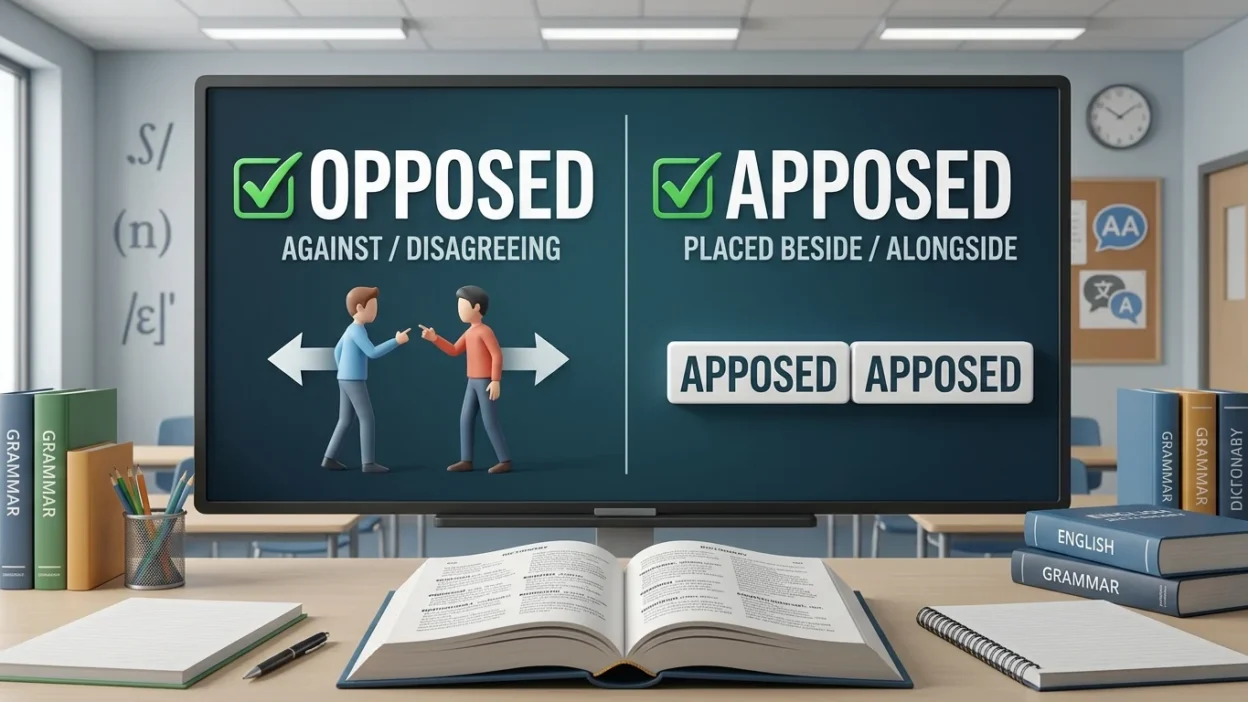
The easiest way to remember the difference is that opposed is usually connected with disagreement, resistance, or being against something, while apposed is a grammatical and technical term meaning placed next to or alongside something. Once you understand this central distinction, choosing between the two becomes much easier.
Quick Answer: Opposed vs Apposed
Opposed means against, in disagreement with, or in conflict with something. Apposed means placed next to or alongside something, especially in grammar or technical contexts.
| Word | Main Meaning | Common Use | Example |
|---|---|---|---|
| Opposed | Against or in disagreement | General English | She is opposed to the proposal. |
| Apposed | Placed beside or alongside | Grammar/technical English | The phrase is apposed to the noun. |
Simple rule to remember
- Opposed = against
- Apposed = placed beside
- They are not interchangeable.
- Opposed is common in everyday English.
- Apposed is much more specialized.
If you mean disagreement or resistance, use opposed. If you mean something positioned next to another thing, particularly in grammar, apposed may be the correct word.
What Does Opposed Mean?
Opposed is the past tense and past participle of the verb oppose. It can also function as an adjective.
The basic meaning is against something or someone.
When a person is opposed to an idea, decision, plan, or action, they do not support it.
For example:
- She is opposed to the new policy.
- Many residents were opposed to the construction project.
- He strongly opposed the proposal.
- The group is opposed to unnecessary changes.
- They were opposed to raising the fees.
The word can express anything from mild disagreement to strong resistance.
Opposed as an adjective
Opposed is often used after the verb be:
- I am opposed to the plan.
- She is opposed to the decision.
- They are opposed to the new rules.
One very important grammar pattern is:
opposed to + noun
or
opposed to + -ing form
Examples:
- He is opposed to the idea.
- She is opposed to changing the schedule.
- They are opposed to increasing taxes.
A common mistake is to use an infinitive after opposed to, but in this expression, to is a preposition.
What Does Apposed Mean?
Apposed is the past participle of appose, a much less common verb.
To appose means to place something next to, beside, or in close relation to something else.
The word is particularly associated with grammar, linguistics, anatomy, and technical writing.
In grammar, something may be described as apposed when it is placed alongside another word or phrase to provide additional information.
For example:
- The descriptive phrase is apposed to the noun.
- The title was apposed to the person’s name.
- In the sentence, the explanatory phrase is apposed to the main noun.
Because apposed is specialized vocabulary, you are much less likely to encounter it in everyday conversation than opposed.
Opposed vs Apposed: Comparison Table
| Feature | Opposed | Apposed |
|---|---|---|
| Base verb | Oppose | Appose |
| Meaning | Against or in disagreement | Placed beside or alongside |
| Commonness | Very common | Uncommon |
| Everyday English | Yes | Rarely |
| Grammar use | General grammar | Linguistics and grammar |
| Technical use | Sometimes | Frequently |
| Related noun | Opposition | Apposition |
| Example | She is opposed to the plan. | The phrase is apposed to the noun. |
The spelling difference is only one letter, but the meanings are completely different.
Opposed Meaning and Examples
The word opposed can be used in several related ways.
Opposed to an idea
When someone does not agree with an idea:
- I am opposed to the proposal.
- The committee is opposed to the change.
- She is strongly opposed to the decision.
Opposed to an action
It can also describe disagreement with something someone wants to do:
- They are opposed to building a factory nearby.
- He is opposed to changing the rules.
- Residents are opposed to closing the park.
Opposing sides
Opposed can also describe two people, groups, or forces that are on different sides of an issue or conflict.
- The two teams faced opposed strategies.
- The candidates hold opposed views on the issue.
- The groups have traditionally been opposed to each other.
In all these examples, the central idea is being against or in conflict with something.
Apposed Meaning and Examples
Apposed is mainly useful when discussing the relationship between two things that have been placed next to each other.
In grammar
Apposition occurs when a noun or noun phrase is placed beside another noun or noun phrase to identify or explain it.
For example:
My brother, Ali, lives in Lahore.
Here, Ali is in apposition to my brother because it provides additional information identifying him.
You may describe the two elements as being apposed.
In technical contexts
The word can also occur in specialized scientific or anatomical writing where two structures are positioned closely together.
Because of this specialized usage, apposed is more likely to appear in academic or technical material than in everyday English.
Opposed vs Apposed in Grammar
The distinction becomes especially useful when studying grammar.
Opposed is related to the verb oppose, meaning to resist or disagree with something.
Apposed is related to apposition, a grammatical relationship in which one element is placed beside another.
Compare:
The teacher is opposed to the new rule.
Here, opposed means against.
The noun is followed by an apposed phrase.
Here, apposed describes a grammatical relationship involving placement beside another element.
These two words may look similar, but their grammatical concepts are entirely different.
Apposed vs Opposed: Word Families
Understanding their related words can make the distinction easier.
Opposed word family
- oppose
- opposed
- opposing
- opposition
- opponent
These words are connected with disagreement, resistance, or conflict.
Apposed word family
- appose
- apposed
- apposition
- appositive
These words are connected with placing something beside or alongside another element.
A useful memory trick is:
Opposition = disagreement
Apposition = placement beside
Common Mistakes With Opposed and Apposed
Mistake 1: Using Apposed When You Mean Against
This is probably the most important error.
Incorrect:
- She is apposed to the plan.
Correct:
- She is opposed to the plan.
If you mean against, use opposed.
Mistake 2: Assuming Apposed Is a Variant of Opposed
It is not.
Apposed is not an alternative spelling of opposed. It comes from a different verb and has a different meaning.
Mistake 3: Using Opposed in a Grammatical Context
If you are specifically describing two grammatical elements placed beside each other, apposed or in apposition may be the appropriate terminology.
Mistake 4: Confusing Apposed With Approved
Because these words can sometimes look confusing when read quickly, learners may accidentally use apposed when they mean approved.
Remember:
- Approved = officially accepted
- Opposed = against
- Apposed = placed beside
These are three completely different words.
American vs British English Differences
There is no significant American vs British English spelling difference between opposed and apposed.
Both American English and British English use:
- opposed
- apposed
- oppose
- appose
- opposition
- apposition
The difference is therefore not regional.
However, the frequency of apposed may vary depending on the type of writing. It is most likely to appear in specialized academic, grammatical, linguistic, or scientific contexts.
Opposed, by contrast, is common in both American and British everyday English.
Synonyms for Opposed
Depending on the context, synonyms for opposed include:
- against
- resistant
- hostile
- disagreeing
- objecting
- contrary
- conflicting
- unwilling
- antagonistic
For example:
- She is opposed to the plan.
- She is against the plan.
- She objects to the plan.
The best synonym depends on the exact meaning and tone.
Words Related to Apposed
Because apposed is specialized, its closest related terms are:
- apposition
- appositive
- adjacent
- alongside
- next to
- juxtaposed
- positioned beside
However, these words are not always perfect substitutes.
For example, apposition has a specific grammatical meaning, while adjacent simply means nearby or next to something.
How to Remember Opposed vs Apposed
A simple memory trick can help:
Opposed = Opposition
Think:
Opposed → Opposition → Against
If you are talking about disagreement, resistance, or conflict, choose opposed.
Apposed = Apposition
Think:
Apposed → Apposition → Beside
If you are talking about a grammatical or technical element placed alongside another element, choose apposed.
This small association can make the difference much easier to remember.
FAQs
What is the difference between opposed and apposed?
Opposed means against, resistant to, or in disagreement with something. Apposed means placed next to or alongside something, especially in grammatical or technical contexts.
Is apposed a correct English word?
Yes. Apposed is a legitimate but relatively uncommon word. It is the past participle of appose and is commonly associated with apposition and specialized terminology.
Is opposed the same as against?
In many contexts, yes. If someone is opposed to an idea, they do not support it or are against it.
What does apposed mean in grammar?
In grammar, apposed describes an element placed alongside another element in an appositional relationship. The related noun is apposition.
Is apposed an American or British spelling?
Neither. Apposed is used in both American and British English. There is no major regional spelling distinction between apposed and opposed.
Is opposed to followed by a noun or verb?
The phrase opposed to is normally followed by a noun, pronoun, or -ing form when to functions as a preposition.
Examples:
- She is opposed to the idea.
- She is opposed to changing the plan.
What is the noun form of opposed?
The related noun is opposition. It refers to disagreement, resistance, or a group or position that is against something.
What is the noun related to apposed?
The related noun is apposition, which describes the grammatical or structural relationship of placing one element beside another.
Final Summary
The difference between opposed vs apposed is much easier once you focus on their meanings. Opposed means against, resistant, or in disagreement with something, and it is a common word in everyday English. Apposed, on the other hand, means placed beside or alongside something and is mainly used in grammar, linguistics, anatomy, and other specialized contexts.
There is no important American-versus-British English distinction between these words. Both varieties use opposed and apposed with the same basic meanings. The key is to remember their different word families: opposed → opposition → against, while apposed → apposition → placed beside.

Liam James is a language enthusiast and content writer at Verseslay, specializing in word comparisons, grammar debates, and vocabulary insights. He helps readers understand language nuances through clear, engaging, and practical explanations.