
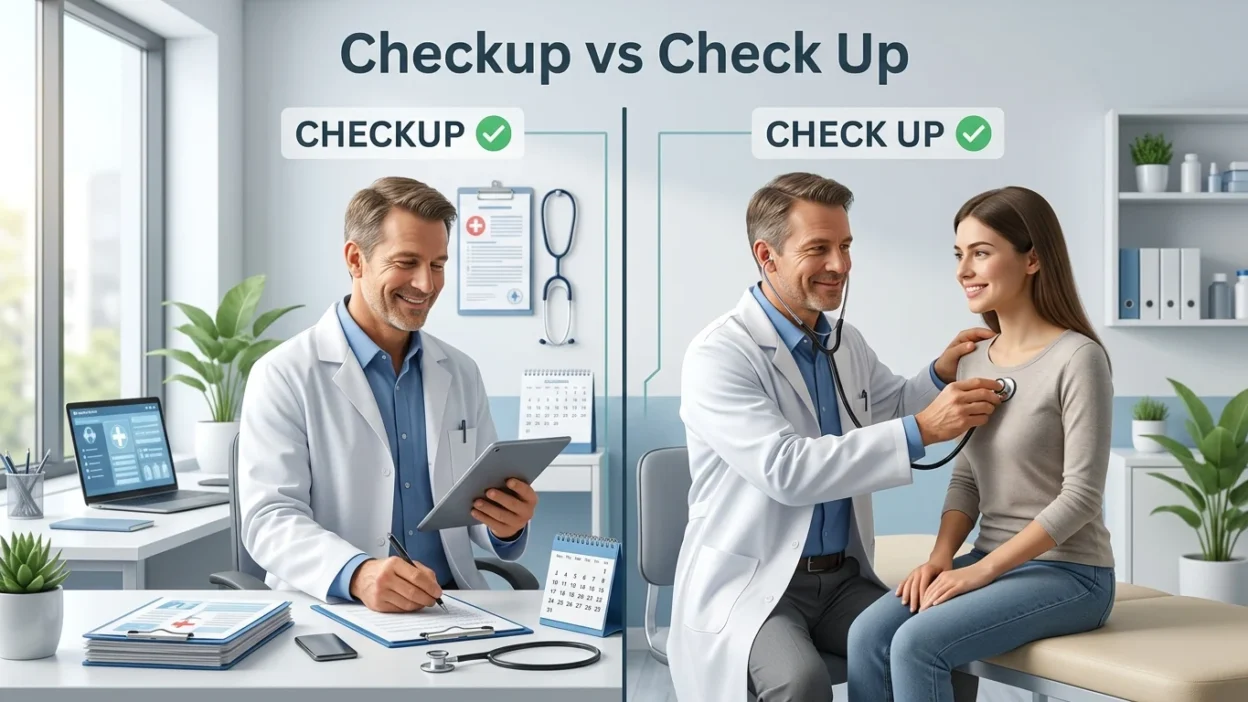
If you have ever wondered whether checkup and check up are the same, you are not alone. These two forms look almost identical, but they serve different grammatical purposes. Knowing when to write them as one word and when to write them as two words can make your English clearer and more accurate.
The good news is that the rule is quite simple once you understand the difference between a noun and a verb phrase. In this guide, we will explain checkup vs check up, show you real-world examples, discuss common mistakes, compare American and British English usage, and give you easy rules to remember.
Quick Answer
Checkup is usually a noun meaning an examination, inspection, or routine medical examination.
Check up is a verb phrase meaning to examine, investigate, or make sure something is correct or healthy.
Simple rule
Checkup = noun
I have a doctor’s checkup tomorrow.
Check up = verb phrase
The doctor will check up on me tomorrow.
A useful way to remember the difference is:
One word = the examination
Two words = the action
What Does Checkup Mean?
Checkup is a noun. It usually refers to a routine examination, particularly a medical examination designed to assess someone’s health.
For example:
I have a dental checkup next week.
The doctor recommended a regular checkup.
She went to the hospital for a routine checkup.
Although checkup is strongly associated with healthcare, the word can sometimes be used more generally to describe an examination or review.
For example:
The car needs a safety checkup.
However, in everyday English, checkup is most commonly used for medical or health-related examinations.
What Does Check Up Mean?
Check up is a verb phrase. It means to examine, investigate, verify, or make sure something is correct.
It is often followed by on when referring to a person or thing being investigated.
Examples:
The doctor will check up on the patient.
I need to check up on the delivery.
She called to check up on her children.
The manager checked up on the progress of the project.
In these examples, check up on means to investigate or make sure that everything is going properly.
Checkup vs Check Up: Main Difference
The easiest way to understand the distinction is grammatical.
| Form | Part of Speech | Meaning | Example |
|---|---|---|---|
| Checkup | Noun | An examination or medical examination | I have a checkup tomorrow. |
| Check up | Verb phrase | To examine or investigate | The doctor will check up on him. |
| Check up on | Phrasal verb | To investigate or monitor someone/something | I need to check up on the children. |
| Check | Verb/Noun | To examine or verify | Please check the report. |
The spelling changes because the grammatical function changes.
When you are naming the examination itself, checkup is generally the appropriate form.
When you are describing the action of examining or investigating, check up is used.
When Should You Use Checkup?
Use checkup when you are talking about an examination as a thing or event.
Medical Checkup
This is the most common use.
Examples:
I have a medical checkup tomorrow.
She goes for a yearly checkup.
The doctor scheduled a routine checkup.
He had a complete health checkup last month.
Dental Checkup
You can also use checkup for dental appointments.
Examples:
I have a dental checkup on Monday.
My dentist recommended a regular checkup.
She went for her six-month dental checkup.
General Examination
The word can sometimes describe other routine inspections.
Examples:
The vehicle needs a safety checkup.
The system requires a regular checkup.
However, depending on the context, words such as inspection, review, examination, or assessment may sound more natural.
When Should You Use Check Up?
Use check up when you are describing the action of examining, investigating, or verifying something.
Examples:
I need to check up on the status of my application.
The nurse checked up on the patient.
The teacher checked up on the students.
He called to check up on his friend.
The manager checked up on the project.
Notice that check up often appears as check up on.
The word on is important when you mean monitoring or investigating someone or something.
Check Up on vs Check Up
There is a useful distinction between check up and check up on.
Check up on someone/something means to investigate, monitor, or make sure everything is okay.
Examples:
I will check up on the children.
She checked up on the order.
The manager checked up on the employees.
However, in some contexts, speakers simply use check instead of check up.
For example:
I will check the information.
This is usually more natural than:
I will check up the information.
The second sentence is generally incorrect if you mean simply verify the information.
Common Mistakes With Checkup and Check Up
Mistake 1: Writing Check Up as One Word When It Is a Verb
Incorrect:
I need to checkup on my brother.
Correct:
I need to check up on my brother.
Because check up on is a verb phrase, it is written as separate words.
Mistake 2: Writing Check Up as Two Words When It Is a Noun
Incorrect:
I have a check up tomorrow.
Correct:
I have a checkup tomorrow.
Here, checkup is the name of the examination, so it is normally written as one word.
Mistake 3: Using Check Up Instead of Check
Incorrect:
Please check up the document.
Better:
Please check the document.
If you simply mean examine or verify something, check is usually the correct verb.
Use check up on when you mean investigate or monitor someone or something.
Mistake 4: Assuming Checkup Always Means Medical Examination
Although checkup is strongly associated with healthcare, it can have broader uses.
However, for non-medical contexts, inspection, assessment, review, or examination may sometimes be more precise.
Checkup vs Check-Up: What About the Hyphen?
You may also see the spelling check-up.
This hyphenated form is especially associated with some British English usage and older style conventions.
In modern American English, checkup is commonly written as one word when used as a noun.
For example:
American English:
I have a checkup tomorrow.
British English may also use:
I have a check-up tomorrow.
However, spelling conventions can vary by publication, dictionary, and style guide. The important point is that checkup and check-up can function as nouns, while check up is the verb phrase.
American vs British English Differences
There is a small spelling difference worth knowing.
American English
Checkup is commonly written as one word.
Example:
I have a medical checkup next week.
British English
Check-up has traditionally been common.
Example:
I have a medical check-up next week.
Modern British usage also increasingly accepts checkup, particularly in general digital and informal writing.
The verb remains:
check up
check up on
This distinction is important regardless of whether you are using American or British English.
Checkup vs Examination vs Inspection
These words can overlap, but they are not identical.
Checkup usually suggests a routine examination, especially medical.
Examination is broader and can refer to a detailed assessment.
Inspection usually involves carefully examining something to identify problems, defects, or compliance issues.
Compare:
The doctor gave me a checkup.
The specialist conducted a detailed examination.
The engineer performed an inspection of the building.
Choosing the most precise word makes your writing more natural.
Checkup vs Check In
Do not confuse checkup with check-in.
A checkup is an examination.
A check-in is an act of reporting your arrival or confirming your presence.
Examples:
I have a medical checkup tomorrow.
Hotel check-in begins at 2 p.m.
These words have completely different meanings.
How to Remember the Difference
Here is an easy memory trick:
If you can put a or my before the word, you probably need the noun checkup.
Examples:
- a checkup
- my checkup
- your checkup
- the checkup
If you are describing an action, use check up.
Examples:
- check up on him
- check up on the patient
- check up on the order
- check up on the situation
Think:
Checkup = thing
Check up = action
Alternatives and Related Words
Depending on your context, these words may work as alternatives:
Alternatives for Checkup
- Examination
- Health examination
- Medical examination
- Screening
- Assessment
- Inspection
- Routine examination
Alternatives for Check Up
- Examine
- Inspect
- Investigate
- Verify
- Review
- Monitor
- Look into
- Follow up on
Using synonyms can help you avoid repetition while keeping your writing precise.
FAQs
1. Is checkup one word or two?
When used as a noun, checkup is commonly written as one word in American English. British English may also use the hyphenated check-up.
2. Is check up a verb?
Yes. Check up is a verb phrase, especially when used with on, as in check up on someone.
3. Which is correct: medical checkup or medical check up?
Medical checkup is correct when referring to the examination itself. In British English, medical check-up is also commonly used.
4. Is checkup only used for medical appointments?
No. It is most commonly associated with medical examinations, but it can sometimes refer more broadly to a routine examination or review.
5. What is the difference between checkup and check up?
Checkup is a noun meaning an examination. Check up is a verb phrase meaning to investigate, examine, or monitor.
6. Should I write check up on or checkup on?
The correct verb phrase is check up on.
For example:
I need to check up on the patient.
7. Is check-up British English?
Check-up has traditionally been common in British English, while checkup is especially common in American English. Both refer to a routine examination.
8. Which form should I use in SEO content?
If you are targeting a specific keyword such as checkup vs check up, naturally use the exact keyword where appropriate, but keep the rest of the article grammatically correct and reader-friendly.
Summary
The difference between checkup vs check up is mainly grammatical. Checkup is a noun referring to an examination, especially a routine medical examination. Check up is a verb phrase describing the action of examining, investigating, or monitoring something, often followed by on.
The spelling can also vary slightly between American and British English. American English commonly uses checkup, while British English has traditionally used check-up. Regardless of the variety of English, remember that the verb phrase remains check up. Once you connect checkup with a thing and check up with an action, the distinction becomes much easier to remember.

Liam James is a language enthusiast and content writer at Verseslay, specializing in word comparisons, grammar debates, and vocabulary insights. He helps readers understand language nuances through clear, engaging, and practical explanations.