Expanding your vocabulary is one of the best ways to become a more confident English speaker and writer.
If you’re looking for verbs that start with O, you’re likely building your vocabulary, preparing for school, teaching students, or searching for stronger action words to improve your writing.
Learning verbs alphabetically is a practical method that makes new words easier to remember and use correctly.
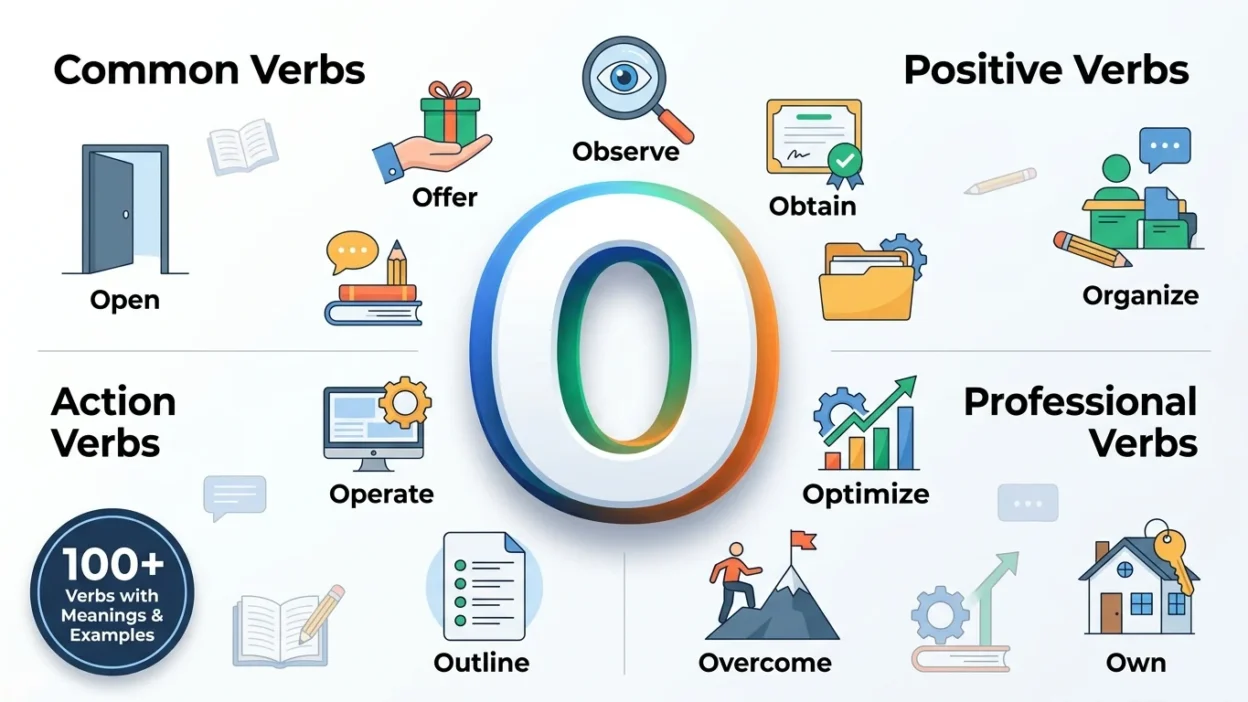
From everyday verbs like open, offer, and obey to advanced words such as optimize, originate, and overcome, the letter O includes many useful action words for conversations, academic writing, business communication, and creative storytelling.
In this guide, you’ll discover over 100 verbs that start with O, along with their meanings, examples, and practical tips for using them naturally.
Quick Answer
Verbs that start with O are action or state-of-being words that begin with the letter O.
Some of the most common examples include:
- Obey
- Observe
- Obtain
- Occupy
- Occur
- Offer
- Open
- Operate
- Oppose
- Order
- Organize
- Originate
- Overcome
- Overlook
- Own
These verbs describe actions, thoughts, communication, movement, organization, and everyday activities.
What Is a Verb?
A verb is a word that expresses an action, an event, or a state of being. Every complete sentence contains a verb because it tells us what the subject does or experiences.
Examples
- She opened the window.
- They observed the experiment carefully.
- We offered our assistance.
- He overcame every challenge.
Each highlighted word is a verb because it describes an action.
Common Verbs That Start With O
Below are some of the most frequently used verbs beginning with the letter O.
| Verb | Meaning |
|---|---|
| Obey | To follow rules or instructions |
| Observe | To watch carefully |
| Obtain | To get or acquire |
| Occupy | To take or use space |
| Occur | To happen |
| Offer | To present or give |
| Open | To make accessible |
| Operate | To control or run |
| Oppose | To resist or disagree |
| Order | To arrange or request |
| Organize | To arrange systematically |
| Originate | To begin or come from |
| Overcome | To succeed despite difficulty |
| Overlook | To fail to notice or supervise |
| Own | To possess |
These verbs are widely used in everyday conversations, classrooms, workplaces, and professional writing.
100+ Verbs That Start With O
Grouping verbs into categories makes them easier to learn and remember.
Everyday O Verbs
- Obey
- Observe
- Obtain
- Occupy
- Occur
- Offer
- Open
- Operate
- Order
- Organize
- Own
- Owe
- Outgrow
- Outlast
- Overhear
- Overlook
- Overpay
- Overtake
- Overtake
- Overwork
School and Work Verbs
- Observe
- Obtain
- Organize
- Operate
- Outline
- Originate
- Optimize
- Offer
- Oversee
- Officialize
Professional and Business Verbs
- Optimize
- Operate
- Organize
- Outsource
- Oversee
- Originate
- Offer
- Offset
- Outline
- Obtain
Advanced O Verbs
- Obliterate
- Obstruct
- Offset
- Omit
- Outperform
- Outweigh
- Overestimate
- Override
- Overrule
- Oscillate
These advanced verbs are especially useful in academic, technical, and professional writing.
Examples of Verbs That Start With O in Sentences
Using verbs in context helps you understand and remember them more effectively.
Open
- Please open the door quietly.
Offer
- She offered to help with the project.
Observe
- Scientists observe the stars every night.
Organize
- We need to organize the files before the meeting.
Operate
- He knows how to operate the machine safely.
Obtain
- You must obtain permission before entering.
Overcome
- She overcame every obstacle through determination.
Own
- They own a small family business.
Oppose
- Several members opposed the proposal.
Outline
- The teacher asked us to outline the chapter before writing the essay.
These examples show how versatile O verbs are in everyday English.
Verbs That Start With O by Category
Learning verbs by category helps you use them more naturally in different situations.
Communication Verbs
These verbs are commonly used when sharing information or expressing ideas.
- Offer
- Oppose
- Order
- Outline
- Observe
Example:
- The manager outlined the project goals during the meeting.
Movement and Action Verbs
These verbs describe physical actions or changes.
- Open
- Occupy
- Outrun
- Overtake
- Overcome
Example:
- The athlete outran every competitor in the race.
Thinking and Learning Verbs
These verbs relate to reasoning, understanding, and analysis.
- Observe
- Organize
- Outline
- Omit
- Overestimate
Example:
- Researchers carefully observed the participants’ behavior.
Improvement and Achievement Verbs
These verbs describe growth, progress, and success.
- Optimize
- Overcome
- Outperform
- Originate
- Obtain
Example:
- The new software helped optimize business operations and improve productivity.
Powerful Action Verbs That Start With O
Strong action verbs make your writing more engaging, persuasive, and professional.
Some powerful O verbs include:
- Optimize
- Overcome
- Outperform
- Operate
- Organize
- Originate
- Oversee
- Offset
- Obtain
- Outline
Example
Weak sentence:
- The team made the process better.
Stronger sentence:
- The team optimized the process to increase efficiency and reduce costs.
Replacing weak verbs with precise action verbs makes your writing clearer, more confident, and more impactful.
Positive Verbs That Start With O
Positive verbs help create an encouraging, confident, and inspiring tone. They are especially useful in leadership, education, customer service, motivational writing, and professional communication.
Here are some uplifting verbs that start with O:
- Offer
- Open
- Optimize
- Overcome
- Organize
- Obtain
- Originate
- Outperform
- Oversee
- Own
Example Sentences
- Great teachers offer support to every student.
- Small improvements can optimize your daily routine.
- Determination helps people overcome challenges.
- Good leaders organize their teams effectively.
- Hard work helps you obtain your goals.
These verbs promote growth, progress, and achievement.
Common Mistakes When Using Verbs That Start With O
Although many O verbs are straightforward, some are commonly confused or misused.
Mistake 1: Confusing Similar Verbs
Some verbs have related meanings but different uses.
Observe means to watch carefully.
- Scientists observe the stars.
Obey means to follow rules or instructions.
- Children should obey traffic signals.
Using one in place of the other changes the meaning of the sentence.
Mistake 2: Confusing “Organize” and “Order”
Organize means to arrange systematically.
- We organized the documents.
Order can mean to command or request something.
- She ordered a cup of coffee.
Although both involve arrangement in some contexts, they are not interchangeable.
Mistake 3: Using Weak Verbs
Instead of writing:
- The company made the system better.
Write:
- The company optimized the system.
- The company improved efficiency.
- The company overhauled its workflow.
Specific action verbs make your writing more engaging and professional.
Comparison Table: Common O Verbs
| Verb | Meaning | Example |
|---|---|---|
| Obey | Follow rules | Always obey traffic signs. |
| Observe | Watch carefully | Students observed the experiment. |
| Obtain | Get or acquire | She obtained a scholarship. |
| Offer | Present willingly | He offered his assistance. |
| Open | Make accessible | Please open the window. |
| Operate | Control or run | She operates heavy machinery. |
| Organize | Arrange systematically | We organized the event. |
| Outline | Summarize the main points | The speaker outlined the proposal. |
Understanding these differences helps you select the most accurate verb.
Why Learning O Verbs Improves Your Writing
Expanding your vocabulary gives you more ways to express ideas clearly and naturally.
Benefits include:
- Improving sentence variety
- Avoiding repetitive language
- Writing stronger essays and reports
- Enhancing business communication
- Developing more engaging storytelling
For example:
Instead of:
- The manager helped the team.
Try:
- The manager organized the team.
- The manager oversaw the project.
- The manager optimized the workflow.
Strong verbs make your writing more descriptive and effective.
Verbs That Start With O for Students
Learning verbs alphabetically helps students build vocabulary step by step.
Here are some beginner-friendly O verbs:
- Obey
- Observe
- Obtain
- Offer
- Open
- Operate
- Order
- Organize
- Own
- Owe
Practice Sentences
- Please open your textbook.
- We observed birds in the park.
- She offered to help me.
- They organized the classroom.
- I obtained permission from my teacher.
Writing simple sentences with new verbs helps improve retention.
Verbs That Start With O for Resume Writing
Action verbs strengthen resumes by emphasizing accomplishments and responsibilities.
Here are excellent resume verbs beginning with O:
- Optimized
- Organized
- Operated
- Obtained
- Oversaw
- Outperformed
- Originated
- Offered
- Orchestrated
- Offset
Resume Examples
- Optimized operational processes to improve efficiency.
- Oversaw a team of 20 employees.
- Organized company-wide training sessions.
- Obtained strategic partnerships with new clients.
- Outperformed quarterly sales targets by 18%.
These verbs communicate leadership, initiative, and measurable success.
American vs British English
Most verbs that start with O have the same spelling and meaning in both American and British English.
Examples include:
- Open
- Offer
- Observe
- Obtain
- Operate
- Organize
- Outline
- Overcome
However, some words related to these verbs may follow different spelling conventions.
Example
American English:
- Organize
- Organized
- Organizing
British English:
- Organise
- Organised
- Organising
Similarly:
American English:
- Optimize
British English:
- Optimise
These differences follow the common American -ize and British -ise spelling pattern. Both forms are correct, provided you use them consistently for your intended audience.
FAQs
What are verbs that start with O?
Verbs that start with O are action or state-of-being words beginning with the letter O. They describe actions, events, or conditions.
Some common examples include:
- Open
- Offer
- Observe
- Obtain
- Organize
- Operate
- Overcome
- Outline
- Oppose
- Own
These verbs are widely used in everyday conversations, school assignments, and professional communication.
What are the most common verbs that start with O?
Some of the most frequently used O verbs are:
- Obey
- Observe
- Obtain
- Occupy
- Occur
- Offer
- Open
- Operate
- Organize
- Order
- Outline
- Overcome
- Overlook
- Own
- Owe
Learning these verbs gives you a solid foundation for speaking and writing English more confidently.
Why should I learn verbs alphabetically?
Learning verbs alphabetically is an effective way to organize your vocabulary and remember new words.
Benefits include:
- Expanding your English vocabulary
- Improving writing and speaking skills
- Preparing for spelling tests and language exams
- Avoiding repetitive words
- Building confidence in communication
This method is especially helpful for students, teachers, and English learners.
What are some positive verbs that start with O?
Here are several positive O verbs:
- Offer
- Open
- Optimize
- Organize
- Obtain
- Overcome
- Outperform
- Originate
- Oversee
- Own
These verbs are excellent for motivational writing, resumes, leadership, and workplace communication.
What are some powerful action verbs that start with O?
Strong action verbs include:
- Optimize
- Overcome
- Outperform
- Operate
- Organize
- Originate
- Oversee
- Offset
- Orchestrate
- Outline
These verbs make essays, business reports, resumes, and presentations more engaging and professional.
Are verbs that start with O useful in professional writing?
Absolutely. Professionals frequently use verbs such as optimize, organize, operate, oversee, obtain, and orchestrate because they clearly describe responsibilities, achievements, and leadership skills.
How can I remember more O verbs?
You can improve your vocabulary by:
- Learning five to ten new verbs each week.
- Grouping verbs into categories.
- Writing original sentences using each verb.
- Reading books, blogs, and articles regularly.
- Reviewing vocabulary with flashcards or language-learning apps.
Regular practice helps you remember and use new words naturally.
Are there irregular verbs that start with O?
Most commonly used O verbs are regular verbs, meaning they form the past tense by adding -ed.
Examples:
| Base Form | Past Tense | Past Participle |
|---|---|---|
| Open | Opened | Opened |
| Offer | Offered | Offered |
| Observe | Observed | Observed |
| Obtain | Obtained | Obtained |
| Organize | Organized | Organized |
| Operate | Operated | Operated |
| Outline | Outlined | Outlined |
| Own | Owned | Owned |
Always check a dictionary when learning unfamiliar verbs, as some less common O verbs may have unique forms or specialized meanings.
Summary
Learning verbs that start with O is an excellent way to strengthen your English vocabulary and communicate more effectively.
From everyday verbs like open, offer, observe, and organize to advanced choices such as optimize, orchestrate, originate, and overcome, these action words help you express ideas with greater precision in conversations, academic writing, business communication, and creative projects.
Building a rich vocabulary also improves sentence variety, reduces repetition, and makes your writing more engaging.
By understanding the meanings of O verbs, practicing them in context, and replacing weak verbs with stronger alternatives, you’ll become a more confident speaker and writer in both personal and professional settings.
Actionable Takeaway
Start by mastering these 10 essential verbs that start with O:
- Obey
- Observe
- Obtain
- Offer
- Open
- Operate
- Organize
- Order
- Outline
- Overcome
Challenge yourself to write one original sentence using each verb every day. As your vocabulary grows, begin incorporating advanced verbs like optimize, orchestrate, originate, and outperform into your writing. This simple daily habit will improve your grammar, expand your vocabulary, and make your English more natural, fluent, and impactful.