Have you ever wondered whether artifact or artefact is the correct spelling? You may have seen both words in books, articles, museums, academic papers, and everyday writing. The difference can be confusing, especially when both spellings appear to describe the same object or discovery.
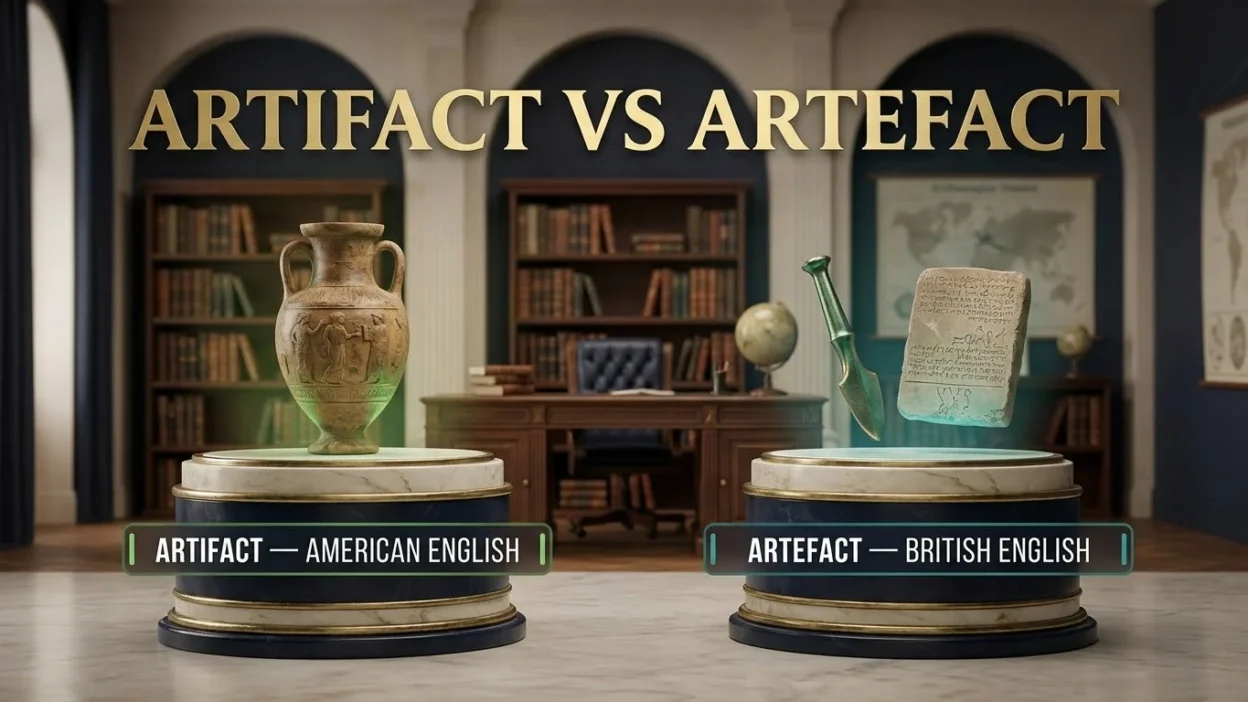
The good news is that artifact and artefact have the same meaning. The main difference is regional spelling: artifact is the standard form in American English, while artefact is commonly used in British English. Once you understand this simple distinction, you can choose the right spelling for your audience and keep your writing clear and consistent.
Quick Answer: Artifact vs Artefact
Artifact is the preferred spelling in American English, whereas artefact is the traditional and commonly accepted spelling in British English.
Both words refer to an object made, modified, or used by humans, especially one with historical, cultural, archaeological, or scientific significance. In computing and other technical fields, the words can also describe an unintended result, distortion, or feature produced by a process.
- American English: Artifact
- British English: Artefact
- Meaning: The same in both spellings
- Pronunciation: Essentially the same
- Plural forms: Artifacts and artefacts
Example: The museum displayed an ancient artifact (American English).
Example: The museum displayed an ancient artefact (British English).
Neither spelling is universally wrong. The appropriate choice depends on your preferred English variety and the style guide you follow.
What Does Artifact Mean?
An artifact is an object created, shaped, or used by humans. The word is especially common in archaeology, history, anthropology, museums, and scientific research.
Artifacts can provide valuable information about how people lived, worked, communicated, and interacted with their surroundings. They may include tools, pottery, coins, weapons, jewelry, clothing, and other objects from the past.
The word also has broader meanings in modern English. In photography, medicine, computing, and scientific research, an artifact can be an effect or feature caused by a technique, instrument, or process rather than by the thing being examined itself.
Examples of Artifact in Sentences
- Archaeologists discovered a Roman artifact buried beneath the old building.
- The museum carefully preserved a valuable artifact from ancient Egypt.
- Researchers studied each artifact to learn more about the community’s daily life.
- The image contained a digital artifact caused by compression.
- The doctor checked whether the unusual pattern was a genuine finding or an imaging artifact.
In all these sentences, artifact is the American English spelling. It is also widely used in international scientific and technical writing.
What Does Artefact Mean?
Artefact has the same meaning as artifact. It refers to a human-made object, particularly one that has historical, archaeological, artistic, or cultural importance.
This spelling is common in British English and is also used in other English-speaking contexts that follow British spelling conventions. You may encounter it in British museums, university publications, historical books, and academic research.
Examples of Artefact in Sentences
- The archaeologist uncovered a rare artefact near the ancient settlement.
- Each artefact was labeled before being placed in the museum.
- The exhibition included a beautiful artefact from the Victorian period.
- Scientists removed the imaging artefact before analyzing the results.
- The historian explained how the artefact revealed details about everyday life in the past.
These examples use artefact, the spelling commonly preferred in British English. The meaning does not change when the final spelling switches from -fact to -fact with an additional e before the ending.
Artifact vs Artefact: Key Differences
Although the two spellings are interchangeable in meaning, their regional preferences differ.
| Feature | Artifact | Artefact |
|---|---|---|
| Preferred variety | American English | British English |
| Meaning | Human-made object or process-related effect | Human-made object or process-related effect |
| Pronunciation | Usually the same | Usually the same |
| Common contexts | US museums, books, research, technology | UK museums, books, research, technology |
| Singular | Artifact | Artefact |
| Plural | Artifacts | Artefacts |
| Is it correct? | Yes | Yes |
The key distinction is spelling, not definition. If you are writing for an American audience, artifact is generally the natural choice. If your readers expect British English, artefact is usually more appropriate.
American English vs British English
Regional spelling differences are common in English. For example, American English generally uses color, while British English often uses colour. Similarly, American English prefers center, while British English generally uses centre.
The artifact vs artefact difference follows the same pattern.
American English: Artifact
In the United States, artifact is the standard spelling. It appears in school textbooks, museum descriptions, archaeological reports, technical documents, and digital media discussions.
Examples:
- The students examined an artifact from Native American history.
- The software introduced an artifact into the final image.
- The museum acquired several artifacts from the ancient world.
British English: Artefact
In British English, artefact is commonly preferred. It appears in educational resources, museum catalogs, archaeological publications, and scientific writing.
Examples:
- The students examined an artefact from British history.
- The software introduced an artefact into the final image.
- The museum acquired several artefacts from the ancient world.
Which Spelling Should You Use?
Follow these practical guidelines:
- Writing for a US audience: Use artifact.
- Writing for a UK audience: Use artefact.
- Writing for an international audience: Choose one spelling based on your publication’s style guide and use it consistently.
- Writing for a school, university, or journal: Follow the institution’s preferred spelling.
- Writing SEO content: Consider your target audience and keyword. If the target keyword is artifact vs artefact, include both forms naturally.
Consistency matters more than treating one regional spelling as incorrect.
Artifact and Artefact in Different Fields
The two spellings are not limited to historical objects. Their meanings can extend into several areas.
1. Archaeology and History
In archaeology, an artifact or artefact is an object made or modified by humans that can help researchers understand past societies.
Examples include stone tools, pottery fragments, coins, and decorative objects.
Example: The discovery of a stone artifact helped researchers understand how early humans prepared food.
2. Museums and Cultural Heritage
Museums preserve artifacts and artefacts because they offer insight into human creativity, traditions, technology, and history.
Example: Every artefact in the exhibition tells part of the region’s cultural story.
3. Computing and Digital Media
In computing, an artifact can be an unintended visual or technical result caused by processing, compression, rendering, or another operation.
Examples include pixelation in a compressed image, unwanted lines in a video, or distortions in an audio recording.
Example: The editor reduced the digital artifacts to improve image quality.
4. Medicine and Scientific Imaging
In medical imaging, an artifact is a feature that appears in an image because of the imaging process rather than the actual anatomy or condition being examined. Such features can sometimes complicate interpretation.
Example: The specialist checked whether the shadow was an imaging artifact.
In British English writing, artefact may be used in these technical contexts as well. The preferred spelling depends on the publication’s language conventions.
Common Mistakes to Avoid
Even though artifact and artefact are both correct, writers sometimes make avoidable errors.
Mistake 1: Assuming One Spelling Is Always Wrong
Incorrect assumption: Artefact is a misspelling of artifact.
Correct understanding: Both forms are accepted, with different regional preferences.
Mistake 2: Mixing Spellings in the Same Article
Using artifact in one paragraph and artefact in another can make an article look inconsistent.
Better approach: Choose one spelling according to your target audience or style guide and use it throughout the article, except when quoting an original source or preserving an official title.
Mistake 3: Thinking the Meaning Changes
The extra e does not create a different definition. Both words can describe a historical object or an unintended effect produced by a process.
Mistake 4: Confusing Artifacts With Natural Objects
In archaeology, an artifact is generally associated with human creation, modification, or use. A naturally occurring stone, for example, is not automatically an artifact simply because it is discovered at an archaeological site.
Context matters when identifying an object.
Mistake 5: Forgetting the Plural Spelling
The plural forms follow their respective spellings:
- One artifact → several artifacts
- One artefact → several artefacts
Do not combine the two forms within the same piece of writing without a clear reason.
FAQs
1. Is artifact or artefact correct?
Both are correct. Artifact is the standard American English spelling, while artefact is commonly preferred in British English.
2. What is the difference between artifact and artefact?
There is no difference in meaning. The distinction is mainly regional spelling preference.
3. Is artefact British or American?
Artefact is commonly associated with British English. It is also used in other English-speaking regions and publications that follow British spelling conventions.
4. Is artifact American English?
Yes. Artifact is the standard spelling in American English and is widely used in US academic, historical, scientific, and technical writing.
5. How do you pronounce artifact and artefact?
Both are generally pronounced the same way: AR-tuh-fakt. Pronunciation can vary slightly by accent, but the extra letter in artefact does not usually change how the word is spoken.
6. What is the plural of artifact and artefact?
The plural of artifact is artifacts, and the plural of artefact is artefacts.
7. Which spelling should I use in academic writing?
Follow the style guide required by your university, journal, or publisher. Use artifact for American English conventions and artefact for British English conventions unless the publication specifies otherwise.
8. Can artifact and artefact refer to digital images?
Yes. Both spellings can describe unwanted visual distortions or other features introduced by image processing, compression, or a technical procedure. The preferred spelling depends on the English variety being used.
Summary
The difference between artifact vs artefact is simple: both words have the same meaning, but they reflect different spelling conventions. Artifact is the standard choice in American English, while artefact is commonly used in British English. Both can refer to human-made historical objects, archaeological discoveries, and unintended effects in technical or scientific processes.
Actionable takeaway: Before publishing an article, report, or assignment, identify your target audience and choose the appropriate spelling. Use artifact for American English or artefact for British English, and keep the spelling consistent throughout your writing.