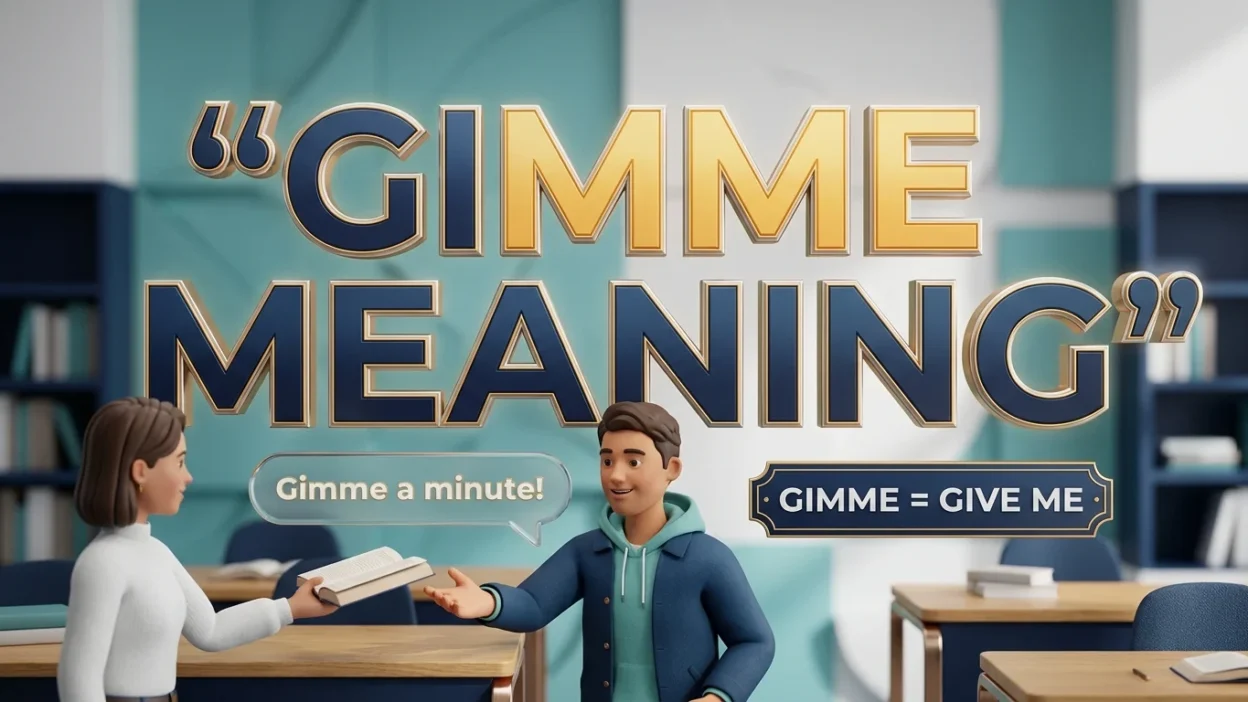
Have you ever seen someone write “Gimme a minute” or heard a person say “Gimme your phone” in a movie, song, or casual conversation? If you have wondered what gimme means, you are not alone. This informal expression is common in everyday American English, especially in conversations between friends, family members, and people who feel comfortable with each other.
Gimme means “give me.” It is an informal spelling that represents how these two words often sound when spoken quickly. You may see it in text messages, social media posts, song lyrics, and casual dialogue. However, it is important to understand when gimme sounds natural and when you should use the standard form give me instead.
Quick Answer: Gimme Meaning
Gimme is an informal way of saying or writing “give me.” People use it to ask someone for something, request a little time, or express what they want.
Examples:
- Gimme a minute. = Give me a minute.
- Gimme your phone. = Give me your phone.
- Gimme some water. = Give me some water.
- Gimme a chance. = Give me a chance.
The word is casual and conversational. In formal writing, school assignments, business emails, and professional communication, it is generally better to write give me.
What Does Gimme Mean?
The expression gimme comes from the spoken contraction of give me. When people speak quickly, the words often blend together and sound like “gimme.”
It is commonly used in informal American English, although people in other English-speaking regions may also recognize and use it.
The expression usually has a direct meaning: someone wants another person to give them something. Depending on the situation and tone, it can sound friendly, playful, impatient, demanding, or even rude.
For example, a friend might say “Gimme a minute” while finishing a task. In this situation, the speaker is simply asking for a little more time.
However, saying “Gimme your money!” to a stranger can sound aggressive or threatening. The meaning of the expression stays similar, but the context changes how it feels.
Examples of Gimme in Everyday English
Here are common examples that can help you understand how native English speakers use gimme in casual conversations.
1. Gimme a Minute
Meaning: Give me a little time.
Example:
- Person A: Are you ready to leave?
- Person B: Gimme a minute. I’m getting my shoes.
This expression is often used when someone needs a short amount of time before doing something.
2. Gimme Some Water
Meaning: Give me some water.
Example:
- After playing badminton, Ali said, “Gimme some water, please.”
This is a casual request for water. Adding please can make it sound more polite, although the standard expression “Could you give me some water, please?” is more suitable in formal situations.
3. Gimme a Chance
Meaning: Give me an opportunity.
Example:
- Gimme a chance to explain what happened.
The speaker wants an opportunity to explain something, prove a point, or show what they can do.
4. Gimme a Break
Meaning: Stop pressuring me, stop criticizing me, or give me some relief.
Example:
- Gimme a break! I have been working all day.
This phrase can also express disbelief or annoyance, depending on the situation.
5. Gimme That Book
Meaning: Give me that book.
Example:
- Gimme that book; I want to check the last page.
This is a direct, informal request. Between close friends, it might sound natural. In a formal situation, “Could you give me that book?” would usually be more appropriate.
6. Gimme a Call
Meaning: Give me a call or phone me.
Example:
- Gimme a call when you get home.
This is a casual way to ask someone to call you. The standard form “Give me a call when you get home” is also very common.
Gimme vs Give Me: What’s the Difference?
The main difference is the level of formality. Both expressions communicate the same basic idea, but they are used differently in writing.
| Feature | Gimme | Give me |
|---|---|---|
| Meaning | Give me | Give me |
| Style | Informal and conversational | Standard English |
| Common use | Casual speech, texts, dialogue | Everyday and formal communication |
| Suitable for school essays? | Usually no | Yes |
| Suitable for professional emails? | Usually no | Yes |
| Example | Gimme a second. | Give me a second. |
Use gimme when you want to reproduce casual speech or create a relaxed tone. Choose give me when you need standard spelling and grammar.
Remember that gimme is not generally treated as a standard written form in formal English. It is best understood as an informal representation of pronunciation.
Is Gimme a Real Word?
Yes, gimme is a recognized informal expression in English. It appears in dictionaries and is widely understood in casual conversation.
However, being recognized as a word does not mean it is suitable for every situation. English contains many informal expressions, including gonna (going to), wanna (want to), and kinda (kind of).
These expressions often represent natural speech, but standard forms are usually preferred in formal writing.
For example:
- Informal: Gimme a minute.
- Standard: Give me a minute.
Both are understandable, but the second is the safer choice for formal communication.
Is Gimme Polite or Rude?
The expression gimme is not automatically rude. Its tone depends on the speaker, the listener, and the situation.
It may sound friendly when used with people you know well. For example, “Gimme a second, buddy” can sound relaxed and familiar.
However, it can sound demanding if you use it with a teacher, employer, customer, or someone you do not know well.
Compare these examples:
- Casual: Gimme a minute, please.
- Polite: Could you give me a minute, please?
- Formal: Could you please allow me a moment?
If you want to sound respectful, especially when speaking to someone in authority, use a polite request rather than simply saying gimme.
Common Mistakes When Using Gimme
Understanding the meaning is easy, but learners should be careful about how and where they use the expression.
Mistake 1: Using Gimme in Formal Writing
Informal: Gimme your feedback on this report.
Better for professional writing: Please give me your feedback on this report.
Mistake 2: Thinking Gimme Means Want Me
Gimme means give me, not want me.
For example, “Gimme a chance” means “Give me a chance,” while “Want me to help?” asks whether someone would like your help.
Mistake 3: Assuming Gimme Is Always Rude
The expression can be friendly or demanding. Tone and context determine how the listener interprets it.
Mistake 4: Using Gimme in Every Conversation
Although native speakers understand gimme, standard expressions are more appropriate in academic, workplace, and formal situations.
Mistake 5: Confusing Gimme With Gonna or Wanna
These informal expressions have different meanings:
- Gimme: Give me.
- Gonna: Going to.
- Wanna: Want to.
For example, “Gimme a pen” means “Give me a pen,” while “I’m gonna leave” means “I’m going to leave.”
Gimme in Text Messages, Movies, and Songs
You may frequently encounter gimme in text messages, entertainment, and online conversations because it captures the sound of relaxed, everyday speech.
In texting, someone might write:
- Gimme 5 minutes.
- Gimme the details.
- Gimme a call later.
- Gimme a chance to explain.
In movies, the expression can make dialogue sound natural, casual, impatient, or emotionally intense. In songs, it can also fit the rhythm of the lyrics.
When reading informal dialogue, understanding gimme can help you follow the conversation without confusing it with a different English word.
FAQs
1. What does gimme mean in English?
Gimme means “give me.” It is an informal expression commonly used in casual conversation and texting.
2. Is gimme short for give me?
Yes. Gimme represents the way give me often sounds when spoken quickly.
3. Is gimme formal or informal?
It is informal. Use give me in formal writing, professional emails, academic assignments, and other situations where standard English is expected.
4. What does gimme a minute mean?
It means “give me a minute.” The speaker is asking for a little time before doing something.
5. Is gimme rude?
Not necessarily. It can sound friendly among people who know each other, but it may sound demanding in formal or unfamiliar situations.
6. What is the difference between gimme and give me?
They have the same basic meaning. Gimme is an informal spelling, while give me is the standard written form.
7. Can I use gimme in a text message?
Yes. It is common in casual text messages and conversations with friends. However, give me is a better choice when you need a more professional tone.
8. Is gimme used in British English?
People who speak British English can understand gimme, and it may appear in informal speech and writing. It is especially associated with casual spoken English and is not restricted to American speakers.
Summary
Gimme means “give me” and is an informal expression used in everyday English. You may hear it in conversations, movies, songs, and text messages. Common examples include “Gimme a minute,” “Gimme some water,” and “Gimme a chance.” Although the expression is widely understood, it can sound demanding depending on the speaker’s tone and the situation.
Actionable takeaway: Use gimme when writing casual dialogue or chatting with friends, but choose give me in formal and professional situations. Learning the difference will help you understand natural English while communicating clearly and respectfully.