
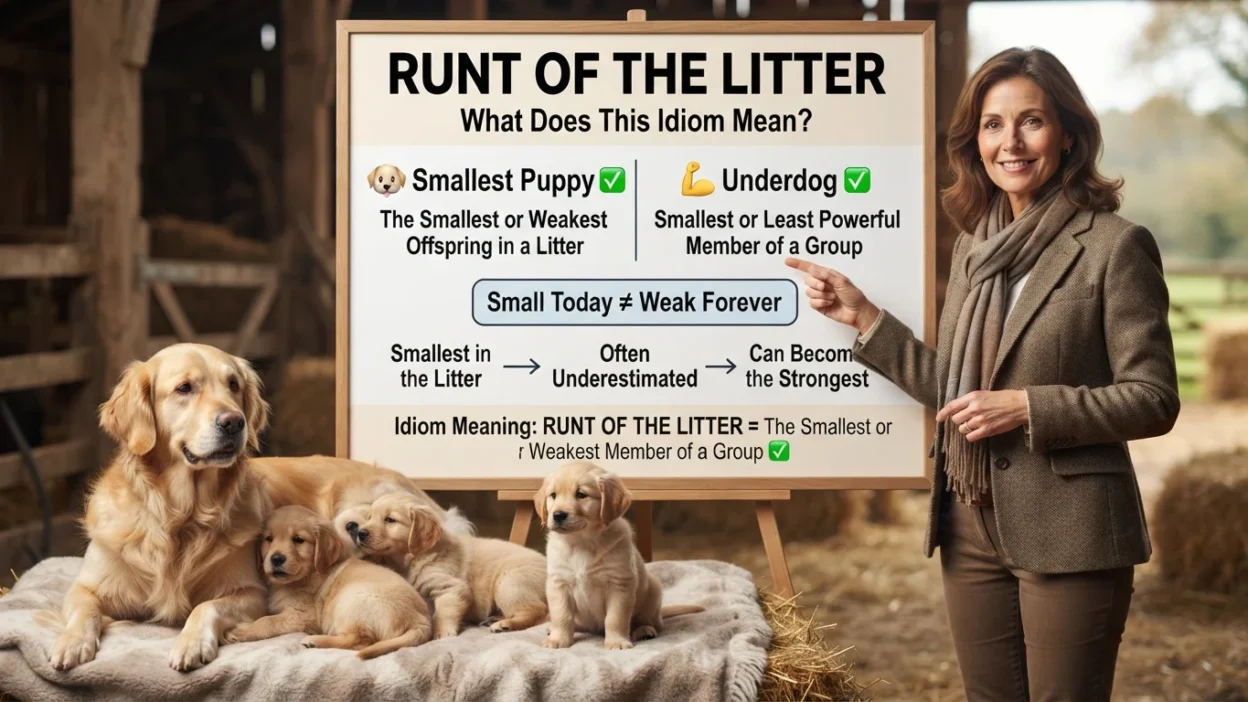
Have you ever heard someone described as the “runt of the litter“ and wondered what it really means? Although the phrase originally referred to animals, it is now commonly used in English to describe the smallest, weakest, or least successful member of a group. Depending on the context, it can be either affectionate or insulting, so understanding how to use it correctly is important.
In this guide, you’ll learn the complete meaning of runt of the litter, where the expression comes from, how it is used in everyday English, and the situations where you should avoid it. We’ll also compare literal and figurative meanings, provide real-world examples, discuss American and British English usage, and answer the most common questions about this popular idiom.
Quick Answer: What Does Runt of the Litter Mean?
The phrase runt of the litter refers to the smallest or weakest offspring born in a group of animals. Figuratively, it describes the smallest, weakest, youngest, least successful, or least powerful member of a group.
Simple Meaning
Runt of the litter = The smallest or weakest member of a group
Example
Although he was the runt of the litter, he eventually became the strongest dog.
In a figurative sentence:
Many people underestimated her because she was considered the runt of the litter, but she proved everyone wrong.
What Does “Runt of the Litter” Mean?
The expression has both a literal and a figurative meaning.
Literal Meaning
In animal breeding, the runt of the litter is the smallest or weakest baby born in the same litter of puppies, kittens, pigs, or other mammals.
Because runts are often born smaller than their siblings, they may need extra care during their early development.
Figurative Meaning
In everyday English, the idiom refers to someone or something viewed as:
- The weakest
- The smallest
- The least influential
- The least successful
- The least impressive
- The underdog
Importantly, being called the runt of the litter does not necessarily mean someone will remain weak or unsuccessful. Many stories use the phrase to highlight determination and eventual success.
Where Does “Runt of the Litter” Come From?
The expression originated in animal breeding.
A litter is a group of young animals born to the same mother at the same time.
Examples include:
- A litter of puppies
- A litter of kittens
- A litter of piglets
Within many litters, one newborn may naturally be smaller than the others. That smallest offspring became known as the runt.
Over time, English speakers borrowed the expression as a metaphor for people, organizations, businesses, sports teams, or other groups considered less powerful or less successful than their peers.
Literal vs Figurative Meaning
| Literal Meaning | Figurative Meaning |
|---|---|
| Smallest baby animal in a litter | Smallest or weakest member of a group |
| Related to animal birth | Used about people, businesses, teams, or organizations |
| Physical size | Power, influence, success, or status |
| Scientific or descriptive | Idiomatic expression |
Understanding the difference helps you recognize whether the phrase is being used literally or as an idiom.
Examples of “Runt of the Litter”
Example 1
The runt of the litter needed extra care during its first few weeks.
This is the literal meaning.
Example 2
Everyone thought their company was the runt of the litter, but it eventually became an industry leader.
The company was initially seen as the weakest competitor.
Example 3
He was the runt of the litter on the basketball team, yet he became its top scorer.
The speaker highlights unexpected success.
Example 4
The smallest puppy turned out to be the healthiest adult dog.
This reflects the idea that being the runt doesn’t determine future success.
Example 5
People underestimated her because she was considered the runt of the litter.
Here, the phrase refers to someone perceived as weaker or less capable.
How Is the Idiom Used?
The expression is often used when discussing:
- Sports teams
- Businesses
- Political groups
- Families
- Schools
- Competitions
- Animals
- Fictional characters
It frequently appears in stories where an underdog eventually succeeds.
For example:
The smallest startup was once the runt of the litter, but today it dominates the market.
This use creates a powerful contrast between humble beginnings and later success.
Is “Runt of the Litter” Negative?
Usually, yes—but not always.
The phrase can sound:
- Humorous
- Affectionate
- Sympathetic
- Critical
- Insulting
Its tone depends entirely on the context.
For example:
Our little puppy is the runt of the litter.
This may simply describe the puppy.
However:
He’s the runt of the litter at work.
This could sound insulting or dismissive.
Because of this, use the expression thoughtfully when referring to people.
Similar Expressions
Several English expressions communicate similar ideas.
| Expression | Meaning |
|---|---|
| Underdog | Person expected to lose |
| Weakest link | Least capable member |
| Small fry | Small or unimportant person |
| Lowest-ranking member | Person with the least status |
| Late bloomer | Someone who succeeds later |
| Black sheep | Family member viewed differently (different meaning) |
Although these expressions overlap in some situations, they are not perfect substitutes.
Common Mistakes
Mistake 1: Assuming the Runt Always Stays Weak
Many people think the runt always remains the weakest.
In reality, many runts grow into healthy, strong adults.
The idiom often appears in inspirational stories where the least likely candidate succeeds.
Mistake 2: Using It as a Medical Term
Although runt has a literal biological meaning, the phrase is usually an informal description rather than a medical diagnosis.
Veterinarians evaluate newborn animals using many health factors beyond size alone.
Mistake 3: Using It as a Personal Insult
Calling someone the runt of the litter may sound offensive.
In professional or formal communication, it’s usually better to choose more neutral language.
Mistake 4: Confusing “Litter” with “Trash”
The word litter has multiple meanings.
In this idiom, litter means:
A group of baby animals born together.
It does not refer to rubbish or garbage.
American English vs British English
The expression runt of the litter is understood in both American English and British English.
Its meaning remains essentially the same in both varieties.
American English may use it slightly more frequently in sports reporting, business writing, and popular media, while British English speakers also recognize the idiom, particularly in discussions involving animals or underdogs.
The grammar, spelling, and meaning remain unchanged.
When Should You Use This Idiom?
The phrase works well in:
- Informal conversations
- Storytelling
- Sports commentary
- Business articles
- Fiction
- Animal discussions
- Motivational writing
Avoid it in:
- Academic research
- Medical reports
- Legal documents
- Professional evaluations
- Sensitive workplace discussions
Choosing language appropriate to your audience helps avoid misunderstandings.
How to Remember the Meaning
A simple memory trick is:
Picture a litter of puppies.
One puppy is noticeably smaller than the others.
That puppy is the runt.
Now extend the image to any group where one member seems smaller, weaker, or less successful.
Remember:
Smallest in the litter → Weakest member of the group
This association makes the idiom much easier to remember.
FAQs
1. What does “runt of the litter” mean?
It refers to the smallest or weakest offspring in a litter of animals or, figuratively, the weakest or least successful member of a group.
2. Is “runt of the litter” an idiom?
Yes. While it has a literal meaning in animal breeding, it is also widely used as an English idiom.
3. Is being the runt always a bad thing?
No. Many runts grow into healthy, strong animals, and many figurative “runts” overcome expectations and succeed.
4. Can “runt of the litter” describe a person?
Yes, but it should be used carefully because some people may find it insulting or dismissive.
5. What is a litter?
A litter is a group of young animals born to the same mother during one birth.
6. Is the phrase common in American and British English?
Yes. Both varieties of English recognize and use the expression.
7. Can businesses be called the runt of the litter?
Yes. The idiom is often used to describe the smallest or least successful company in a competitive market.
8. Is “runt of the litter” formal?
No. It is generally considered an informal expression and is best suited to conversations, storytelling, journalism, and creative writing.
Final Summary
The phrase runt of the litter originally described the smallest or weakest baby animal in a litter. Over time, it evolved into a popular English idiom referring to the least powerful, least successful, or smallest member of a group. Although the expression often highlights weakness or disadvantage, it is also commonly associated with determination, resilience, and unexpected success.
Whether you’re discussing animals, businesses, sports teams, or people, understanding the context is essential. While the idiom is widely understood in both American and British English, it can sound negative when used about individuals. Choosing it carefully will help your communication remain respectful and effective.
Actionable Takeaway
Remember this simple rule:
Literal meaning: The smallest baby animal in a litter.
Figurative meaning: The smallest, weakest, or least successful member of a group.
Whenever you hear runt of the litter, think of an underdog rather than a permanent failure. Many of the greatest success stories begin with someone who was underestimated, making this idiom both memorable and surprisingly inspiring.