Have you ever heard someone say “might as well” and wondered whether it could be written as “mine as well” or “mind as well”? These phrases can sound surprisingly similar in fast speech, especially for English learners. However, only one of them is a standard English expression with the meaning people usually intend.
Understanding might as well vs mine as well vs mind as well is important because a small spelling mistake can completely change—or destroy—the meaning of a sentence. Whether you’re writing an email, chatting with friends, studying English, or improving your vocabulary, this guide will help you understand the correct phrase, learn how to use it naturally, and avoid common mistakes.
Quick Answer
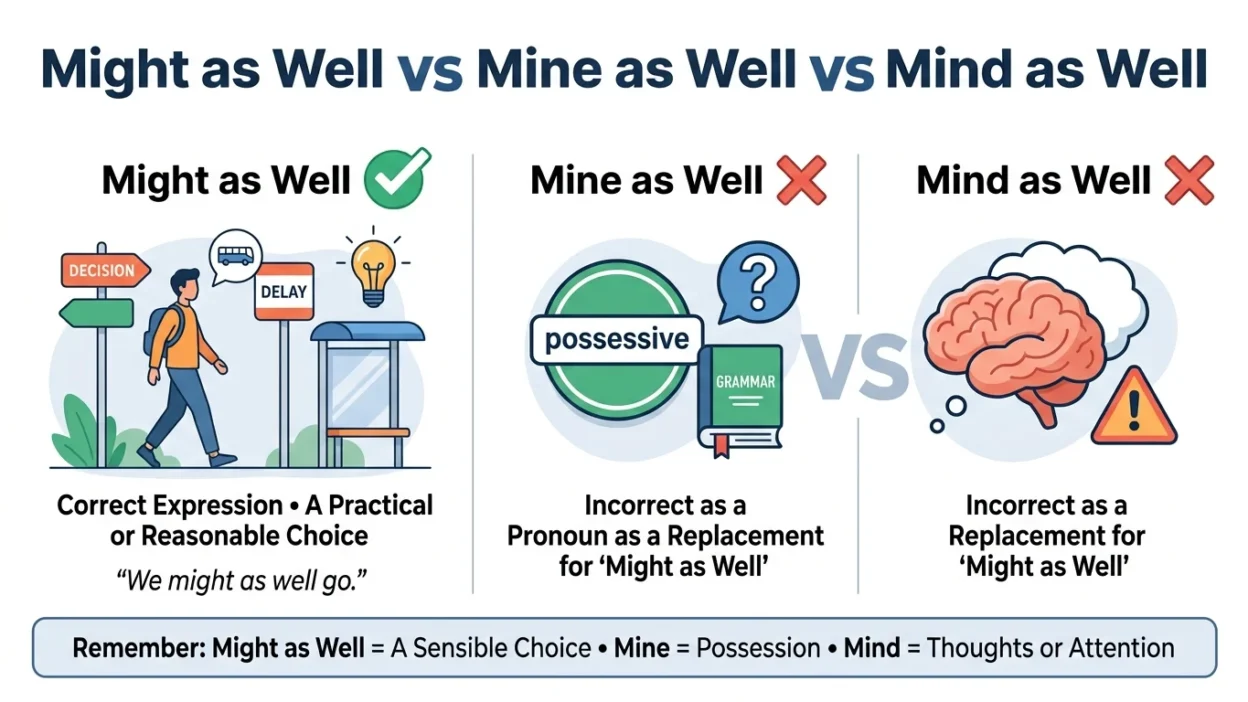
The correct phrase is might as well. ✅
It is an English expression used when you decide to do something because there is no strong reason not to do it, or because it seems like the most practical option.
- Might as well = The situation makes this a reasonable choice.
- Mine as well = ❌ Not the standard phrase intended in this context.
- Mind as well = ❌ Not the standard expression.
Example
This means staying home seems like the sensible choice under the circumstances.
What Does “Might as Well” Mean?
Might as well is an idiomatic expression used to suggest that something is a reasonable, practical, or equally good option.
It often communicates the idea:
It can also express a casual decision or suggestion.
Examples
- We have plenty of time, so we might as well walk.
- You’re already here, so you might as well come inside.
- The movie starts in ten minutes. We might as well wait.
- If you’re going to the store, you might as well buy some milk.
The expression doesn’t necessarily mean that the speaker is excited about the action. Sometimes it simply means, “Why not?”
Why Do We Say “Might as Well”?
The phrase contains the modal verb might, but it doesn’t always express uncertainty in the usual sense.
In might as well, the phrase works as a fixed expression.
For example:
The speaker isn’t necessarily saying, “Perhaps we will leave.” Instead, the meaning is closer to:
This is why might as well is often used when circumstances influence a decision.
What Does “Mine as Well” Mean?
Mine as well is not the standard phrase people mean when they use might as well.
The word mine is usually a possessive pronoun.
For example:
- This book is mine.
- That car is mine.
- Your phone is newer than mine.
Because mine refers to possession, mine as well does not normally express the idea of “we might as well do something.”
Example of Correct “Mine”
- Your bag is blue, and mine is black.
Here, mine means “my bag.”
If you write:
the sentence is incorrect because mine cannot replace might in the idiom.
What Does “Mind as Well” Mean?
Mind as well is also not the standard expression.
The word mind has several meanings in English.
It can refer to:
- The human brain or thoughts
- Paying attention
- Caring about something
- Being bothered by something
Examples:
- Do you mind if I sit here?
- I don’t mind waiting.
- Keep that in mind.
- She has a creative mind.
However, mind as well does not normally mean “might as well.”
Might as Well vs Mine as Well vs Mind as Well
Here’s a quick comparison.
| Phrase | Correct as the Intended Idiom? | Meaning | Example |
|---|---|---|---|
| Might as well | ✅ Yes | A reasonable choice under the circumstances | We might as well leave. |
| Mine as well | ❌ No | Not the standard idiomatic expression | Incorrect: We mine as well leave. |
| Mind as well | ❌ No | Not the standard idiomatic expression | Incorrect: We mind as well leave. |
The answer is simple: Use “might as well.”
How to Use “Might as Well” in Sentences
The most common structure is:
Examples:
- I might as well go now.
- We might as well stay here.
- You might as well ask him.
- They might as well wait.
- She might as well try.
Notice that the verb after might as well remains in its base form.
Correct
- We might as well go.
- You might as well try.
Incorrect
- We might as well going.
- You might as well tried.
“Might as Well” for Suggestions
You can use the expression to make a casual suggestion.
Example
The speaker suggests eating there because they’re already at the location.
Another example:
The suggestion is based on the current circumstances.
“Might as Well” When There Is No Better Option
This is one of the most common uses.
Imagine you’re waiting for a bus, but the bus is delayed for an hour.
You might say:
The meaning is that walking may be the better choice because waiting is taking too long.
Another example:
The circumstances make leaving a sensible decision.
“Might as Well” Can Sound Resigned
Sometimes the expression suggests that the speaker isn’t particularly enthusiastic but accepts the situation.
For example:
The speaker may not prefer going alone, but there seems to be no reason not to go.
Similarly:
It’s too late to change the tickets. We might as well continue with the trip.
Here, the phrase communicates acceptance of the circumstances.
Common Mistakes to Avoid
1. Writing “Mine as Well”
Incorrect:
We mine as well take the train.
Correct:
We might as well take the train.
The mistake often happens because might and mine can sound similar when spoken quickly.
2. Writing “Mind as Well”
Incorrect:
You mind as well come with us.
Correct:
You might as well come with us.
The word mind is a completely different word with different meanings.
3. Changing the Verb Form
Incorrect:
We might as well going home.
Correct:
We might as well go home.
After might, always use the base form of the verb.
4. Confusing “Might as Well” With “May as Well”
You may also hear:
We may as well leave.
This is also correct and has essentially the same meaning as might as well.
Might as Well vs May as Well
Both expressions can mean that something is a reasonable choice.
Might as Well
We might as well take a taxi.
May as Well
We may as well take a taxi.
In everyday English, might as well is extremely common. May as well is also grammatically correct but can sometimes sound slightly more formal or less conversational depending on context.
American vs British English
There is no major difference between American and British English when it comes to might as well.
Both varieties use the expression naturally.
Examples:
- American English: We might as well leave now.
- British English: We might as well leave now.
The meaning is the same.
You may also hear may as well in both varieties.
Related Words and LSI Keywords
If you’re learning English expressions, these related terms can help expand your vocabulary:
- idiomatic expressions
- English phrases
- common English expressions
- might as well meaning
- may as well meaning
- English grammar
- confusing English words
- commonly misheard phrases
- spoken English
- English vocabulary
- possessive pronouns
- modal verbs
- everyday English
Understanding these related concepts can help you recognize similar expressions in conversation and writing.
FAQs
Which is correct: might as well, mine as well, or mind as well?
Might as well is the correct expression when you mean that something is a reasonable choice under the circumstances.
What does “might as well” mean?
It means that doing something seems sensible because there is no strong reason not to do it or because there may not be a better option.
Is “mine as well” grammatically correct?
The words mine and as well can appear together in certain contexts, but mine as well is not the standard phrase used to express the meaning of might as well.
Is “mind as well” correct?
Not as a replacement for might as well. The word mind has different meanings and cannot be substituted for might in this expression.
Can I say “may as well” instead of “might as well”?
Yes. May as well is also correct and generally expresses the same idea.
What verb comes after “might as well”?
Use the base form of the verb.
Correct: We might as well go.
Incorrect: We might as well going.
Is “might as well” used in American and British English?
Yes. It is common and natural in both varieties of English.
Summary
The difference between might as well vs mine as well vs mind as well is easy to understand once you focus on meaning. Might as well is the correct and widely used English expression for saying that something is a reasonable choice, especially when there is no better alternative or when circumstances make an action seem practical. The words mine and mind have their own meanings, but neither can replace might in this common idiom.
Remember that might as well is often used in casual suggestions and everyday decisions. You might use it when you’re already somewhere, when waiting seems pointless, or when circumstances make one option just as good as another. Both American and British English use the expression in essentially the same way.