
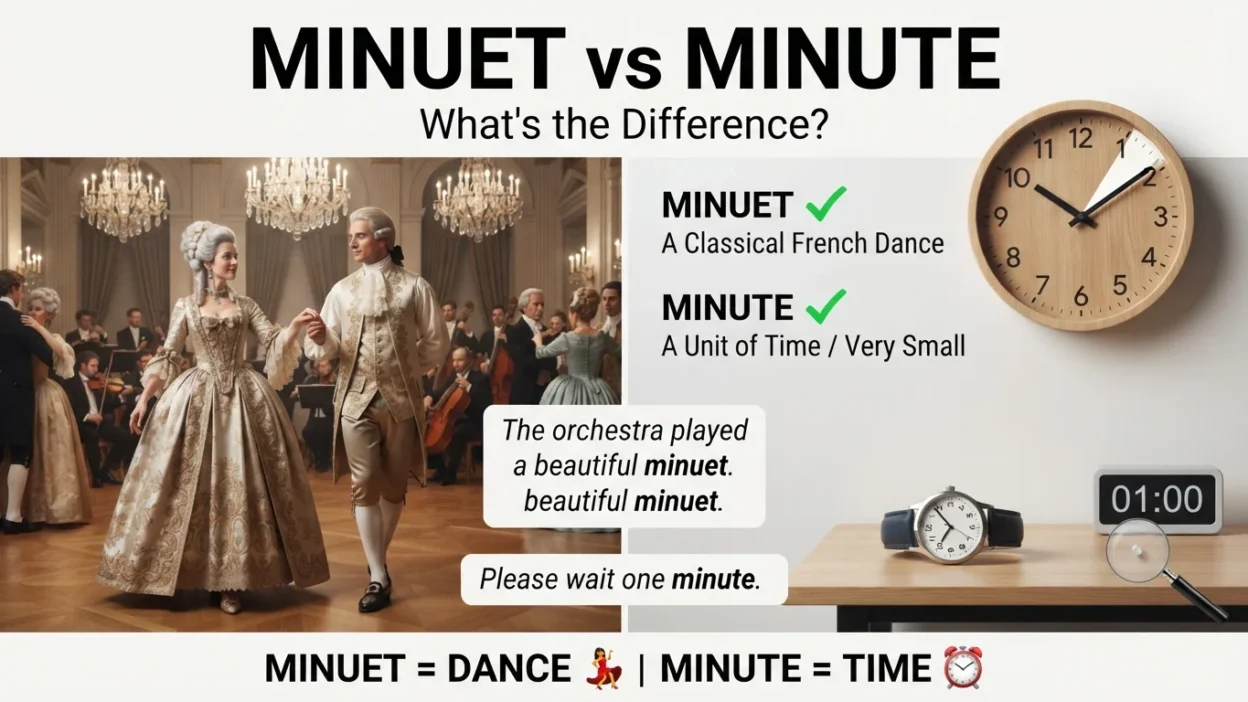
The comparison minuet vs minute can be confusing because these two words look remarkably similar but have completely different meanings and pronunciations. Many English learners accidentally mix them up, especially when reading older texts or listening to spoken English.
Fortunately, the distinction is straightforward once you understand each word. Minute usually refers to a unit of time or something extremely small, while minuet is a graceful French dance that became popular in the 17th and 18th centuries. This guide explains the meaning, pronunciation, usage, examples, and common mistakes so you can confidently choose the correct word.
Quick Answer: Minuet vs Minute
Although minuet and minute are spelled similarly, they have entirely different meanings.
- Minute usually means 60 seconds or very small.
- Minuet is a slow, elegant ballroom dance that originated in France.
Simple Rule
Use minute when talking about time or something tiny.
Use minuet when referring to the classical dance or the music written for it.
What Does “Minute” Mean?
The word minute has two common meanings.
1. Minute as a Unit of Time
A minute equals 60 seconds.
Examples:
- The meeting starts in five minutes.
- Please wait one minute.
- The movie begins in ten minutes.
This is the most common meaning.
2. Minute Meaning Very Small
When pronounced my-NOOT, minute means extremely small or tiny.
Examples:
- Scientists observed minute particles.
- There was only a minute difference between the two samples.
- The document contained minute details.
Although the spelling is identical, the pronunciation changes depending on the meaning.
What Does “Minuet” Mean?
A minuet is a slow, graceful dance that became popular in European royal courts during the 1600s and 1700s.
The word also refers to the musical composition written for that dance.
Examples:
- The dancers performed a beautiful minuet.
- Mozart composed several elegant minuets.
- The orchestra played a traditional minuet.
Today, the word is mostly found in discussions about:
- Classical music
- European history
- Ballroom dancing
- Music education
Minuet vs Minute Comparison Table
| Feature | Minuet | Minute |
|---|---|---|
| Part of speech | Noun | Noun or adjective |
| Meaning | Classical French dance | Unit of time or very small |
| Pronunciation | min-yoo-ET | MIN-it (time), my-NOOT (small) |
| Common context | Music, dance, history | Everyday conversation, science, time |
| Modern usage | Relatively uncommon | Extremely common |
The two words are unrelated in meaning despite their similar spelling.
Pronunciation Difference
Correct pronunciation helps avoid confusion.
Minuet
Pronounced:
min-yoo-ET
The stress falls on the final syllable.
Minute (Time)
Pronounced:
MIN-it
Example:
“I’ll be there in one minute.”
Minute (Very Small)
Pronounced:
my-NOOT
Example:
“There was a minute crack in the glass.”
The different pronunciations make spoken English much clearer.
Examples of “Minute”
Here are several examples using minute.
Example 1: Time
Please give me one minute.
Example 2: Waiting
The train will arrive in three minutes.
Example 3: Cooking
Boil the pasta for eight minutes.
Example 4: Small Detail
The microscope revealed minute organisms.
Example 5: Scientific Writing
Researchers measured minute changes in temperature.
Notice that the meaning changes depending on the pronunciation and context.
Examples of “Minuet”
Now let’s look at examples using minuet.
Example 1: Dance
The dancers practiced a traditional minuet.
Example 2: Music
The orchestra performed a Mozart minuet.
Example 3: History
Royal families often enjoyed the minuet during formal celebrations.
Example 4: Music Lesson
The piano student learned a simple minuet.
Example 5: Concert
The concert concluded with a beautiful minuet.
Common Mistakes
Mistake 1: Using “Minuet” Instead of “Minute”
Incorrect:
“I’ll be there in five minuets.”
Correct:
“I’ll be there in five minutes.”
The dance cannot replace the unit of time.
Mistake 2: Confusing the Pronunciation of “Minute”
Remember:
MIN-it = time
my-NOOT = extremely small
Examples:
The meeting lasted one minute.
There was a minute scratch on the surface.
Mistake 3: Assuming the Words Are Related
Although minuet and minute look alike, they come from different historical backgrounds and have different meanings.
One refers to music and dance.
The other refers to time or small size.
Mistake 4: Misspelling “Minuet”
People sometimes write:
- minuette
- minuett
- minute
The correct spelling is:
minuet
Minuet vs Minute in Everyday English
You’ll encounter minute almost every day because it appears in conversations about:
- Time
- Schedules
- Cooking
- Sports
- Meetings
- Travel
- Science
Examples:
The meeting lasted twenty minutes.
I’ll call you in a minute.
There was only a minute difference.
By contrast, minuet is much less common.
You’ll usually see it in:
- Classical music books
- Dance history
- Music performances
- Historical novels
- Educational materials
Memory Trick
Here’s an easy way to remember the difference.
Minute = Time
Think of a clock.
Minutes appear on every clock.
Minuet = Dance
Think of the ending:
-et
Imagine an elegant dancer performing on a stage.
This simple association makes the words much easier to remember.
American vs British English
There is virtually no difference between American and British English regarding these words.
Both varieties use:
Minute
- For time
- For something extremely small
Both also recognize minuet as the name of the historical dance and musical form.
The only slight difference is frequency.
Because minuet mainly appears in classical music and historical discussions, most people in both countries encounter it less often than minute.
When Should You Use Each Word?
Choose minute when talking about:
- Time
- Seconds
- Waiting
- Schedules
- Tiny details
- Scientific descriptions
Examples:
The lecture lasted forty-five minutes.
Scientists detected minute particles.
Choose minuet when talking about:
- Classical dance
- Baroque music
- Mozart
- Historical ballroom dancing
- Musical compositions
Examples:
The orchestra played a delightful minuet.
Students learned the minuet during dance class.
FAQs
1. What is the difference between minuet and minute?
Minute refers to a unit of time or something extremely small, while minuet is a traditional French dance and the music written for it.
2. How do you pronounce minuet?
Minuet is pronounced min-yoo-ET, with the stress on the last syllable.
3. Is minuet still used today?
Yes, but mainly in discussions of classical music, dance, and history rather than everyday conversation.
4. Why is “minute” pronounced differently?
The pronunciation depends on the meaning.
MIN-it refers to time.
my-NOOT means extremely small.
5. Is minuet related to minute?
No. Despite their similar spelling, they have different meanings, pronunciations, and historical origins.
6. Which word is more common?
Minute is far more common because it is used in everyday speech.
7. Can “minute” be an adjective?
Yes.
When pronounced my-NOOT, it functions as an adjective meaning very small.
8. Is a minuet a type of music?
Yes.
A minuet refers both to the elegant dance and the musical composition written to accompany it.
Final Summary
The difference between minuet vs minute is much easier than it first appears. Minute is one of the most common English words and usually refers to 60 seconds or, when pronounced differently, something extremely small. In contrast, minuet is a specialized term describing a graceful French ballroom dance and the music written for it. Although the words look similar, they are unrelated in meaning and pronunciation.
The easiest way to avoid confusion is to focus on the context. If you’re discussing time, schedules, or tiny details, the correct word is minute. If you’re reading about classical music, European history, or traditional dances, the correct word is minuet. Once you connect minute with clocks and minuet with dancing, choosing the right word becomes simple.