
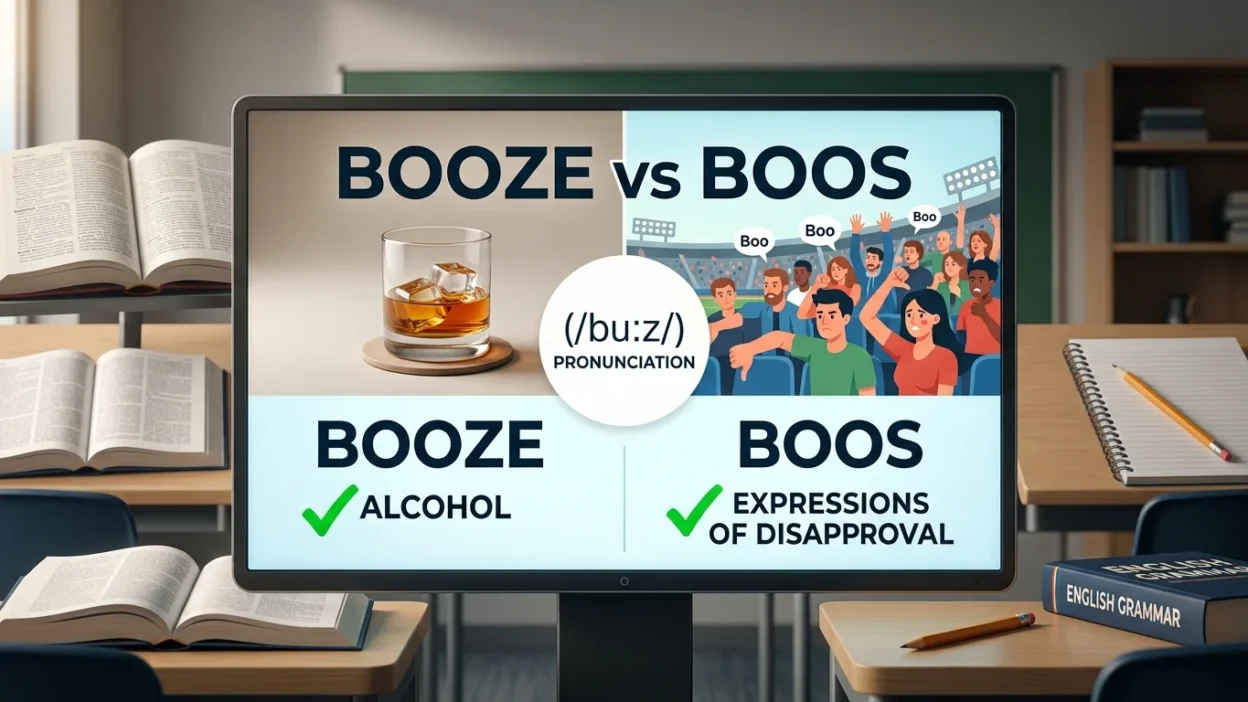
Have you ever seen the words booze and boos and wondered whether they have the same meaning? They look and sound similar, but they are actually very different words. One is commonly associated with alcoholic drinks, while the other is related to expressions of disapproval from an audience.
Understanding the difference between booze vs boos is useful because these words can easily be confused in writing. The pronunciation is also different, especially because the final sounds are not the same. Once you understand what each word means and how it is used, choosing the right spelling becomes simple.
Quick Answer: Booze vs Boos
Booze is an informal word meaning alcohol or alcoholic drinks. Boos is the plural or third-person singular form of boo, referring to expressions of disapproval, or the act of saying boo to someone.
| Word | Meaning | Part of Speech | Example |
|---|---|---|---|
| Booze | Alcoholic drinks | Noun / informal verb | He doesn’t drink booze. |
| Boos | Expressions of disapproval or jeering sounds | Noun / verb | The player heard loud boos. |
Simple rule
- Booze = alcohol
- Boos = sounds of disapproval
- Booze rhymes with choose
- Boos rhymes with news
- They have different meanings and different pronunciations.
If you are talking about alcoholic drinks, use booze. If you are talking about people shouting or making sounds of disapproval, use boos.
What Does Booze Mean?
Booze is an informal word for alcoholic drinks.
It can refer to alcoholic beverages in general rather than one specific type of drink.
For example:
- He doesn’t drink booze.
- There was too much booze at the party.
- They bought some booze for the celebration.
- The restaurant does not serve booze.
- He gave up booze several years ago.
In these examples, booze means alcohol.
The word is informal, so it is more common in casual conversations, popular culture, informal writing, and dialogue than in formal or professional writing.
Booze as a verb
Booze can also be used as a verb meaning to drink alcohol, especially heavily or socially.
Examples:
- They spent the evening boozing.
- He used to booze with his friends.
- The characters in the movie were boozing at a bar.
The noun booze is generally more common in everyday usage than the verb.
What Does Boos Mean?
Boos comes from the word boo.
A boo is a sound people make to show disapproval, disagreement, or dislike, especially toward a performer, player, speaker, or team.
The plural form is boos.
For example:
- The player was greeted with loud boos.
- The singer heard boos from part of the audience.
- The referee faced boos from the crowd.
- The politician was met with boos during the speech.
In each example, boos refers to sounds of disapproval.
Boos as a verb
Boos can also be the third-person singular form of the verb boo.
For example:
- The crowd boos the referee.
- The audience boos when the decision is announced.
- The crowd boos whenever the player touches the ball.
Here, boos describes an action rather than a noun.
Booze vs Boos: Comparison Table
| Feature | Booze | Boos |
|---|---|---|
| Basic meaning | Alcohol | Sounds/actions of disapproval |
| Base word | Booze | Boo |
| Common part of speech | Noun | Noun / verb |
| Informal? | Yes | Usually casual |
| Pronunciation | /buːz/ | /buːz/ |
| Meaning in context | Alcoholic drinks or drinking | Jeering or expressing disapproval |
| Example | They bought some booze. | The crowd gave the team boos. |
Interestingly, booze and boos are usually pronounced the same: /buːz/.
This means that context becomes especially important when you hear the words spoken.
Are Booze and Boos Pronounced the Same?
Yes. In standard English pronunciation, booze and boos are homophones or near-identical in pronunciation.
Both are generally pronounced like booz.
The spelling is different because the words come from different origins and have completely different meanings.
Compare:
Booze → alcohol
Boos → sounds of disapproval
This is an excellent example of why English spelling can be confusing. Two words can sound the same while having completely different meanings and spellings.
Examples of Booze in Sentences
Here are some natural examples using booze:
- They brought some booze to the party.
- He decided to stop drinking booze.
- The store sells a wide range of booze.
- There was plenty of booze at the celebration.
- She avoids booze during the week.
- The hotel has a bar that serves booze.
- They talked about the amount of booze being served.
Remember that booze is an informal term. In formal writing, terms such as alcohol, alcoholic beverages, or alcoholic drinks are usually more appropriate.
Examples of Boos in Sentences
Now look at boos:
- The referee was met with loud boos.
- The actor received boos from part of the audience.
- The player heard boos after missing the penalty.
- The crowd erupted in boos when the decision was announced.
- The politician faced boos during the speech.
- The team walked off the field to a chorus of boos.
In these examples, boos refers to expressions of disapproval.
Booze vs Boo
It is also helpful to understand the relationship between boos and boo.
Boo can be a noun:
The crowd gave the referee a loud boo.
It can also be a verb:
The crowd began to boo the referee.
The third-person singular form is:
The crowd boos the referee.
The plural noun is:
The crowd gave him several boos.
So:
- Boo = one sound or the base verb
- Boos = multiple sounds or third-person singular verb
- Booze = alcohol
Common Mistakes With Booze and Boos
Mistake 1: Using Boos When You Mean Alcohol
Incorrect:
We bought some boos for the party.
If you mean alcoholic drinks, the correct spelling is:
We bought some booze for the party.
Mistake 2: Using Booze for Audience Disapproval
Incorrect:
The referee received loud booze from the crowd.
Correct:
The referee received loud boos from the crowd.
Here, the crowd is expressing disapproval, so boos is correct.
Mistake 3: Thinking the Pronunciation Tells You the Spelling
Because booze and boos sound the same, listening alone cannot tell you which spelling to use.
You need to understand the context.
Mistake 4: Using Booze in Formal Writing
Although booze is a well-established English word, it is informal.
In formal writing, use:
- Alcohol
- Alcoholic drinks
- Alcoholic beverages
For example:
Informal:
The restaurant serves booze.
More formal:
The restaurant serves alcoholic beverages.
American vs British English Differences
Both booze and boos are used in American English and British English.
There is no major spelling difference between the two varieties.
However, booze is informal in both varieties and may be more common in casual speech, entertainment, journalism, and popular culture.
Boos is also widely understood and used in both American and British English, particularly in sports, entertainment, politics, and public performances.
Examples:
American English:
The crowd gave the player loud boos.
British English:
The crowd gave the player loud boos.
The meaning remains the same.
Synonyms for Booze
Depending on the context, informal or neutral alternatives for booze include:
- Alcohol
- Alcoholic drinks
- Alcoholic beverages
- Drinks
- Liquor
- Spirits
- Beer
- Wine
These words are not always exact synonyms because some refer to particular categories of alcoholic beverages.
For formal writing, alcohol or alcoholic beverages is usually the safest choice.
Synonyms and Related Words for Boos
Words related to boos include:
- Jeers
- Catcalls
- Taunts
- Disapproval
- Derision
- Mockery
- Heckling
Again, these words are not always exact synonyms.
For example, jeers can involve mocking or insulting sounds, while boos specifically refer to the familiar sound used to express disapproval.
Why Context Matters
Because booze and boos sound the same, context is the key to understanding them.
Consider these two sentences:
There was a lot of booze at the party.
You immediately know the subject is alcohol.
Now:
There were loud boos at the stadium.
You know that the audience was expressing disapproval.
The surrounding words make the intended meaning clear.
This is common in English because many words have identical pronunciations but different spellings and meanings.
Is Booze a Formal Word?
No. Booze is generally considered informal.
It is perfectly understandable and widely used, but it may not be appropriate in formal academic or professional writing.
Instead of:
The study examined people’s attitudes toward booze.
A formal version might be:
The study examined people’s attitudes toward alcohol.
The second sentence is more neutral and professional.
Is Boo a Negative Word?
Not always.
Boo can express disapproval, but it can also be used playfully.
For example, children may say boo to surprise someone, or a person may jokingly say boo to scare a friend.
However, boos from an audience usually indicate disapproval or dissatisfaction.
For example:
The referee was met with boos.
This clearly suggests that the audience was unhappy with the referee’s decision.
FAQs
What is the difference between booze and boos?
Booze means alcohol or alcoholic drinks, while boos refers to sounds or expressions of disapproval. They have different meanings but are generally pronounced the same.
Are booze and boos pronounced the same?
Yes. In standard English, both are generally pronounced /buːz/.
Is booze a formal word?
No. Booze is an informal term for alcohol. In formal writing, alcohol or alcoholic beverages is usually more appropriate.
What does boos mean?
Boos can mean multiple expressions of disapproval, such as sounds made by an unhappy audience. It can also be the third-person singular form of the verb boo.
Is booze American or British English?
Booze is used in both American and British English. It is an informal term rather than a regional spelling difference.
Why do booze and boos sound the same?
They are pronounced the same because their spelling differences do not change the vowel and final consonant sounds in standard pronunciation.
Can booze be used as a verb?
Yes. Booze can be used informally as a verb meaning to drink alcohol, particularly in a social or excessive way.
What is a formal alternative to booze?
The most suitable formal alternatives are alcohol, alcoholic drinks, and alcoholic beverages, depending on the context.
Final Summary
The difference between booze vs boos is simple once you focus on meaning. Booze is an informal word for alcohol or alcoholic drinks, while boos refers to sounds or expressions of disapproval. Interestingly, the two words are generally pronounced exactly the same, making them a useful example of English homophones and spelling differences.
There is no major American-versus-British English distinction between these words. Both are used in American and British English. The main thing to remember is context: if you are talking about alcohol, use booze; if you are talking about an unhappy audience or expressions of disapproval, use boos.