
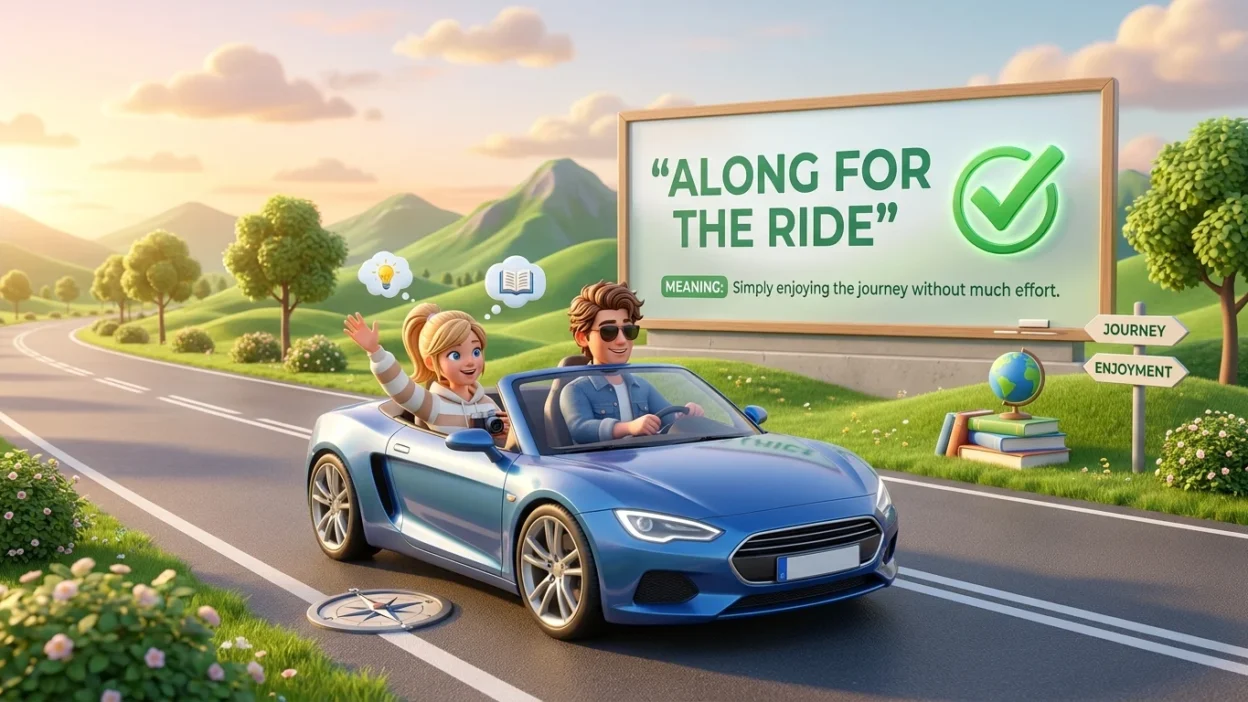
Have you ever heard someone say, “I’m just along for the ride,” and wondered what they really meant? This common English expression is often used in everyday conversations, movies, books, and social situations. Although it sounds like someone is physically traveling in a vehicle, its meaning can be much broader.
The phrase “along for the ride” usually describes someone who participates in an experience, situation, or journey without being the person making the main decisions or controlling what happens. Depending on the context, it can express excitement, support, acceptance, or a relaxed attitude toward life. In this guide, you will learn the meaning of along for the ride, explore practical examples, discover similar expressions, and understand how to use it naturally in English.
Quick Answer: What Does Along for the Ride Mean?
“Along for the ride” means participating in an experience or situation without necessarily controlling it or taking the lead.
The expression can be used literally when someone accompanies another person on a journey, or figuratively when someone shares an experience without being responsible for its direction.
Examples:
- “My friends planned the entire trip, and I was just along for the ride.”
- “She is leading the project, but I’m happy to be along for the ride.”
- “Life has been unpredictable lately, so I’m just along for the ride.”
In simple words, it means going with the flow, joining an experience, or being part of something without being in charge.
What Is the Meaning of Along for the Ride?
The idiom “along for the ride” has both a literal and a figurative meaning. Understanding the context helps you determine which meaning the speaker intends.
1. Literal Meaning
In its literal sense, “along for the ride” means accompanying someone on a journey, usually in a car or another vehicle, without being the person driving.
For example:
“My brother is driving to the market, and I’m coming along for the ride.”
This means the speaker is accompanying their brother but is not responsible for driving.
2. Figurative Meaning
The figurative meaning is more common in everyday conversations. It describes being involved in an activity, relationship, project, or life experience without having control over its direction.
For example:
“My colleagues are organizing the event, and I’m just along for the ride.”
Here, the speaker is participating in the event but is not responsible for planning or making important decisions.
The expression does not necessarily suggest a lack of interest. Someone can be enthusiastic, supportive, and fully engaged while allowing another person to take the lead.
How to Use Along for the Ride in a Sentence
You can use “along for the ride” in casual conversations, personal stories, workplace discussions, and situations involving relationships or personal experiences.
Here are some common ways to use the phrase.
1. When Someone Else Is Making the Decisions
Use the expression when another person is in charge and you are happy to follow their lead.
Example: “You choose the restaurant. I’m just along for the ride.”
Meaning: The speaker does not want to make the decision and is comfortable letting someone else choose.
2. When Sharing an Experience
The phrase can describe joining someone else’s adventure, activity, or project.
Example: “My best friend started a travel blog, and now I’m along for the ride.”
Meaning: The speaker is sharing the experience of the friend’s new project.
3. When Accepting Uncertainty
Sometimes, people use the phrase to describe allowing events to unfold without trying to control every detail.
Example: “I don’t know where this opportunity will lead, but I’m along for the ride.”
Meaning: The speaker is open to the experience despite not knowing the outcome.
4. When Supporting Someone
You can also use the idiom when you are supporting another person’s plans or ambitions.
Example: “It’s your dream, and I’ll be along for the ride as you work toward it.”
Meaning: The speaker intends to support the other person throughout their journey.
10 Everyday Examples of Along for the Ride
The following sentences show how this idiom works in different situations.
- Road trip: “My cousins are planning a road trip, and I’m just along for the ride.”
- Friendship: “My best friend has exciting plans, and I’m happy to be along for the ride.”
- Workplace: “The manager is leading the project, while I’m along for the ride and learning new skills.”
- Relationship: “He has big dreams for the future, and she is excited to be along for the ride.”
- Life: “I cannot predict what will happen next, so I’m just along for the ride.”
- Business: “My sister started her own business, and I’ve been along for the ride since day one.”
- Travel: “Everyone else knows the destination, but I’m just along for the ride.”
- Sports: “My friends follow every match closely, and I’m along for the ride because I enjoy their company.”
- Family: “My parents planned the family vacation, and I was happy to be along for the ride.”
- Personal growth: “This new chapter of my life is full of surprises, and I’m ready to be along for the ride.”
These examples demonstrate that the phrase can communicate different feelings depending on the situation. It may sound relaxed, enthusiastic, supportive, or slightly passive.
Is Along for the Ride Positive or Negative?
The expression “along for the ride” is generally neutral. Its emotional meaning depends on the speaker’s tone and the surrounding conversation.
Positive Meaning
The phrase can express excitement, trust, companionship, or willingness to experience something new.
Example: “You’ve worked so hard for this opportunity, and I’m proud to be along for the ride.”
Here, the speaker feels happy to share another person’s journey.
Neutral Meaning
It can simply mean that someone is participating without taking responsibility for decisions.
Example: “I’m along for the ride while the team decides how to proceed.”
This statement does not necessarily communicate a strong positive or negative emotion.
Negative Meaning
In certain contexts, the phrase can suggest that someone is passive, uninvolved in decision-making, or merely present.
Example: “Everyone else is doing the work, and he’s just along for the ride.”
This sentence may imply that the person is benefiting from the group’s efforts without contributing much.
Remember: The idiom itself is not automatically positive or negative. The situation and the speaker’s intention determine its meaning.
Along for the Ride: Synonyms and Similar Expressions
Several English expressions have meanings similar to “along for the ride,” but they are not always interchangeable.
| Expression | Meaning | Example |
|---|---|---|
| Going with the flow | Accepting events without trying to control everything | “I’m going with the flow this year.” |
| Tagging along | Joining someone, often informally | “Can I tag along with you?” |
| Following someone’s lead | Letting another person guide the situation | “I’ll follow your lead.” |
| Along for the journey | Sharing an experience or process | “I’m happy to be along for the journey.” |
| Riding along | Accompanying someone in a vehicle | “I rode along with my brother.” |
| Taking a back seat | Taking a less active role | “I’ll take a back seat during the planning.” |
| Being part of the adventure | Participating in an exciting experience | “I’m glad to be part of the adventure.” |
Along for the Ride vs. Going with the Flow
“Along for the ride” emphasizes participating in an experience without necessarily directing it. “Going with the flow” emphasizes accepting circumstances as they develop instead of resisting or controlling them.
Example:
- “I’m along for the ride while my friends plan the trip.” (I’m participating without leading.)
- “I’m going with the flow and will enjoy whatever happens.” (I’m accepting the situation as it unfolds.)
Along for the Ride vs. Tagging Along
“Tagging along” usually means joining another person or group, sometimes without having been part of the original plan. “Along for the ride” can describe a broader experience, including long-term projects, relationships, or life changes.
Example:
- “Can I tag along when you visit your cousins?”
- “I’ve been along for the ride since my friend launched her company.”
Common Mistakes to Avoid
Although “along for the ride” is easy to understand, English learners sometimes use it incorrectly.
Mistake 1: Assuming It Always Means Traveling
Incorrect understanding: “Along for the ride” only refers to sitting in a car.
Correct understanding: The expression can describe physical travel or figurative participation in an experience.
Example: “I’ve been along for the ride throughout his career.”
This sentence refers to sharing someone’s professional journey, not necessarily traveling with them.
Mistake 2: Confusing It With Being Completely Uninvolved
Someone who is along for the ride may still participate, offer support, and contribute to an experience. The expression does not automatically mean that the person is doing nothing.
Example: “I’m along for the ride, but I’ll help wherever I can.”
This sentence shows that participation and support are possible even when someone is not in charge.
Mistake 3: Using It in Place of Every Similar Idiom
Not every situation involving acceptance or companionship calls for this phrase.
For example, “I’m going with the flow” is more natural when discussing a flexible attitude toward unexpected changes. “I’m tagging along” is often better when asking to join a group.
Choose the expression that best matches your intended meaning.
Mistake 4: Forgetting the Word “For”
The standard expression is “along for the ride,” not “along the ride” when you intend to use this idiom.
Correct: “I’m happy to be along for the ride.”
Incorrect: “I’m happy to be along the ride.”
The word “for” is an essential part of the expression.
American vs. British English: Is There a Difference?
“Along for the ride” is understood in both American English and British English. Its basic meaning remains the same, and there is no major difference in spelling or grammatical usage.
In American English, the expression is common in informal conversations about road trips, relationships, work, and personal experiences.
Example: “I’m just along for the ride while they figure everything out.”
British English speakers also use the expression naturally, particularly when discussing shared experiences or situations in which someone is not taking the lead.
Example: “I’m happy to be along for the ride while the others make the arrangements.”
The phrase is informal and suitable for everyday speech, messages, storytelling, and relaxed workplace conversations. In formal writing, alternatives such as “participating without leading” or “taking a supporting role” may be more precise.
FAQs
1. What does along for the ride mean in simple words?
It means being part of an experience without being the person who controls or directs it. For example, you might join a trip that someone else has planned.
2. Is along for the ride an idiom?
Yes. “Along for the ride” is a common English idiom. Although it can refer literally to traveling with someone, it is often used figuratively to describe participation in an experience.
3. What does I’m just along for the ride mean?
It means the speaker is participating but is not making the main decisions. Depending on the context, it can suggest that the person is relaxed, happy to follow someone else’s lead, or not directly involved in planning.
4. Is along for the ride a positive expression?
It can be positive, neutral, or negative. It may express excitement about sharing an experience, simply describe someone’s role, or suggest that someone is not contributing much.
5. What is another way to say along for the ride?
Similar expressions include “going with the flow,” “tagging along,” “following someone’s lead,” and “being part of the journey.” The best alternative depends on the context.
6. Can I use along for the ride in a relationship?
Yes. It can describe supporting a partner and sharing their experiences, ambitions, or life journey.
Example: “I love you, and I’m happy to be along for the ride as we build our future together.”
7. Is along for the ride formal or informal?
It is primarily an informal expression. It works well in everyday conversations, text messages, and casual writing. In formal contexts, you may prefer “taking a supporting role” or “participating without leading.”
8. What is the difference between along for the ride and tagging along?
“Along for the ride” often refers to a shared experience without taking control. “Tagging along” usually means joining someone or a group, especially for a particular activity or outing.
Summary
The phrase “along for the ride” means participating in a journey, activity, situation, or experience without necessarily being in control of what happens. It can be used literally for traveling with someone or figuratively for sharing another person’s plans, supporting a project, or experiencing life’s changes. Its tone may be positive, neutral, or negative depending on the context, and it is commonly used in both American and British English.
Understanding this idiom can help you sound more natural in everyday English conversations. Remember that being along for the ride does not always mean being passive or unhelpful; it can also express trust, companionship, and a willingness to experience something without needing to control every detail.

Liam James is a language enthusiast and content writer at Verseslay, specializing in word comparisons, grammar debates, and vocabulary insights. He helps readers understand language nuances through clear, engaging, and practical explanations.