
The difference between gases vs gasses is a common English spelling question, especially because both words look almost identical and are pronounced differently depending on the context. If you’re writing about chemistry, science, or everyday air, you may wonder whether the plural of gas should be spelled gases or gasses.
The good news is that the answer depends on the meaning of the word. Gases is the standard plural of the noun gas, while gasses is usually the third-person singular form of the verb gas, meaning to expose someone or something to gas. Understanding this small but important difference will help you avoid spelling mistakes and choose the right word confidently.
Quick Answer: Gases vs Gasses
The correct word depends on how you are using it.
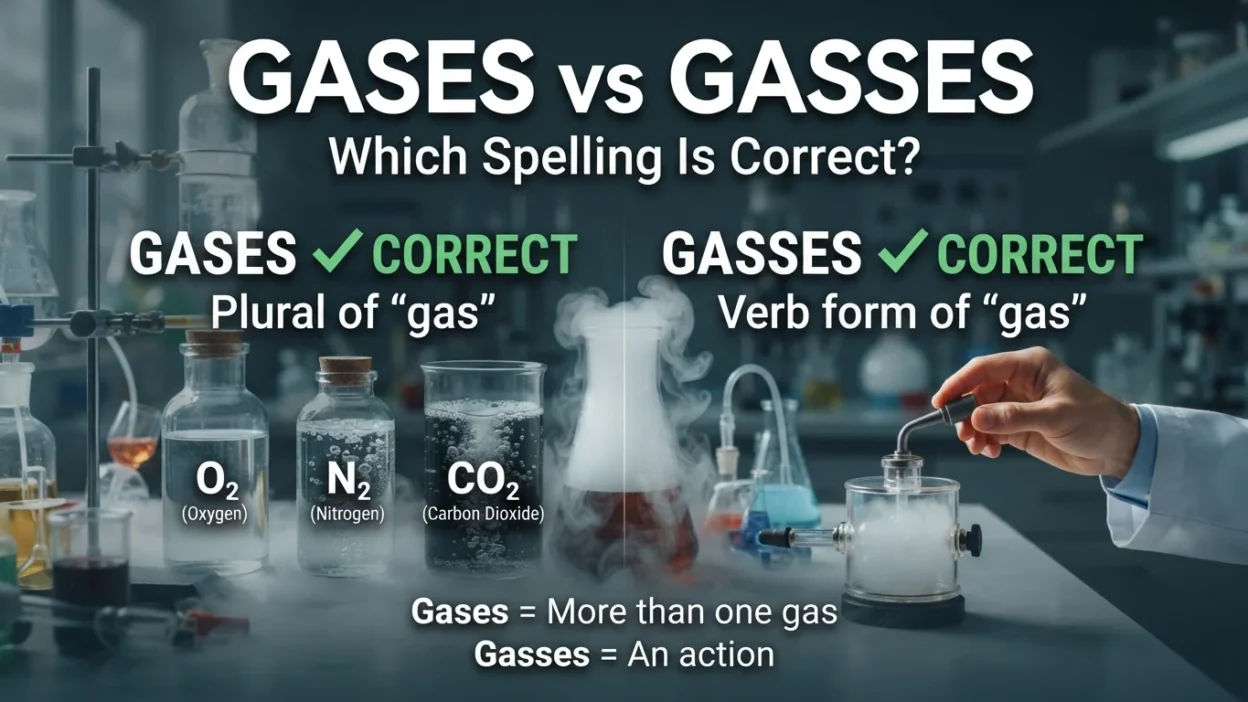
Gases ✓ = plural of the noun gas
Gasses ✓ = third-person singular form of the verb gas
Examples:
The atmosphere contains several different gases.
The factory gasses the insects to control the infestation.
In most science-related writing, you will want gases, not gasses.
Simple Rule
If you mean more than one type or amount of gas, use gases.
If you mean someone or something uses gas as a verb, gasses may be correct.
Remember:
Gas → Gases = plural noun
To gas → Gasses = verb form
What Does “Gases” Mean?
Gases is the plural form of the noun gas.
A gas is one of the fundamental states of matter, along with solids and liquids. Unlike solids and liquids, gases do not have a fixed shape or fixed volume. They expand to fill the container or space available to them.
Examples of gases include:
- Oxygen
- Nitrogen
- Hydrogen
- Carbon dioxide
- Helium
- Neon
- Water vapor
When talking about more than one gas, the standard plural form is gases.
For example:
The atmosphere is made up of several gases.
Scientists study gases under different temperatures and pressures.
Some gases are essential for life.
The word gases is especially common in scientific, environmental, medical, and educational writing.
What Does “Gasses” Mean?
Gasses is generally a verb form.
It comes from the verb gas, which can have different meanings depending on the context.
For example, to gas can mean to expose someone or something to gas.
The third-person singular form is:
He gasses
She gasses
The machine gasses
For example:
The machine gasses the insects in a controlled environment.
In this sentence, gasses is a verb, not a plural noun.
The word may also appear in contexts involving fuel or engines. However, the exact meaning depends on the verb being used.
Because gasses is less common in everyday writing, many people accidentally use it when they actually mean the plural noun gases.
Gases vs Gasses: Comparison Table
| Word | Correct? | Part of Speech | Meaning | Example |
|---|---|---|---|---|
| Gases | ✓ | Plural noun | More than one gas | The gases escaped from the container. |
| Gasses | ✓ | Verb | Third-person singular of “gas” | The machine gasses the insects. |
| Gas | ✓ | Singular noun / verb | One gas or the action of using gas | Oxygen is a gas. |
| Gassing | ✓ | Verb form | The act of using or exposing to gas | The process involves gassing the material. |
The key difference is grammar and meaning.
Gases is normally a plural noun.
Gasses is normally a verb.
Gases vs Gasses: The Main Difference
The easiest way to understand the difference is to look at the word’s role in a sentence.
Gases as a Noun
When gas is a noun, the plural is usually gases.
One gas
Two gases
Several gases
For example:
Oxygen and nitrogen are gases.
Here, gases refers to multiple substances.
Gasses as a Verb
When gas is used as a verb, gasses can be the third-person singular present-tense form.
For example:
The company gasses the products to eliminate pests.
Here, gasses describes an action performed by the company.
This distinction is similar to other English words that change form depending on whether they are being used as nouns or verbs.
Examples of “Gases”
Here are some natural examples of gases.
Example 1: Science
The experiment involved three different gases.
The word refers to three types or quantities of gas.
Example 2: Atmosphere
Earth’s atmosphere contains several important gases.
Here, gases refers to multiple substances present in the atmosphere.
Example 3: Chemistry
Some gases react when exposed to heat.
The sentence refers to more than one gas.
Example 4: Environment
Greenhouse gases contribute to climate change.
This is one of the most common phrases containing gases.
Example 5: Medicine
Certain gases are used during medical procedures.
Again, the word is the plural noun form.
Examples of “Gasses”
Now let’s look at examples where gasses functions as a verb.
Example 1
The company gasses the storage area to eliminate pests.
Here, gasses means exposes the area to gas.
Example 2
The facility gasses the products before shipping them.
The company performs an action involving gas.
Example 3
The machine gasses the containers as part of the treatment process.
Here, gasses is the third-person singular form of the verb gas.
These uses are much less common than gases, which is why many people rarely encounter gasses.
Common Mistakes
Mistake 1: Using “Gasses” as the Plural of Gas
Incorrect:
The atmosphere contains many gasses.
Correct:
The atmosphere contains many gases.
When you are talking about multiple gases, use gases.
Mistake 2: Assuming “Gases” Is Always a Verb
In most contexts, gases is a plural noun.
For example:
Greenhouse gases affect the environment.
It does not describe an action here.
Mistake 3: Adding an Extra “S” Automatically
English spelling can be tricky because some words form plurals with -es, while others use -s.
For the noun gas, the standard plural is:
gas → gases
The extra e helps create the correct plural spelling.
Mistake 4: Confusing Gas With Gass
The base noun is:
gas
The plural is:
gases
The verb form can be:
gas → gasses
The context tells you which form you need.
Why Is the Plural of Gas “Gases”?
The plural gases follows a common English spelling pattern.
Words ending in certain sounds, especially those ending in s, often add -es to form the plural.
For example:
gas → gases
This makes the plural easier to pronounce.
The pronunciation also changes:
gas sounds like “gass”
gases is generally pronounced like “gas-iz”
This difference can help you recognize the plural form when speaking.
Gases vs Gasses in Science
If you’re writing a science article, school assignment, research paper, or educational explanation, gases is almost certainly the word you need when referring to multiple gases.
For example:
Noble gases are chemically stable elements.
Scientists analyze gases in the laboratory.
Different gases have different properties.
The atmosphere contains a mixture of gases.
The word gasses would only be appropriate if you are using gas as a verb.
Therefore, if your topic is chemistry, physics, environmental science, or biology, remember:
One gas → multiple gases
American English vs British English
The spelling difference between gases and gasses is essentially the same in American and British English.
Both varieties use:
Gases as the plural of gas.
Both can use:
Gasses as a third-person singular form of the verb gas.
For example:
American English: The atmosphere contains several gases.
British English: The atmosphere contains several gases.
There is no major regional spelling difference here.
However, some dictionaries and style guides may differ in how frequently they accept or prefer certain verb forms. In ordinary writing, gases remains the standard plural noun.
Gases vs Gasses in Everyday Writing
In most everyday situations, gases is the word you will see.
Common phrases include:
- Greenhouse gases
- Natural gases
- Toxic gases
- Noble gases
- Exhaust gases
- Industrial gases
- Atmospheric gases
- Combustible gases
For example:
Greenhouse gases are an important topic in environmental science.
Some industrial gases require special storage conditions.
By contrast, gasses is much less common because its use is limited to specific verb contexts.
A Simple Memory Trick
Here’s an easy way to remember the difference:
Gases = Things
Gasses = Action
If you are talking about different types of gas, use gases.
Oxygen and hydrogen are gases.
If you are describing an action performed by someone or something, gasses may be correct.
The machine gasses the products.
Another simple trick is:
Gas + more than one = gases
Gas + he/she/it does something = gasses
This isn’t a rule for every possible meaning of the word, but it works well for the most common situations.
Gases vs Gas: Singular and Plural
Understanding the singular and plural forms can make this topic even easier.
Singular
Gas
Example:
Oxygen is a gas.
Plural
Gases
Example:
Oxygen and nitrogen are gases.
Verb
Gas
Example:
The company plans to gas the area.
Third-Person Singular Verb
Gasses
Example:
The company gasses the area.
The same basic word can therefore appear in different forms depending on its grammatical function.
FAQs
1. Is it gases or gasses?
Both spellings can be correct, but they have different grammatical uses. Gases is the plural of the noun gas, while gasses is generally a verb form.
2. What is the plural of gas?
The standard plural of gas is gases.
Example:
The atmosphere contains several gases.
3. Is “gasses” a correct word?
Yes. Gasses can be correct when it is used as a verb, usually as the third-person singular form of gas.
Example:
The machine gasses the material.
4. Should I write greenhouse gases or greenhouse gasses?
The correct phrase is greenhouse gases because you are referring to multiple types of gas.
5. Why is gases spelled with an “e”?
The standard plural of gas is gases, using -es. This spelling also makes the plural easier to pronounce.
6. Is there a difference between American and British English?
No significant difference exists. Both American and British English use gases as the plural of gas.
7. How do you pronounce gases?
Gases is generally pronounced approximately like “gas-iz.” The pronunciation is different from the singular gas.
8. What is the easiest way to remember gases vs gasses?
Think of gases as a plural noun referring to substances and gasses as a verb describing an action.
Final Summary
The difference between gases vs gasses is mainly about grammar and meaning. Gases is the standard plural form of the noun gas and is used when talking about more than one gas. For example, oxygen, nitrogen, and carbon dioxide are all gases. This spelling is especially common in science, chemistry, environmental studies, and everyday discussions about the atmosphere.
Gasses, on the other hand, is generally used as a verb. It is the third-person singular form of gas, meaning that a person, organization, or machine performs an action involving gas. If you are simply talking about multiple gases, gases is the correct choice. The spelling is the same in both American and British English.