The difference between proved vs proven is a common English grammar question. Both words come from the verb prove, and both can be correct. The confusion usually comes from the fact that proved and proven can both function as past participles, but they are not always used in exactly the same way.
If you’ve ever wondered whether to say “It has proved successful” or “It has proven successful,” you’re not alone. The good news is that modern English accepts both forms in many situations. However, there are some differences in usage, especially between American and British English. This guide explains proved vs proven in simple terms, with clear examples, common mistakes, a comparison table, and practical tips to help you choose the right word confidently.
Quick Answer: Proved vs Proven
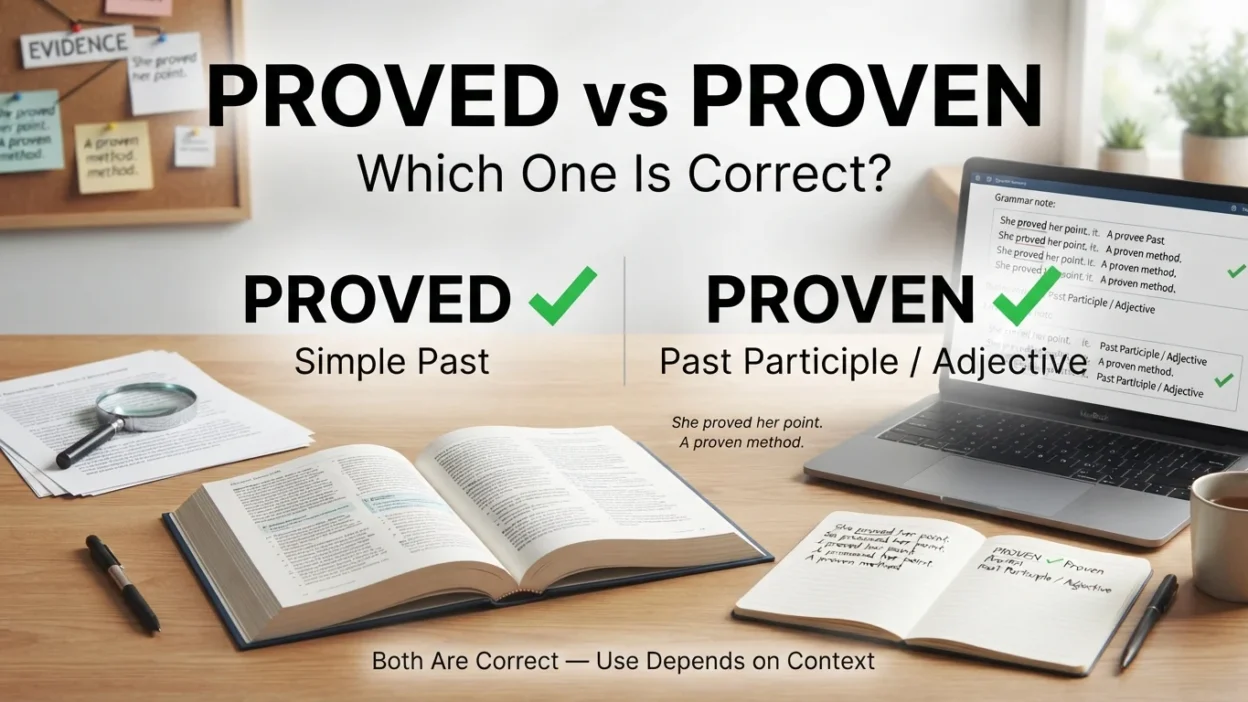
Both proved and proven are correct forms of the verb prove, but their usage can vary depending on the sentence and regional preference.
Proved is the regular past tense and past participle of prove.
Proven is an alternative past participle that is especially common in American English and is often used before a noun or with forms of have and be.
Examples
She proved that the theory was correct.
The theory has proven to be correct.
This is a proven method.
In general:
Proved = the standard past tense and a widely accepted past participle.
Proven = an established alternative past participle, especially common in American English.
Both can be correct, but the best choice depends on the sentence and style.
What Does “Proved” Mean?
Proved is the simple past tense and past participle of the verb prove.
The verb prove means to demonstrate that something is true, correct, effective, or genuine.
For example:
The scientist proved that the theory was accurate.
Here, proved describes an action that happened in the past.
As a past participle, proved can also be used with auxiliary verbs.
For example:
The evidence has proved his argument correct.
The method has proved effective.
In these sentences, proved means that something was demonstrated or shown to be true or effective.
What Does “Proven” Mean?
Proven is also a past participle of prove.
It is especially common in American English and is widely accepted in modern standard English.
For example:
The method has proven effective.
She has proven that she can handle the responsibility.
This is a proven strategy.
The word proven is particularly common when it appears directly before a noun.
For example:
a proven method
a proven strategy
a proven solution
a proven track record
In these expressions, proven often means tested, demonstrated, or shown to be effective or reliable.
Proved vs Proven: Comparison Table
| Feature | Proved | Proven |
|---|---|---|
| Base verb | Prove | Prove |
| Simple past | Yes | No |
| Past participle | Yes | Yes |
| Meaning | Demonstrated or shown to be true | Demonstrated, tested, or established |
| American English | Common | Very common |
| British English | Very common | Also accepted |
| Before a noun | Possible but less common | Very common |
| Example | She proved her point. | A proven method |
| Common phrase | Has proved effective | Has proven effective |
The key point is that proved and proven overlap in meaning, but proven is particularly common as an adjective and in certain past-participle constructions.
Proved vs Proven: The Main Difference
The biggest difference is grammatical usage and regional preference.
Proved as Simple Past
When describing a completed action in the past, proved is the standard choice.
He proved his innocence in court.
She proved that the answer was correct.
The experiment proved the hypothesis.
You would not normally use proven as the simple past tense.
Incorrect:
He proven his innocence.
Correct:
He proved his innocence.
This is one of the most important rules to remember.
Proven as a Past Participle
Proven is often used as a past participle with auxiliary verbs or as an adjective.
For example:
The approach has proven successful.
The treatment has proven effective.
This is a proven technique.
In these examples, proven emphasizes that something has been demonstrated or established through experience or evidence.
Examples of “Proved”
Here are some natural examples of proved.
Example 1: Demonstrating a Fact
The scientist proved that the experiment could be repeated.
The scientist demonstrated something to be true.
Example 2: Showing Ability
She proved that she was capable of leading the team.
She demonstrated her ability.
Example 3: A Past Event
The evidence proved his argument was correct.
The evidence demonstrated that his argument was correct.
Example 4: Legal Context
The defendant proved his innocence.
The person demonstrated that he was innocent.
Example 5: Testing an Idea
The experiment proved the original theory wrong.
The experiment demonstrated that the theory was incorrect.
Examples of “Proven”
Example 1: Proven Method
This is a proven method for improving productivity.
The method has been tested and shown to work.
Example 2: Proven Strategy
The company uses a proven strategy to attract customers.
The strategy has demonstrated its effectiveness.
Example 3: Proven Effective
The treatment has proven effective for many patients.
The treatment has demonstrated effectiveness.
Example 4: Proven Track Record
She has a proven track record of success.
Her past performance demonstrates her ability.
Example 5: Proven Solution
The software provides a proven solution to the problem.
The solution has already been tested or shown to work.
Is “Proven” More Correct Than “Proved”?
No. Proven is not more correct than proved, and proved is not more correct than proven in every situation.
Both are accepted forms of the verb prove, but they have different grammatical roles.
The simple past is:
Prove → Proved
For example:
The experiment proved the theory correct.
The past participle can be:
Proved or proven
For example:
The experiment has proved the theory correct.
The experiment has proven the theory correct.
Both sentences can be correct.
However, proven is often preferred before a noun:
a proven method
a proven approach
a proven solution
Proved vs Proven in American English
In American English, proven is extremely common as a past participle.
For example:
The strategy has proven successful.
The method has proven effective.
This is a proven solution.
American English also uses proved as the simple past:
The evidence proved the claim was false.
So, American English commonly uses:
Prove → Proved → Proven
Proved vs Proven in British English
British English traditionally has a stronger preference for proved as the past participle in some constructions.
For example:
The method has proved effective.
However, proven is also widely used in British English, especially as an adjective.
For example:
a proven method
a proven track record
a proven strategy
Therefore, the difference between American and British English is mainly one of preference and frequency, rather than correctness.
Common Mistakes
Mistake 1: Using “Proven” as the Simple Past
Incorrect:
She proven that the claim was false.
Correct:
She proved that the claim was false.
Remember that proved is the simple past tense.
Mistake 2: Thinking “Proven” Is Always Wrong
Incorrect assumption:
Proven is not a real English word.
This is false.
Proven is a well-established and widely accepted English word.
Mistake 3: Thinking “Proved” Is Always Better
Some writers believe that proved is always the only correct form.
That is not true.
For example:
a proven method
is a completely standard phrase.
Mistake 4: Confusing “Proved” With “Proven”
Both words come from prove, but they are not interchangeable in every grammatical structure.
The simple past is:
She proved it.
The past participle can be:
She has proven it.
or:
She has proved it.
Proved vs Proven in Formal Writing
Both forms can be appropriate in formal writing.
However, consistency is important.
If you’re writing for a specific audience, consider regional preferences.
For American English audiences, proven may sound more natural in sentences such as:
The approach has proven successful.
For British English audiences, proved may be preferred in some similar constructions:
The approach has proved successful.
But proven remains perfectly acceptable in phrases such as:
a proven approach
The most important thing is to use the correct grammatical form and maintain consistency throughout your writing.
How to Remember Proved vs Proven
A simple memory trick is:
Proved = Past action
Proven = Established or demonstrated
For example:
She proved her point yesterday.
This describes a completed action.
She has proven her ability.
This emphasizes an established result.
You can also remember:
Prove → Proved → Proven
Think of proven as the special past participle that often appears in phrases like:
- Proven method
- Proven strategy
- Proven solution
- Proven effective
- Proven successful
- Proven track record
FAQs
1. Is “proved” or “proven” correct?
Both are correct. Proved is the simple past tense and can also be a past participle. Proven is an alternative past participle and is especially common in American English and before nouns.
2. Is “proven” grammatically correct?
Yes. Proven is a standard and widely accepted form of the verb prove when used as a past participle or adjective.
3. Should I say “has proved” or “has proven”?
Both can be correct. Has proved is traditionally more common in some British English contexts, while has proven is especially common in American English. Both are widely understood.
4. Is “proven” more common in American English?
Yes. American English frequently uses proven as a past participle.
For example:
The method has proven effective.
5. Is “proved” more common in British English?
British English has traditionally favored proved in some past-participle constructions, although proven is also widely used and accepted, especially as an adjective.
6. Can I say “a proved method”?
It is grammatically possible, but a proven method is much more natural and common in modern English.
7. What is the past tense of prove?
The simple past tense of prove is proved.
Example:
The evidence proved his claim.
8. What is the past participle of prove?
Both proved and proven can function as past participles.
Examples:
The evidence has proved useful.
The evidence has proven useful.
Final Summary
The difference between proved vs proven is not simply a matter of one being correct and the other being wrong. Both words are accepted forms of the verb prove, but they are used differently depending on grammar and context. Proved is always the standard simple past form, as in “She proved her point.” It can also be used as a past participle.
Proven is an alternative past participle that is particularly common in American English and is frequently used as an adjective before nouns. Expressions such as “a proven method,” “a proven strategy,” and “a proven track record” are standard and natural. British English may favor proved in some constructions such as “has proved effective,” but proven is also widely accepted.

Liam James is a language enthusiast and content writer at Verseslay, specializing in word comparisons, grammar debates, and vocabulary insights. He helps readers understand language nuances through clear, engaging, and practical explanations.