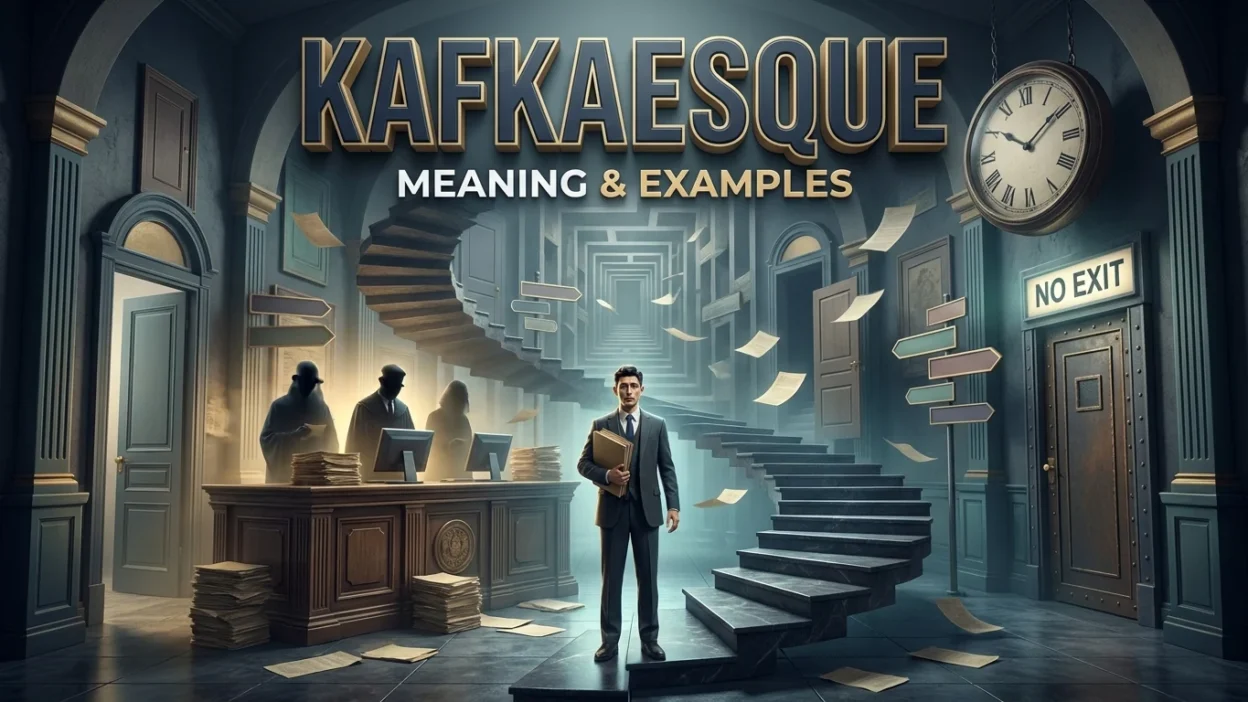
Have you ever experienced a situation so confusing, absurd, or frustrating that nothing seems to make sense? Perhaps you have been trapped in endless paperwork, dealt with an organization that keeps changing its rules, or tried to resolve a problem with no clear explanation. English has a powerful word for situations like these: Kafkaesque.
The word Kafkaesque describes experiences that feel bizarre, nightmarish, oppressive, or absurd, especially when people become trapped in complicated systems they cannot understand or control. It comes from the work of writer Franz Kafka, whose stories often feature ordinary people facing mysterious authorities and seemingly impossible circumstances. Understanding the Kafkaesque meaning can help you describe confusing real-life experiences, analyze literature, and express frustration more precisely.
Quick Answer: What Does Kafkaesque Mean?
Kafkaesque (pronounced kaf-kuh-ESK) is an adjective describing a strange, absurd, oppressive, or nightmarish situation in which people feel powerless against confusing rules, mysterious authorities, or an impersonal system.
Examples:
- Dealing with the government department became a Kafkaesque nightmare.
- The employee faced a Kafkaesque process involving endless forms and contradictory instructions.
- His attempt to correct a simple mistake turned into a Kafkaesque ordeal.
In simple words, Kafkaesque describes a situation that is so confusing and unreasonable that it feels like something out of a disturbing story by Franz Kafka.
Origin of the Word Kafkaesque
The word Kafkaesque comes from Franz Kafka, a German-language writer born in Prague in 1883. He became famous for literary works that explore alienation, anxiety, bureaucracy, guilt, and the struggle of individuals against mysterious or powerful systems.
His stories often place ordinary people in extraordinary circumstances. The characters may face unexplained accusations, incomprehensible rules, or authorities that refuse to provide clear answers.
Over time, his name became the basis for the adjective Kafkaesque, which describes situations resembling the strange and unsettling worlds found in his writing.
Two of his best-known works help explain the term:
- The Trial: A man named Josef K. is arrested and subjected to a mysterious legal process without receiving a clear explanation of the accusation against him.
- The Metamorphosis: Gregor Samsa wakes up transformed into a gigantic insect-like creature, creating a bizarre situation that disrupts his family life and identity.
These works illustrate the disturbing mixture of absurdity, helplessness, and uncertainty associated with the word.
What Does Kafkaesque Mean in Everyday English?
In everyday English, Kafkaesque is often used to describe situations that feel irrational, overwhelming, or impossible to resolve.
It usually involves more than ordinary confusion. The situation often includes a system that seems indifferent to human needs, rules that make little sense, or a person who cannot obtain a straightforward answer.
1. Confusing Bureaucracy
A situation may be called Kafkaesque when an organization creates endless procedures without offering a clear solution.
Example: Getting a simple document approved became a Kafkaesque experience because every department demanded another form.
The problem is not simply paperwork. It is the frustrating, self-perpetuating process that leaves the person feeling powerless.
2. Unexplained Accusations
The word can describe situations in which someone is accused of wrongdoing but cannot discover the reason or defend themselves effectively.
Example: He found himself in a Kafkaesque disciplinary process, facing accusations that nobody would explain.
This reflects the themes of uncertainty and powerlessness found in Kafka’s fiction.
3. Absurd Rules and Procedures
Sometimes rules contradict one another or make it impossible to achieve the result they supposedly support.
Example: The company created a Kafkaesque policy requiring employees to obtain approval from a manager who was not authorized to approve the request.
Such a situation feels irrational because the system prevents people from solving the very problem they are trying to address.
4. Feeling Trapped by a System
Kafkaesque situations frequently involve individuals who cannot escape an impersonal structure, even when they follow the rules.
Example: She spent months trying to close the account, but every attempt led to another department and another unexplained requirement.
The defining feature is the sense that the system controls the person rather than helping them.
Kafkaesque Examples in Sentences
Here are additional examples showing how to use Kafkaesque naturally.
- The student described the university’s appeal process as Kafkaesque because nobody could explain the decision.
- What began as a routine insurance claim developed into a Kafkaesque nightmare.
- The film portrays a Kafkaesque world where the rules change without warning.
- His Kafkaesque experience at the airport involved repeated questioning and contradictory instructions.
- The investigation became Kafkaesque when the authorities refused to explain the allegations.
- Navigating the company’s outdated computer system was a Kafkaesque ordeal.
- The novel captures the Kafkaesque anxiety of living under an unpredictable authority.
- She called the situation Kafkaesque because every attempt to solve the problem made it worse.
- The residents faced a Kafkaesque housing process in which no office accepted responsibility.
- Being asked to prove that a missing document had never existed felt Kafkaesque.
Notice that the adjective can describe a process, experience, system, nightmare, world, or ordeal.
Kafkaesque vs Absurd vs Surreal
These words are related, but they do not have exactly the same meaning.
| Word | Meaning | Example |
|---|---|---|
| Kafkaesque | Bizarre, oppressive, and confusing, often involving an impersonal system | The appeal process became Kafkaesque. |
| Absurd | Ridiculous, unreasonable, or contrary to logic | The rule was absurd. |
| Surreal | Strange or dreamlike, as if reality has become unreal | The empty city looked surreal. |
| Bureaucratic | Related to official procedures and administrative systems | The application faced bureaucratic delays. |
| Nightmarish | Extremely frightening, unpleasant, or distressing | The journey was nightmarish. |
| Dystopian | Relating to an imagined society marked by suffering or oppressive conditions | The novel depicts a dystopian society. |
The key difference: Something absurd may simply be ridiculous, and something surreal may feel dreamlike. A Kafkaesque situation typically combines strangeness or absurdity with anxiety, powerlessness, or an incomprehensible system.
For example, seeing a purple elephant in a dream is surreal. Being repeatedly denied a permit because every office insists another office must approve it may be Kafkaesque.
Kafkaesque vs Orwellian
Kafkaesque is sometimes confused with Orwellian, another adjective derived from a famous writer.
Kafkaesque usually emphasizes confusing procedures, mysterious authority, helplessness, and the absurdity of systems that people cannot understand.
Orwellian refers more specifically to oppressive surveillance, propaganda, manipulation of truth, and authoritarian control, drawing on the writing of George Orwell.
Consider these examples:
- Kafkaesque: A person cannot discover why their application has been rejected, despite repeated attempts to obtain an explanation.
- Orwellian: A government monitors citizens’ private communications and manipulates public information to control them.
The two ideas can overlap. A fictional society might be both Kafkaesque and Orwellian if it combines incomprehensible bureaucracy with authoritarian surveillance.
How to Use Kafkaesque Correctly
Because Kafkaesque has a distinctive meaning, it works best when the situation involves more than a minor inconvenience.
Use It as an Adjective
Kafkaesque describes a noun, such as a process, situation, experience, or system.
- It was a Kafkaesque situation.
- The process became Kafkaesque.
- We experienced a Kafkaesque nightmare.
Use It When a Situation Feels Irrational and Oppressive
The word is particularly effective when people face confusing procedures, unexplained decisions, or systems that seem impossible to challenge.
For example, describing a complicated administrative process as Kafkaesque may communicate more than saying it was merely annoying.
Avoid Using It for Every Small Problem
Waiting five minutes for a cup of coffee is usually not Kafkaesque. A prolonged process involving contradictory instructions, unexplained restrictions, and no way to obtain a decision might be.
The word carries literary and emotional weight, so use it when the situation genuinely fits its meaning.
Capitalization and Spelling
The standard spelling is Kafkaesque, with a capital K because it is derived from the surname Kafka.
Examples:
- The novel has a Kafkaesque atmosphere.
- She described the experience as Kafkaesque.
Avoid misspellings such as Kafkesque or Kafka-esque when you intend to use the standard dictionary form Kafkaesque.
Is Kafkaesque a Negative Word?
Yes, Kafkaesque generally has a negative or unsettling connotation. It often suggests anxiety, frustration, absurdity, helplessness, or oppression.
For example:
The sentence The company introduced a Kafkaesque approval process suggests that the process is confusing, unreasonable, and difficult to escape.
However, the word can also be used neutrally in literary criticism to describe the atmosphere or themes of a story. A reviewer might call a novel Kafkaesque because it resembles Kafka’s style or explores similar ideas.
Is Kafkaesque Used in American and British English?
Yes. Kafkaesque is used in both American and British English, and its basic meaning does not change between the two varieties.
Examples in American English:
- The insurance dispute turned into a Kafkaesque ordeal.
- The agency’s procedures were Kafkaesque.
Examples in British English:
- The application process became a Kafkaesque nightmare.
- He described the official investigation as Kafkaesque.
The spelling remains the same in both varieties. The word is more common in formal writing, journalism, political commentary, literary criticism, and sophisticated everyday conversation than in very casual speech.
FAQs
1. What does Kafkaesque mean in simple words?
Kafkaesque means extremely strange, confusing, or oppressive, especially when a person feels trapped in a system they cannot understand or control.
2. How do you pronounce Kafkaesque?
It is commonly pronounced kaf-kuh-ESK, with the main stress on the final syllable.
3. Why is it called Kafkaesque?
The word comes from Franz Kafka, a writer whose stories often feature mysterious authorities, absurd situations, anxiety, and powerless individuals struggling against incomprehensible systems.
4. What is an example of a Kafkaesque situation?
A person repeatedly submits the same paperwork, but each department rejects it for a different unexplained reason and sends them somewhere else. This can be described as Kafkaesque.
5. Is Kafkaesque the same as absurd?
No. Absurd means ridiculous or unreasonable, while Kafkaesque usually suggests a deeper sense of helplessness, anxiety, or entrapment within a strange system.
6. Is Kafkaesque a negative word?
Generally, yes. It often describes unpleasant, oppressive, or frustrating experiences, although it can also be used as a literary term without directly criticizing a real situation.
7. Can Kafkaesque be used in everyday conversation?
Yes. You can use it to describe a confusing administrative process, an unreasonable institutional rule, or an experience that feels bizarre and impossible to resolve.
8. What is the difference between Kafkaesque and Orwellian?
Kafkaesque usually emphasizes absurdity, uncertainty, and helplessness within an incomprehensible system. Orwellian more often emphasizes surveillance, propaganda, manipulation, and authoritarian control.
Summary
Kafkaesque is an adjective derived from the name of Franz Kafka. It describes situations that are bizarre, unsettling, or oppressive, particularly when individuals become trapped in confusing systems, face unexplained accusations, or struggle against rules that seem impossible to understand. The word is especially useful when ordinary terms such as strange, absurd, or frustrating do not fully capture the experience.
To remember its meaning, think of a person trying to solve a simple problem but becoming trapped in an endless maze of contradictory rules and unexplained decisions. That feeling of absurdity, anxiety, and powerlessness is what makes a situation Kafkaesque. Use the word when the circumstances genuinely fit, and it can make your English more precise and expressive.

Liam James is a language enthusiast and content writer at Verseslay, specializing in word comparisons, grammar debates, and vocabulary insights. He helps readers understand language nuances through clear, engaging, and practical explanations.