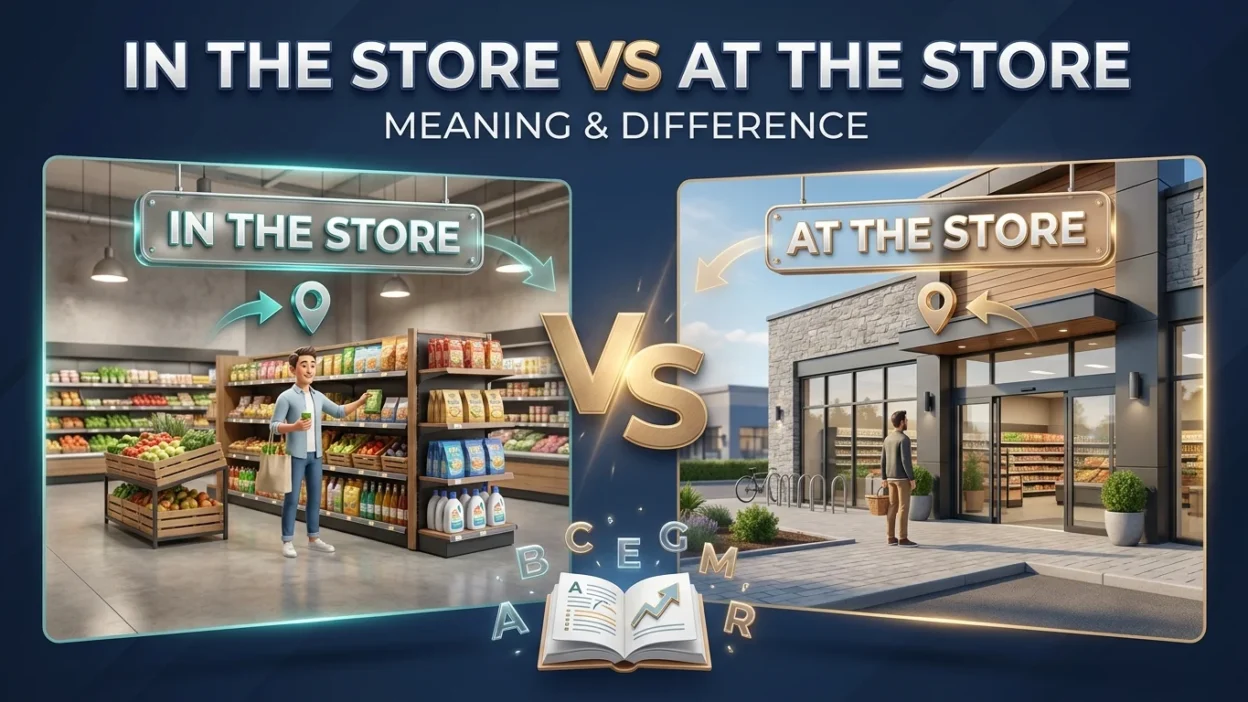
Have you ever wondered whether you should say “in the store” or “at the store”? Both phrases are correct in English, but they emphasize slightly different things. Choosing the right expression can help you communicate more naturally in everyday conversations, emails, and written English.
The difference is simple once you understand how English uses the prepositions in and at to describe places. Although both expressions can refer to the same location, “in the store” usually emphasizes being inside the building, while “at the store” identifies the store as the place where someone is or where an activity is happening. Let’s explore their meanings, examples, grammar rules, and common mistakes.
Quick Answer
- In the store: Use this when emphasizing that someone or something is physically inside the store.
- At the store: Use this when identifying the store as a person’s location or the place where an activity takes place, without necessarily emphasizing being inside the building.
Examples:
- I am in the store, looking for a new jacket.
- I am at the store and will be home soon.
Both sentences are grammatically correct. The best choice depends on what you want to emphasize.
What Does “In the Store” Mean?
The phrase “in the store” means inside a store or within its physical space. The preposition in commonly emphasizes being inside an enclosed area, such as a building, room, or shop.
When you use this phrase, you generally want to communicate that someone or something is physically within the store.
Examples of “In the Store”
- I am in the store right now.
This emphasizes that you are inside the store. - She is in the store buying groceries.
She is inside the store and shopping. - There are many customers in the store today.
The customers are inside the building. - I left my umbrella in the store.
This means the umbrella was left inside the store. - We met an old friend in the store.
The meeting happened inside the store. - The children are waiting in the store.
They are waiting inside the building.
When Should You Use “In the Store”?
Use in the store when the physical interior of the store matters to your message.
It is particularly useful when talking about:
- Shopping inside a building
- Finding or leaving something inside a store
- Describing customers inside the premises
- Explaining where an event occurred
- Distinguishing the interior from the outside area
For example, if someone asks where you left your wallet, you might say, “I think I left it in the store.”
The phrase helps identify the location inside the building.
What Does “At the Store” Mean?
The phrase “at the store” means at the location of a store. It identifies the store as the place where someone is, where an activity is taking place, or where someone is expected to be.
Unlike in, the preposition at does not necessarily emphasize whether the person is physically inside the building. The person may be shopping inside, standing outside the entrance, or referring generally to the store location, depending on the context.
Examples of “At the Store”
- I am at the store right now.
This identifies the store as your current location. - My father is at the store buying milk.
He is at the store location to buy milk. - I’ll meet you at the store at 5 p.m.
The store is the agreed meeting place. - She works at the store near our house.
This identifies the store as her workplace. - I saw my neighbor at the store yesterday.
The store is the location where you saw your neighbor. - Please call me when you arrive at the store.
The store is the destination you are traveling to.
When Should You Use “At the Store”?
Use at the store when you want to identify the store as a location or destination rather than emphasize its interior.
Common situations include:
- Telling someone where you are
- Describing where you work
- Arranging a meeting
- Explaining where you saw someone
- Talking about arriving at or leaving a location
For example, if your friend asks where you are, you can reply, “I’m at the store. Do you need anything?”
This sounds natural because the main point is your location, not whether you are inside the building.
In the Store vs At the Store: Key Differences
The main difference lies in what the speaker wants to emphasize.
| Feature | In the Store | At the Store |
|---|---|---|
| Main emphasis | Inside the building | The store as a location |
| Focus | Interior or physical presence inside | General location or destination |
| Typical use | Describing something inside | Reporting where someone is |
| Example | I found my keys in the store. | I’ll meet you at the store. |
| Workplace example | He is in the store helping a customer. | He works at the store. |
| Does it always mean indoors? | Usually emphasizes being inside | Not necessarily |
Remember that these are differences in emphasis, not strict rules that make the phrases mutually exclusive. In many situations, both expressions can describe the same event.
Can You Use “In the Store” and “At the Store” Interchangeably?
Sometimes, yes. Both expressions can be correct when referring to someone who is shopping.
Consider these sentences:
- I’m in the store.
- I’m at the store.
Both may describe someone who is currently shopping. However, the first sentence emphasizes being inside the building, while the second simply identifies the person’s location.
Consider another example:
- She is in the store talking to the manager.
- She is at the store talking to the manager.
Both are natural. The first highlights her presence inside the building. The second highlights the store as the location of the conversation.
The context often determines which expression sounds more appropriate.
Common Mistakes to Avoid
English learners sometimes confuse in and at because both prepositions can describe locations. Here are a few mistakes to watch for.
1. Thinking “At the Store” Always Means Outside
This is incorrect. Saying “I’m at the store” does not mean that you are standing outside. You may be inside shopping, near the entrance, or somewhere else at the store location.
For example:
- Natural: I’m at the store buying some fruit.
- Also natural: I’m in the store buying some fruit.
Both sentences work.
2. Thinking “In the Store” Is Always Better for Shopping
Although in the store emphasizes being inside, at the store is equally natural in many shopping situations.
For example:
- I am in the store looking for shoes.
- I am at the store looking for shoes.
Neither sentence is inherently incorrect.
3. Confusing “At the Store” With “To the Store”
These phrases serve different grammatical purposes.
- I’m at the store. This describes your location.
- I’m going to the store. This describes movement toward the store.
Use at for location and to when expressing movement toward a destination.
4. Forgetting the Article “The”
When referring to a particular store, English commonly uses the.
- Natural: I’m at the store.
- Natural: I’m in the store.
You can also say at a store or in a store when referring to any store rather than a specific or understood one.
5. Assuming Every Location Uses the Same Preposition
English prepositions depend on meaning and established usage. For example, we usually say at school, in the classroom, at work, and in the office. The appropriate choice depends on how the place is being viewed in the sentence.
In the Store vs At the Store in American and British English
Both expressions are standard in American and British English. The basic distinction between in and at remains the same in both varieties.
American English examples:
- I’m at the store. I’ll call you later.
- There are too many people in the store.
British English examples:
- I’m at the shop. I’ll call you later.
- There are too many people in the shop.
One regional difference is that British speakers often use shop where American speakers commonly use store, although both words are understood in both countries.
The preposition rules are not fundamentally different. You can use in the store and at the store in either variety of English.
How to Remember the Difference
A simple memory trick can help you choose the correct phrase.
Think of “in” as inside and “at” as location.
- If you want to emphasize that someone or something is inside the building, use in the store.
- If you want to identify the store as the place where someone is or where an event happens, use at the store.
For example, imagine that your brother has gone shopping. If you want to tell someone that he is physically inside the building, you can say, “He is in the store.” If you simply want to explain where he is, “He is at the store” is a natural choice.
This guideline will help you in most everyday situations, although context can make both expressions appropriate.
FAQs
1. Is “in the store” grammatically correct?
Yes. “In the store” is correct when referring to someone or something inside a store. For example, “The cashier is in the store.”
2. Is “at the store” grammatically correct?
Yes. “At the store” is correct when identifying the store as a location, destination, or place where an activity occurs. For example, “I’ll meet you at the store.”
3. Which is correct: “I’m in the store” or “I’m at the store”?
Both are correct. “I’m in the store” emphasizes being inside the building, while “I’m at the store” identifies your general location.
4. Should I say “I work in the store” or “I work at the store”?
Both are possible. “I work at the store” identifies the store as your workplace. “I work in the store” can emphasize working inside the building or distinguish the store interior from another area.
5. Can I say “meet me in the store”?
Yes. Use “meet me in the store” when you want the meeting to take place inside the building. “Meet me at the store” identifies the store as the meeting location without specifically emphasizing the interior.
6. What is the difference between “at the store” and “to the store”?
“At the store” describes a location, while “to the store” generally indicates movement toward that destination. For example, “I’m at the store” describes where you are, while “I’m going to the store” describes where you are heading.
7. Are “in the store” and “at the store” different in British English?
The basic distinction is the same in British English as in American English. British speakers may say “shop” more frequently than “store” in everyday conversation, depending on the context.
8. Which phrase should I use in a WhatsApp message?
Both are natural. Say “I’m at the store” when giving someone a quick location update. Say “I’m in the store” when you specifically want to emphasize that you are inside.
Summary
The difference between “in the store” and “at the store” is mainly about emphasis. “In the store” highlights being inside the building, whereas “at the store” identifies the store as a location, destination, or place where something happens. Both expressions are grammatically correct, and they can often describe the same situation.
To choose confidently, remember this simple rule: use in when the interior matters and at when the location matters. For everyday conversations, both phrases are natural, so focus on the meaning you want to communicate rather than memorizing an inflexible rule.