The difference between she has vs she have is a common English grammar question, especially for English learners. Both has and have are forms of the verb to have, but they are not interchangeable. Choosing the correct form depends mainly on the subject of the sentence and the tense or grammatical structure being used.
The good news is that the basic rule is quite simple: with the third-person singular subject she, we normally use has in the present simple tense. For example, we say “She has a new phone,” not “She have a new phone.” However, have can still appear with she in certain structures, such as questions and sentences using auxiliary verbs. Let’s explore she has vs she have in detail with clear examples, common mistakes, and easy grammar tips.
Quick Answer: She Has vs She Have
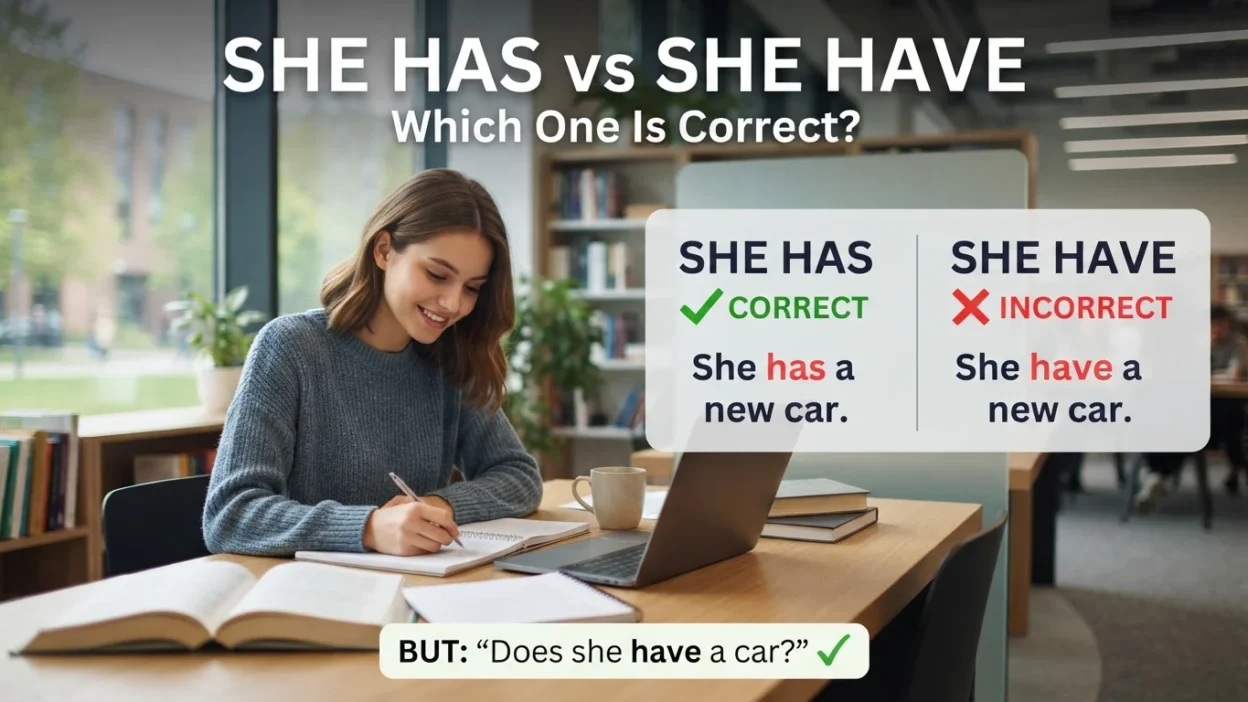
The correct choice in a normal present simple sentence is:
She has ✓
She have ✗
For example:
She has a beautiful house.
She has two brothers.
She has a lot of work.
However, she have can appear after certain auxiliary verbs.
For example:
Does she have a car?
She doesn’t have a car.
Here, have is correct because does or doesn’t already carries the third-person singular grammar.
Quick Rule
Use:
She has → in ordinary present simple affirmative sentences.
Does she have…? → in questions.
She doesn’t have… → in negative sentences.
She will have… → after modal or auxiliary verbs such as will.
This is one of the most important patterns to remember when learning the difference between she has vs she have.
What Does “She Has” Mean?
She has is the third-person singular present form of the verb have.
We use has with:
- She
- He
- It
- Singular nouns
Examples:
- She has a new job.
- She has three children.
- She has a headache.
- She has a beautiful voice.
- She has enough money.
- She has an interesting idea.
In these sentences, has expresses possession, characteristics, experiences, conditions, or relationships.
The basic structure is:
She + has + noun
For example:
She has a car.
She has a problem.
She has a sister.
What Does “She Have” Mean?
On its own, she have is generally incorrect in a standard present simple affirmative sentence.
For example:
She have a car. ✗
The correct sentence is:
She has a car. ✓
However, have can correctly appear with she when another auxiliary or modal verb controls the verb form.
For example:
Does she have a car?
She doesn’t have a car.
Will she have enough time?
She may have a problem.
In these examples, have is correct because the words does, doesn’t, will, and may affect the grammatical structure.
She Has vs She Have: Comparison Table
| Sentence | Correct? | Explanation |
|---|---|---|
| She has a car. | ✓ | Correct present simple form |
| She have a car. | ✗ | Incorrect in standard English |
| Does she have a car? | ✓ | “Does” takes the third-person grammar |
| She doesn’t have a car. | ✓ | “Doesn’t” is followed by the base form “have” |
| She will have a car. | ✓ | “Will” is followed by the base form |
| She may have a car. | ✓ | “May” is followed by the base form |
| She has finished her work. | ✓ | Present perfect with “has” |
| She have finished her work. | ✗ | Incorrect auxiliary form |
This table shows why the answer is not simply “never use have with she.” The correct choice depends on the structure of the sentence.
When to Use “She Has”
Use she has in affirmative present simple sentences when she is the subject.
Example 1: Possession
She has a new laptop.
This means that she owns or possesses a new laptop.
Example 2: Family Relationships
She has two sisters.
The sentence describes her family.
Example 3: Physical Condition
She has a headache.
Here, has describes a condition or experience.
Example 4: Personal Experience
She has a lot of experience.
This means she possesses or has gained experience.
Example 5: Daily Life
She has breakfast at eight o’clock.
Here, has does not mean possession. It is part of the expression have breakfast, meaning to eat breakfast.
When “She Have” Is Correct
Although she have is incorrect as a simple affirmative sentence, have is correct after certain auxiliary and modal verbs.
1. Does She Have?
Use does + she + have when forming a present simple question.
Examples:
- Does she have a car?
- Does she have any brothers?
- Does she have enough time?
- Does she have a job?
- Does she have your phone number?
The structure is:
Does + she + have + object?
Not:
Does she has a car? ✗
Correct:
Does she have a car? ✓
The reason is that does already marks the third-person singular form, so the main verb returns to its base form, have.
2. She Doesn’t Have
The same rule applies to negative sentences.
Examples:
- She doesn’t have a car.
- She doesn’t have enough money.
- She doesn’t have any children.
- She doesn’t have much free time.
The structure is:
She + does not/doesn’t + have
Not:
She doesn’t has a car. ✗
Correct:
She doesn’t have a car. ✓
3. She Will Have
After will, use the base form have.
Examples:
- She will have more time tomorrow.
- She will have a new job next month.
- She will have an opportunity to travel.
Not:
She will has more time. ✗
Correct:
She will have more time. ✓
4. She Can Have
Modal verbs are followed by the base form of the verb.
Examples:
- She can have some cake.
- She can have another chance.
- She can have the last piece.
The same rule applies to:
- She may have…
- She might have…
- She should have…
- She could have…
- She must have…
She Has in the Present Perfect Tense
Another important use of she has is the present perfect tense.
The structure is:
She + has + past participle
Examples:
- She has finished her homework.
- She has visited London.
- She has completed the project.
- She has already eaten.
- She has gone home.
Here, has works as an auxiliary verb.
For example:
She has finished her work.
The word finished is the past participle, while has forms the present perfect tense.
Do not say:
She have finished her work. ✗
The correct sentence is:
She has finished her work. ✓
Common Mistakes With She Has and She Have
Mistake 1: She Have a Car
Incorrect:
She have a car.
Correct:
She has a car.
Because she is a third-person singular subject, the present simple form is has.
Mistake 2: Does She Has a Car?
Incorrect:
Does she has a car?
Correct:
Does she have a car?
After does, use the base form have.
Mistake 3: She Doesn’t Has
Incorrect:
She doesn’t has a phone.
Correct:
She doesn’t have a phone.
Again, doesn’t already carries the third-person singular form.
Mistake 4: She Will Has
Incorrect:
She will has a meeting tomorrow.
Correct:
She will have a meeting tomorrow.
After will, always use the base form of the verb.
Mistake 5: She Have Finished
Incorrect:
She have finished her work.
Correct:
She has finished her work.
In the present perfect tense, she takes has.
A Simple Trick to Remember She Has vs She Have
Ask yourself what comes before the verb.
If the sentence starts with:
She + verb
Use has:
She has a car.
If you have does, doesn’t, will, can, may, or another modal or auxiliary verb, use the base form have.
Examples:
Does she have a car?
She doesn’t have a car.
She will have a car.
She can have a car.
This simple rule will help you avoid many common grammar mistakes.
American English vs British English
There is no significant difference between American and British English when it comes to the basic rule for she has vs she have.
Both varieties use:
She has a car.
Does she have a car?
She doesn’t have a car.
However, there can be differences in how have got is used.
In British English, it is common to say:
She has got a new car.
or:
She’s got a new car.
American English speakers may more commonly say:
She has a new car.
or:
She has a new car.
Both varieties understand has got, but the frequency of use can differ.
These regional differences do not change the basic grammar rule: she has is the standard affirmative present form, while have follows auxiliary verbs such as does and will.
FAQs
1. Is it “she has” or “she have”?
In a normal present simple affirmative sentence, the correct form is she has.
Example:
She has a new phone.
2. Is “she have” ever correct?
Yes. Have is correct after auxiliary or modal verbs.
Examples:
Does she have a car?
She doesn’t have a car.
She will have more time.
3. Should I say “Does she has” or “Does she have”?
The correct form is Does she have?
After does, use the base form have.
4. Is “She doesn’t have” correct?
Yes. She doesn’t have a car is grammatically correct.
Do not say She doesn’t has a car.
5. Why do we use “has” with she?
Because she is a third-person singular subject. In the present simple tense, the verb have changes to has.
6. Is “She has finished” correct?
Yes. She has finished is the present perfect tense.
The structure is she + has + past participle.
7. Is the rule different in American and British English?
No. The basic rule is the same in both varieties of English.
8. How can I remember the difference?
Remember this pattern:
She has.
Does she have?
She doesn’t have.
She will have.
This pattern covers many common situations.
Final Summary
The difference between she has vs she have is mainly determined by the grammatical structure of the sentence. In a standard present simple affirmative sentence, use she has, because she is a third-person singular subject. For example, She has a new car and She has two sisters are both correct.
However, have is correct when it follows certain auxiliary or modal verbs. We say Does she have a car?, She doesn’t have a car, and She will have a car. The important rule is that does, doesn’t, will, can, may, and similar verbs are followed by the base form have, not has.