
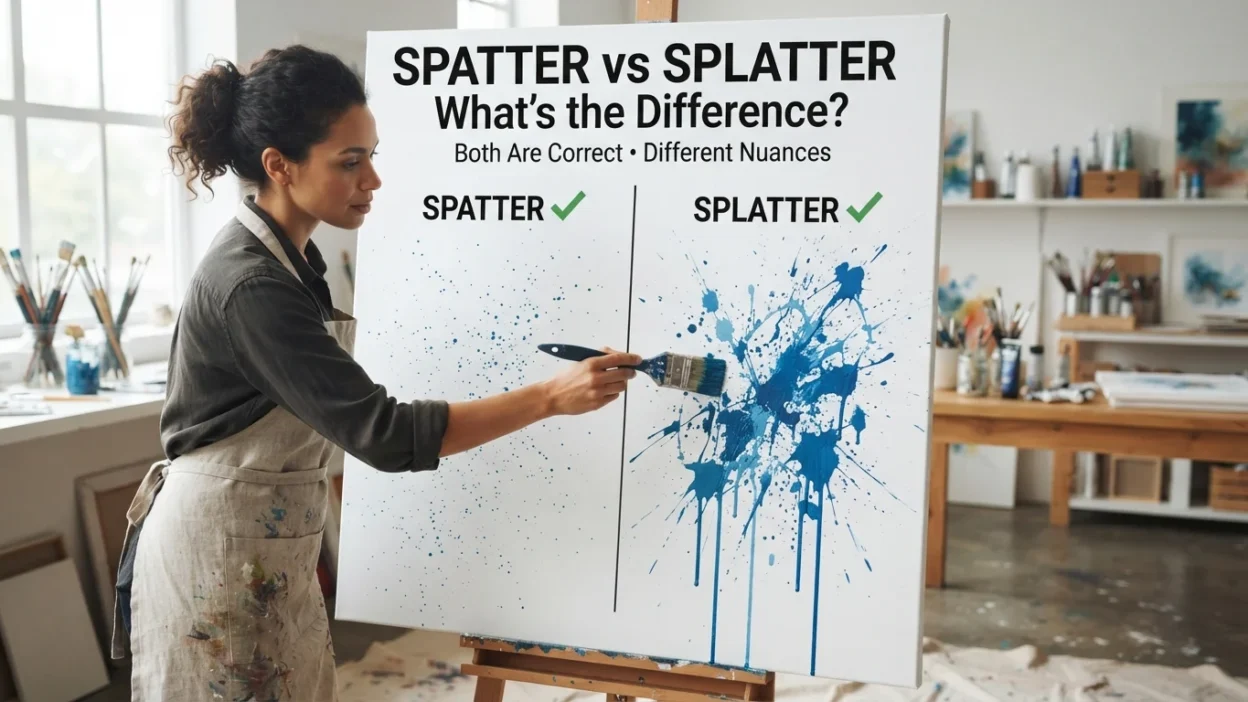
The difference between spatter vs splatter can be surprisingly confusing. Both words describe small drops or particles of a liquid or substance spreading across a surface, and in many everyday situations, they can be used interchangeably. However, there are subtle differences in meaning, intensity, and common usage that can help you choose the right word.
If you’ve ever wondered whether to say “paint spatter” or “paint splatter,” you’re not alone. Both expressions are used in modern English, but spatter often suggests smaller, lighter, or scattered drops, while splatter can suggest a more forceful or messy spread. Let’s explore the difference between spatter vs splatter, with simple explanations, examples, common mistakes, and helpful usage tips.
Quick Answer: Spatter vs Splatter
Both spatter and splatter can describe liquid or small particles being scattered onto a surface.
- Spatter usually suggests small drops scattered or sprinkled over something.
- Splatter often suggests a larger, messier, or more forceful spread of liquid or material.
- Both words can be used as nouns and verbs.
- In many everyday contexts, the two words overlap in meaning.
- Neither word is automatically wrong; the best choice depends on context and the effect you want to describe.
Simple Examples
Spatter: The rain spattered mud onto the car.
Splatter: The paint splattered across the wall.
The first sentence focuses on scattered drops, while the second creates a stronger impression of a messy or energetic spread.
What Does “Spatter” Mean?
The word spatter means to scatter small drops or particles of a liquid or substance over a surface.
It can be used as a verb:
Water spattered the windows.
It can also be used as a noun:
There were spots of paint spatter on the floor.
The word often suggests relatively small droplets distributed over an area.
For example:
The muddy road spattered the car with dirt.
This means that small drops of mud or dirt landed on the car.
Spatter can describe many ordinary substances, including:
- Water
- Mud
- Paint
- Oil
- Rain
- Food
- Cleaning products
The word can also be used figuratively in some contexts, although its most common use involves physical drops or particles.
What Does “Splatter” Mean?
The word splatter also means to scatter liquid or small particles, but it often carries a stronger sense of force, messiness, or sudden movement.
As a verb:
The paint splattered across the floor.
As a noun:
There was paint splatter everywhere.
The word splatter often creates a more vivid image of something spreading unpredictably.
For example:
The child splattered paint all over the canvas.
This suggests a lively, messy, and energetic action.
The word can describe:
- Paint
- Mud
- Water
- Food
- Grease
- Sauce
- Other liquids or materials
Because of its stronger and messier connotation, splatter is often preferred when the action is forceful or dramatic.
Spatter vs Splatter: Comparison Table
| Feature | Spatter | Splatter |
|---|---|---|
| Basic meaning | Small drops scattered over a surface | Liquid or material scattered in a messy or forceful way |
| Typical impression | Light, scattered, fine drops | Messier, larger, more energetic spread |
| Verb | Yes | Yes |
| Noun | Yes | Yes |
| Can describe paint | Yes | Yes |
| Can describe water | Yes | Yes |
| Can describe mud | Yes | Yes |
| Intensity | Often milder | Often stronger |
| Meaning overlap | High | High |
| American English | Common | Common |
| British English | Common | Common |
The distinction is not absolute. In many cases, native speakers use spatter and splatter interchangeably.
Spatter vs Splatter: The Main Difference
The easiest way to understand the difference is to think about intensity and messiness.
Spatter often describes smaller drops that are scattered across a surface.
Splatter often suggests a more dramatic or messy action in which liquid or material is thrown or spread around.
Consider these examples:
The rain spattered the windows.
This sounds like small drops of rain hitting the glass.
The paint splattered across the walls.
This creates a stronger image of paint being thrown or spread messily.
The difference is subtle, and context matters.
Examples of “Spatter”
Here are some examples of how to use spatter naturally.
Example 1: Rain
Rain spattered the windshield.
The sentence describes small drops of rain hitting the windshield.
Example 2: Mud
The passing truck spattered mud onto my shoes.
The mud was scattered in small drops.
Example 3: Paint
The artist used a brush to spatter paint onto the canvas.
This describes a technique in which small drops of paint are scattered across the surface.
Example 4: Water
Water spattered onto the kitchen floor.
Small drops of water landed on the floor.
Example 5: Cooking
Oil spattered when it touched the hot pan.
The sentence describes small drops of hot oil being scattered.
Examples of “Splatter”
Now let’s look at examples using splatter.
Example 1: Paint
The children splattered paint across the canvas.
This suggests an energetic and messy painting technique.
Example 2: Mud
The car splattered mud all over the driveway.
The word splattered emphasizes the mess created by the moving car.
Example 3: Sauce
Tomato sauce splattered onto the table.
This suggests that the sauce spread messily.
Example 4: Water
The waves splattered water onto the rocks.
The action sounds more forceful and energetic.
Example 5: Cooking
Grease splattered across the stove.
This creates a vivid impression of a messy cooking situation.
Spatter vs Splatter in Art
The two words are especially common when talking about painting techniques.
An artist may spatter paint by scattering small drops across a canvas.
The term splatter painting is also widely used to describe a style involving paint being thrown, flicked, or scattered onto a surface.
For example:
The artist created a colorful spatter effect.
The artist created a dramatic splatter painting.
Both are understandable, but splatter often sounds more energetic and visually dramatic.
If you are describing a controlled technique involving small droplets, spatter may be the better choice.
If you are describing a bold, messy, expressive style, splatter may fit better.
Spatter vs Splatter in Everyday English
In everyday conversations, the distinction is often not important.
For example, someone might say:
There is paint spatter on the floor.
Another person might say:
There is paint splatter on the floor.
Both sentences communicate essentially the same idea.
The choice may depend on personal preference or the exact image the speaker wants to create.
This is one reason English learners sometimes find these words confusing. Unlike words with completely different meanings, spatter and splatter have overlapping definitions.
Common Mistakes
Mistake 1: Thinking One Word Is Always Correct
It is not accurate to say that spatter is always correct and splatter is always wrong, or vice versa.
Both words are standard English words.
The difference is usually one of nuance.
Mistake 2: Assuming “Splatter” Only Means Large Drops
Splatter can describe small drops too.
The word simply tends to create a stronger impression of messiness or force.
Mistake 3: Assuming “Spatter” Is Only Used for Water
Spatter can describe many substances.
For example:
- Paint spatter
- Mud spatter
- Rain spatter
- Oil spatter
- Water spatter
The context determines the exact meaning.
Mistake 4: Confusing “Spatter” With “Splash”
A splash usually involves a larger amount of liquid moving or spreading.
A spatter usually involves smaller drops.
For example:
The child splashed water into the pool.
Small drops of water spattered the floor.
These words are related but not identical.
Spatter vs Splatter vs Splash
These three words are sometimes confused.
Spatter
Small drops scattered across a surface.
Rain spattered the window.
Splatter
Liquid or material scattered in a more forceful or messy way.
Paint splattered the wall.
Splash
A larger amount of liquid moving or being thrown around.
The waves splashed against the boat.
These definitions overlap, but the intensity and size of the liquid movement can differ.
American English vs British English
There is no major difference between American and British English when it comes to the basic meanings of spatter and splatter.
Both words are used in both varieties of English.
American English commonly uses expressions such as:
Paint splatter
Blood spatter
Mud spatter
British English speakers also understand and use both terms.
The most noticeable difference is not regional grammar but context and collocation. Certain combinations may be more common in specific fields or industries.
For example, spatter is commonly used in technical and scientific contexts, while splatter may be more common in casual descriptions of something messy.
When Should You Use Spatter?
Choose spatter when you want to emphasize:
- Small droplets
- Scattered spots
- Fine particles
- A lighter or more controlled effect
- Technical or descriptive language
Examples:
The rain spattered the glass.
The artist used a spatter technique.
There was mud spatter on the vehicle.
When Should You Use Splatter?
Choose splatter when you want to emphasize:
- Messiness
- Force
- Sudden movement
- A dramatic effect
- A larger or more energetic spread
Examples:
The paint splattered across the wall.
The sauce splattered onto the table.
The children were splattering paint everywhere.
Remember that these are guidelines, not strict grammar rules.
FAQs
1. What is the difference between spatter and splatter?
Spatter usually suggests small drops scattered over a surface, while splatter often suggests a messier or more forceful spread. However, their meanings overlap significantly.
2. Is spatter or splatter correct?
Both are correct. The best choice depends on context, intensity, and the effect you want to describe.
3. Is paint spatter or paint splatter correct?
Both expressions are correct. Paint splatter may suggest a more energetic or messy effect, while paint spatter can emphasize scattered drops.
4. Is spatter more formal than splatter?
Not necessarily, but spatter is sometimes more common in technical or scientific contexts. Splatter often sounds more vivid or informal.
5. Are spatter and splatter synonyms?
They are near-synonyms. Both can describe liquid or small particles being scattered, but splatter often suggests more force or messiness.
6. Is there a difference between American and British English?
There is no major difference in the basic meanings. Both spatter and splatter are used in American and British English.
7. Can spatter and splatter be used as nouns?
Yes.
Examples:
There was paint spatter on the floor.
There was paint splatter on the floor.
8. Which word should I use?
Use spatter when emphasizing small, scattered drops. Use splatter when emphasizing a messy, forceful, or energetic spread. When the distinction is not important, either word may work.
Final Summary
The difference between spatter vs splatter is mainly a matter of nuance rather than strict grammar. Both words describe the scattering of liquid, paint, mud, or other small particles across a surface. Spatter often suggests smaller or more lightly scattered drops, while splatter tends to create a stronger impression of force, energy, or messiness.
However, these meanings overlap considerably, and native speakers often use the two words interchangeably. For example, both paint spatter and paint splatter are natural expressions. The best choice depends on the context and the specific image you want your reader or listener to imagine.

Liam James is a language enthusiast and content writer at Verseslay, specializing in word comparisons, grammar debates, and vocabulary insights. He helps readers understand language nuances through clear, engaging, and practical explanations.