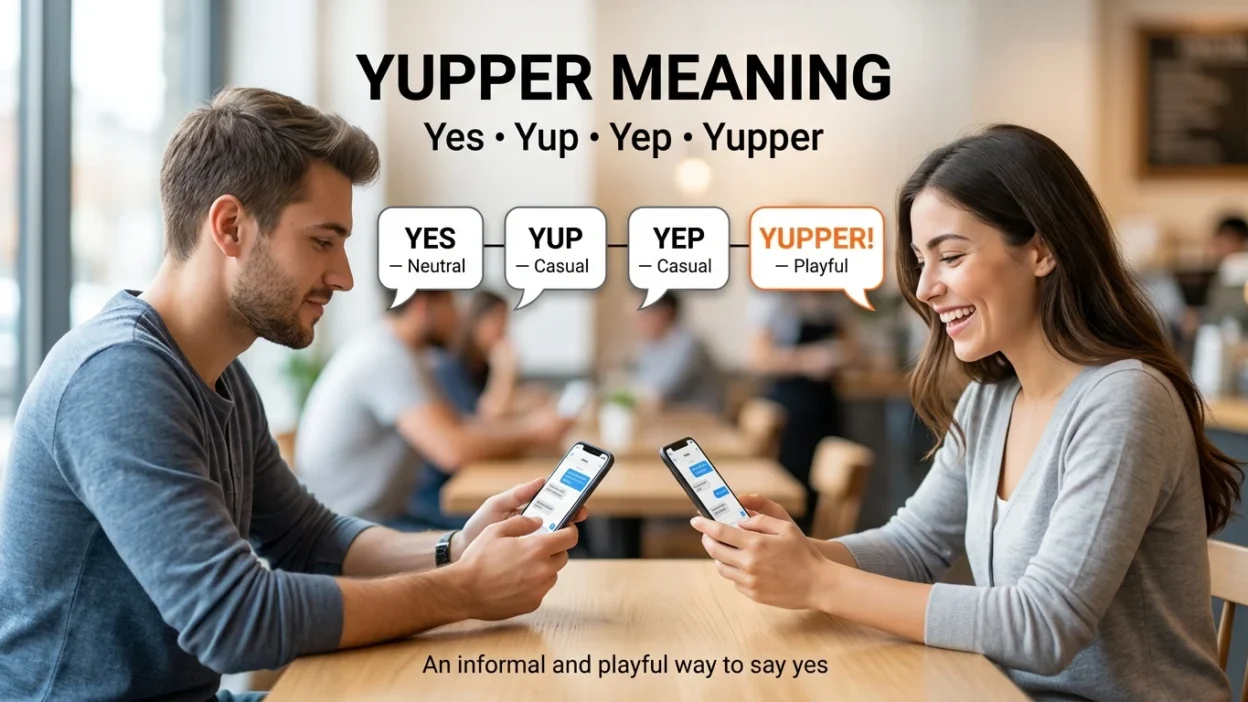
If you have seen yupper in a text, comment, meme, or casual conversation, you may have wondered whether it is a real English word or simply a playful version of yup. The answer is a little more interesting than a simple yes or no. Yupper is an informal expression used to communicate agreement, confirmation, or an enthusiastic yes. It is closely related to words such as yup, yep, and yuppers.
Unlike standard words such as yes, yupper belongs mainly to casual and playful English. It can make a response sound cheerful, humorous, friendly, or slightly exaggerated. Because its tone matters so much, it is most suitable for conversations with friends, texting, social media, and other informal situations rather than academic or professional writing.
Quick Answer: What Does Yupper Mean?
Yupper is an informal, playful way of saying yes, yup, or yep.
It can express:
- Agreement
- Confirmation
- Enthusiasm
- Friendly acceptance
- Playful humor
Example:
Are you coming with us?
Yupper!
This simply means Yes, I am coming, but the response sounds more cheerful and informal.
The word is not a standard choice for formal English. Several contemporary language references describe it as informal slang or casual usage rather than a standard formal vocabulary item.
What Is the Meaning of Yupper?
The most common yupper meaning is an enthusiastic or playful yes.
For example:
Did you finish your homework?
Yupper!
The speaker is confirming that the homework is finished.
Another example:
Are we still meeting at six?
Yupper, see you then!
Here, yupper expresses agreement with a friendly tone.
The exact emotional effect depends on the speaker. It can sound excited, humorous, relaxed, or deliberately exaggerated.
Is Yupper a Real Word?
This is where things become interesting.
Yupper is a real expression in informal usage, but it is not generally treated like a standard formal English word. Several language references describe it as slang or an informal expression rather than a conventional dictionary word.
This distinction is useful:
Standard English: yes
Casual English: yup, yep
Playful informal English: yupper, yuppers
So, if someone asks whether yupper is a word, the safest answer is that it is an informal expression used in real English communication, but it should not normally be used in formal writing.
Yupper vs Yup vs Yep vs Yes
These expressions have similar meanings, but their tone is different.
| Expression | Meaning | Tone | Best Use |
|---|---|---|---|
| Yes | Agreement | Neutral | Formal and informal |
| Yep | Yes | Casual | Everyday conversation |
| Yup | Yes | Casual and relaxed | Texting and conversation |
| Yupper | Yes | Playful and enthusiastic | Informal conversation |
| Yuppers | Yes | Very playful | Jokes and casual messages |
For example:
Yes, I understand.
This sounds neutral and straightforward.
Yep, I understand.
This sounds relaxed.
Yup, I understand.
This sounds casual.
Yupper, I understand.
This sounds playful or humorous.
The basic meaning remains the same, but the personality of the response changes.
How to Use Yupper in a Sentence
Because yupper normally functions as an informal affirmative response, it is often used by itself.
For example:
Are you ready?
Yupper!
It can also be followed by additional information:
Yupper, I will be there at seven.
Yupper, that sounds good to me.
Yupper, I already finished it.
Yupper! Let’s go.
It is particularly natural in text messages and casual online conversations.
Yupper Examples in Everyday Conversation
Here are some natural examples:
Are you joining us for dinner?
Yupper!
Did you remember to bring the tickets?
Yupper, they are in my bag.
Do you want another cup of coffee?
Yupper, please.
Are we still going to the game tonight?
Yupper! I would not miss it.
Did you finish the project?
Yupper, all done.
In each example, yupper communicates agreement or confirmation while adding a playful tone.
Yupper in Texting and Social Media
You are more likely to encounter yupper in informal digital communication than in formal writing.
It may appear in:
- Text messages
- Group chats
- Social media comments
- Online communities
- Gaming conversations
- Memes
- Friendly emails
- Casual conversations
For example:
Ready for the weekend?
Yupper!
Or:
You coming tonight?
Yupper, definitely.
The informal spelling makes the message feel relaxed and conversational.
Yupper vs Yuppers
You may also see yuppers, which is another playful form.
In many casual contexts, yupper and yuppers communicate essentially the same idea: an enthusiastic yes.
For example:
Are you coming?
Yupper!
Or:
Are you coming?
Yuppers!
The second version may sound even more exaggerated or playful.
Neither is appropriate when you need formal, neutral English.
Common Mistakes With Yupper
Mistake 1: Using Yupper in Formal Writing
Avoid using yupper in academic essays, formal reports, official applications, or professional correspondence.
Instead of:
Yupper, I agree with the proposal.
Use:
Yes, I agree with the proposal.
The standard form is clearer and more professional.
Mistake 2: Thinking Yupper Is the Same as Standard Yes
Although the basic meaning is similar, the tone is different.
Yes is neutral.
Yupper is playful and informal.
Choosing the wrong form can make a formal message sound unnecessarily casual.
Mistake 3: Confusing Yupper With Yuppie
Yupper and yuppie are completely different terms.
A yuppie historically refers to a young urban professional, particularly in discussions of affluent professional culture.
Yupper, in its common informal usage, is a playful affirmative expression related to yup or yep.
Do not treat these words as synonyms.
Mistake 4: Assuming Every Use Has the Same Tone
Context matters.
A person might use yupper sincerely, jokingly, enthusiastically, or even sarcastically.
For example:
You are doing the dishes tonight, right?
Yupper…
Depending on tone and context, this could simply mean yes or could carry humorous reluctance.
Is Yupper American or British English?
The playful use of yupper is particularly associated with informal American-style conversational and internet English, although informal expressions can spread easily across English-speaking communities.
There is no major American-versus-British grammar rule that makes the word universally correct or incorrect. The more important distinction is formal versus informal English.
In both American and British English, yes remains the standard neutral affirmative response.
Yupper Pronunciation
When used as a playful form of yup, yupper is generally pronounced approximately like:
YUH-per
The first part sounds similar to yup, followed by a light -er sound.
Because it is informal slang, pronunciation can vary slightly depending on the speaker and region.
Where Did Yupper Come From?
The most straightforward explanation is that the common informal use developed around yup, with the additional ending creating a more playful or emphatic form.
However, the word has also been recorded with other meanings in user-generated slang sources. For example, some entries use yupper for someone who frequently says yup, while other sources record unrelated regional or humorous meanings.
This is a useful reminder that slang can have multiple meanings depending on community and context.
For someone encountering yupper in ordinary online conversation, however, the safest interpretation is usually yes, yup, or yep.
FAQs
1. What does yupper mean?
Yupper usually means yes, yup, or yep. It adds a playful, friendly, or enthusiastic tone to an affirmative response.
2. Is yupper a real English word?
Yupper is used in real informal English communication, but it is not generally treated as a standard formal English word. It is best understood as an informal slang expression.
3. Is yupper the same as yup?
They can have the same basic meaning, but yupper usually sounds more playful or enthusiastic than the simple yup.
4. What is the difference between yupper and yuppers?
Both can express an informal yes. Yuppers often sounds more exaggerated, cheerful, or playful than yupper.
5. Can I use yupper in formal writing?
It is better to avoid it. Use yes, certainly, I agree, or another standard expression in formal writing.
6. Is yupper rude?
No. The word is not inherently rude. It is generally friendly or playful, although tone and context can make it sound sarcastic.
7. Is yupper the same as yuppie?
No. They have different meanings. Yupper is commonly used as an informal affirmative expression, while yuppie refers to a different social and cultural term.
8. Can yupper be used by itself?
Yes. A simple Yupper! can function as an informal response meaning Yes!
Final Summary
The most common yupper meaning is a playful or enthusiastic yes. It is closely related to informal expressions such as yup and yep, but it can sound slightly more cheerful, exaggerated, or humorous. You may encounter it in texts, social media, group chats, online conversations, and friendly speech.
Yupper is best viewed as an informal expression rather than a formal vocabulary choice. It can make a casual conversation feel more relaxed and personal, but it is not a good replacement for yes in academic, professional, or official writing. Context and tone are especially important because slang can develop different meanings in different communities.

Liam James is a language enthusiast and content writer at Verseslay, specializing in word comparisons, grammar debates, and vocabulary insights. He helps readers understand language nuances through clear, engaging, and practical explanations.