Looking for my question is alternatives can help you make your English sound more natural, polished, and appropriate for different situations. Although my question is is grammatically correct, repeating it can make your writing or speech sound less varied.
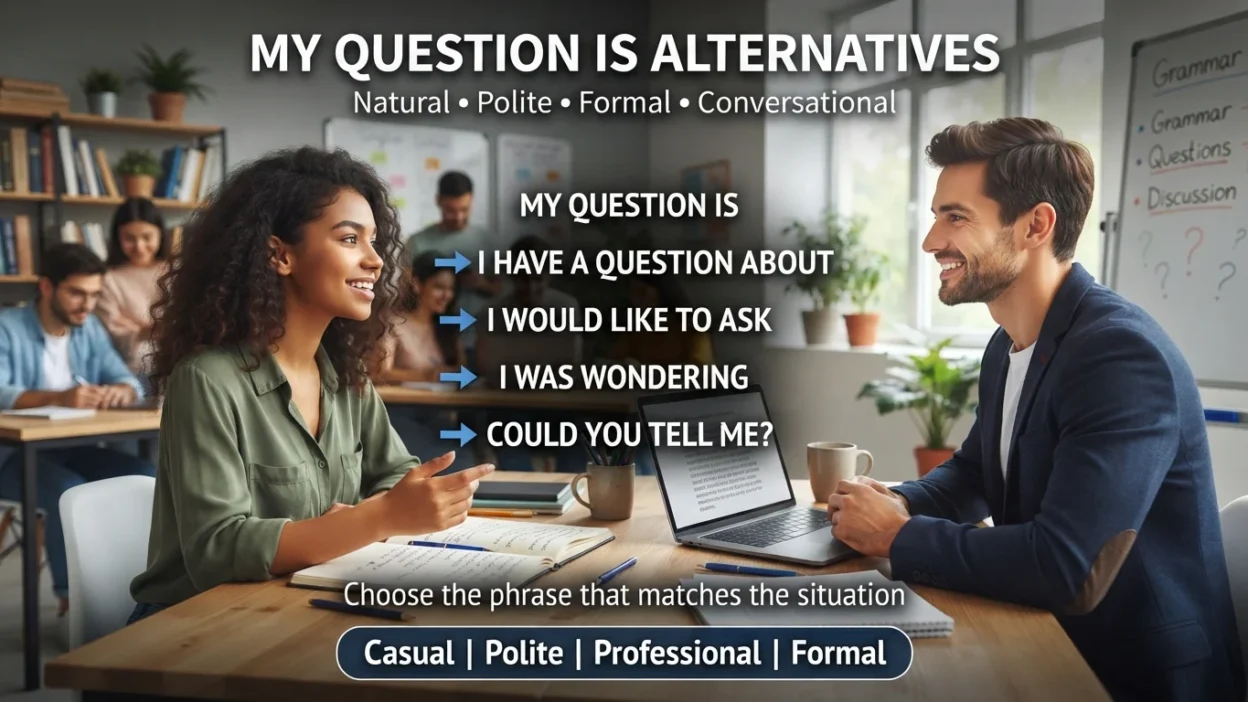
Depending on the context, you can replace my question is with phrases such as I would like to ask, I have a question about, I am wondering, I would like to know, or what I would like to know is. The best choice depends on whether you are writing formally, speaking casually, asking for clarification, or introducing a specific question.
Quick Answer: What Are Alternatives to My Question Is?
Some useful alternatives to my question is include:
- I have a question about…
- I would like to ask…
- I would like to know…
- I am wondering…
- Could you tell me…
- May I ask…
- What I would like to know is…
- I am curious about…
- I would appreciate clarification on…
- Can you explain…
For everyday conversation, I have a question about and I was wondering sound natural.
For formal situations, I would like to ask and I would like to know are useful choices.
What Does My Question Is Mean?
The phrase my question is is used to introduce the specific question a speaker or writer wants to ask.
For example:
My question is, when will the project be completed?
The speaker uses the phrase to identify the question they want answered.
It can also be used to emphasize or introduce an important point:
My question is whether we should continue with the plan.
In this example, the speaker is not simply asking for information. They are focusing attention on a particular issue.
Although the expression is correct, it is not always necessary. In many situations, English sounds more natural when the question is asked directly.
Instead of:
My question is, where is the nearest station?
You could simply say:
Where is the nearest station?
The shorter version is more direct.
Why Use Alternatives to My Question Is?
Using different expressions can make your English more natural and flexible.
If you repeatedly write:
My question is…
My next question is…
My other question is…
your writing may start to sound repetitive.
Alternatives allow you to match your language to the situation.
For example:
I have a question about the schedule.
sounds conversational and natural.
I would appreciate clarification regarding the schedule.
sounds more formal.
I was wondering when the schedule would be available.
sounds polite and indirect.
Learning these alternatives can therefore improve your vocabulary, writing style, and communication skills.
My Question Is Alternatives for Formal Writing
When writing an email, report, application, academic message, or professional communication, you may want a more polished expression.
I Would Like to Ask
I would like to ask whether the meeting can be rescheduled.
This is polite and professional.
I Would Like to Know
I would like to know when the results will be announced.
This is useful when requesting information.
I Would Appreciate Clarification on
I would appreciate clarification on the new procedure.
This is particularly suitable for professional or formal communication.
Could You Clarify
Could you clarify how the new system works?
This is polite and direct.
I Am Seeking Information About
I am seeking information about the application process.
This sounds formal and works well in professional contexts.
My Question Is Alternatives for Everyday Conversation
In casual English, you usually do not need a formal phrase.
I Have a Question About
I have a question about tomorrow’s meeting.
This is one of the most natural alternatives.
I Was Wondering
I was wondering if you could help me.
This is a common and polite conversational expression.
Can I Ask
Can I ask what time you are leaving?
This is simple and informal.
Do You Know
Do you know when the store opens?
This can be much more natural than beginning with my question is.
I Am Curious About
I am curious about how this works.
This works well when you want to express genuine interest.
My Question Is Alternatives for Polite Questions
Sometimes the goal is not simply to ask a question but to sound respectful.
Useful options include:
- May I ask…
- Could you tell me…
- Would you mind telling me…
- I was wondering if…
- I would like to ask…
- Could you please explain…
For example:
Could you tell me when the office will reopen?
This sounds more polite than simply demanding information.
Another example:
I was wondering if you could explain this part of the report.
This is especially natural in professional or educational settings.
Comparison Table
| Alternative | Tone | Best Use |
|---|---|---|
| My question is | Neutral | Introducing a specific question |
| I have a question about | Natural | Everyday and professional English |
| I would like to ask | Polite | Formal and professional situations |
| I would like to know | Polite | Requests for information |
| I was wondering | Polite and indirect | Conversation and emails |
| May I ask | Respectful | Formal or polite situations |
| Could you tell me | Polite | Asking for information |
| I am curious about | Friendly | Casual conversation |
| What I would like to know is | Emphatic | Highlighting a specific issue |
| I would appreciate clarification on | Formal | Business and professional writing |
My Question Is vs I Have a Question
Both expressions are correct, but they are used somewhat differently.
I have a question simply tells someone that you want to ask something.
My question is usually introduces the actual question or issue.
Compare:
I have a question about the new policy.
This introduces the topic.
My question is whether the new policy applies to everyone.
This introduces the specific question.
In many everyday situations, I have a question about sounds more natural.
My Question Is vs I Was Wondering
These expressions can both introduce questions, but their tone differs.
My question is is direct.
I was wondering is more indirect and often sounds softer or more polite.
Compare:
My question is, when will you finish the work?
I was wondering when you might finish the work.
The second version can sound less demanding.
This makes I was wondering particularly useful in polite requests.
Common Mistakes With My Question Is Alternatives
Mistake 1: Using a Formal Expression in Every Situation
You do not always need complicated language.
Instead of:
I would appreciate clarification regarding the location of the restaurant.
In casual conversation, you can simply say:
Where is the restaurant?
Clear and direct English is often the most natural choice.
Mistake 2: Adding Unnecessary Words
Sometimes learners use several introductory phrases before asking a simple question.
For example:
I would like to ask you if you could possibly tell me where the station is.
This is grammatically possible, but it can sound unnecessarily wordy.
A simpler version is:
Could you tell me where the station is?
Mistake 3: Confusing Direct and Indirect Questions
After expressions such as I would like to know and I was wondering, use normal indirect-question word order.
Correct:
I would like to know where he lives.
Not:
I would like to know where does he live.
The second structure incorrectly uses direct-question word order.
Mistake 4: Overusing My Question Is
The phrase itself is not wrong.
The problem is repetition.
Instead of repeatedly writing:
My question is…
vary your wording with:
- I would like to know…
- I was wondering…
- Could you explain…
- I have a question about…
- May I ask…
American vs British English
There is no significant difference between American and British English in the basic use of my question is.
Both varieties commonly use alternatives such as:
I have a question.
I would like to ask…
I was wondering…
Could you tell me…?
The main difference is not geographical but contextual. Formality, politeness, and personal style influence which expression sounds most appropriate.
Is My Question Is Grammatically Correct?
Yes, my question is is grammatically correct.
For example:
My question is whether we should continue.
It can also be followed by a direct question in conversational contexts:
My question is, why did this happen?
However, in many cases, the phrase is unnecessary.
Instead of:
My question is, how can I solve this problem?
you can simply write:
How can I solve this problem?
Therefore, the phrase is correct, but it should be used when it adds emphasis or helps organize the discussion.
Best Alternatives Based on Context
Choosing the right alternative becomes easier when you consider the situation.
For Casual Conversation
Use:
- Can I ask…?
- I have a question about…
- Do you know…?
- I was wondering…
For Professional Emails
Use:
- I would like to ask…
- I would like to know…
- Could you clarify…?
- I would appreciate clarification on…
For Academic Writing
Use:
- The question is whether…
- This raises the question of whether…
- A key question is whether…
- The issue to consider is whether…
For Interviews or Discussions
Use:
- I would like to ask…
- My question concerns…
- Could you explain…?
- What I would like to know is…
FAQs
1. What is another way to say my question is?
You can say I have a question about, I would like to ask, I would like to know, or I was wondering, depending on the context.
2. Is my question is grammatically correct?
Yes. My question is is grammatically correct and can be used to introduce a specific question or issue.
3. What is the most natural alternative to my question is?
In everyday English, I have a question about is one of the most natural alternatives.
4. What is a polite alternative to my question is?
I would like to ask, I was wondering, and Could you tell me are polite alternatives.
5. Can I use my question is in formal writing?
Yes. However, depending on the context, phrases such as I would like to ask or the question is whether may sound more appropriate.
6. Is I was wondering a good alternative?
Yes. I was wondering is a very common and polite way to introduce an indirect question or request.
7. What can I say instead of my question is in an email?
You can use I would like to ask, I would like to know, Could you clarify, or I would appreciate clarification on.
8. Should I always replace my question is?
No. There is nothing wrong with the phrase. Use it when you want to introduce or emphasize a particular question. Alternatives are useful mainly for variety and tone.
Final Summary
The phrase my question is is grammatically correct and useful when you want to introduce a specific question or highlight an important issue. However, it is not always necessary, and using alternatives can make your English sound more natural and varied. In everyday conversation, expressions such as I have a question about, I was wondering, and can I ask are especially useful.
For formal or professional communication, I would like to ask, I would like to know, could you clarify, and I would appreciate clarification on can sound more polished. American and British English generally use these expressions in the same way, so the main consideration is the level of formality and the context.