
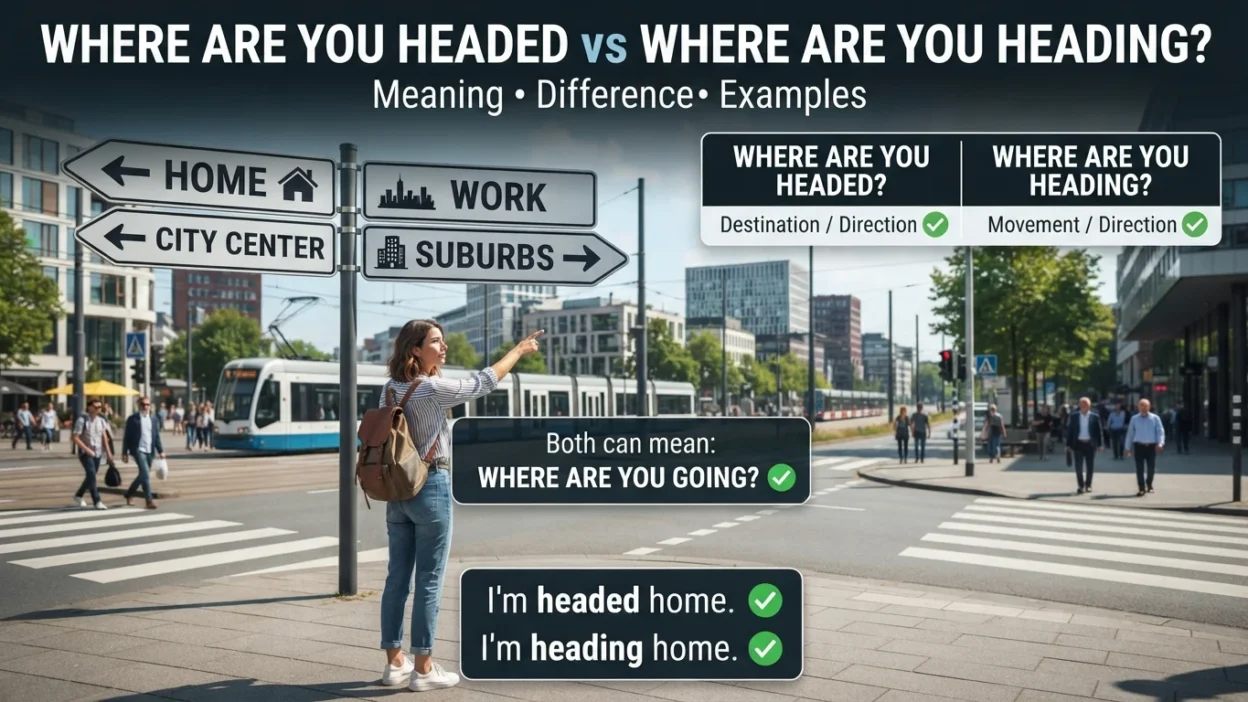
If you have ever wondered about where are you headed vs where are you heading, you are not alone. Both expressions are common in English, and both can be used when asking someone about their destination or future direction. The difference is subtle, which can make the two phrases confusing for English learners.
In most everyday situations, where are you headed and where are you heading have essentially the same meaning. Both can ask where someone is going. The main difference is related to verb form, tone, and context rather than a major difference in meaning. Understanding these small differences will help you choose the most natural expression in conversations, writing, and professional communication.
Quick Answer: Where Are You Headed vs Where Are You Heading
Both expressions can mean:
Where are you going?
Examples:
Where are you headed?
Where are you heading?
Both can be used to ask about someone’s destination.
The main difference is grammatical:
- Where are you headed? uses headed as a past participle functioning as part of a descriptive construction.
- Where are you heading? uses heading as the present participle of head.
- Both expressions are natural in modern English.
- Where are you headed? can sound slightly more conversational and direct.
- Where are you heading? can emphasize the action or direction of going somewhere.
What Does Where Are You Headed Mean?
Where are you headed? is a common way to ask someone where they are going.
For example:
Where are you headed after work?
This asks about the person’s destination after work.
You might also hear:
Where are you headed this weekend?
This asks about the person’s plans or destination.
The word headed can describe movement toward a particular destination or goal.
It can be used for physical movement:
Where are you headed now?
It can also be used more figuratively:
Where is this project headed?
Here, the question is about the future direction or likely outcome of the project.
What Does Where Are You Heading Mean?
Where are you heading? also asks about someone’s destination or direction.
For example:
Where are you heading after lunch?
Where are you heading tonight?
Where are you heading with that idea?
The present participle heading emphasizes the action or process of moving toward something.
Like headed, heading can describe both physical and figurative direction.
For example:
Where are you heading?
This can mean where you are physically going.
Where is the company heading?
This can mean what direction the company is moving toward or what its future may look like.
Where Are You Headed vs Where Are You Heading Comparison
| Expression | Basic Meaning | Typical Tone | Common Use |
|---|---|---|---|
| Where are you headed? | Where are you going? | Casual and direct | Everyday conversation |
| Where are you heading? | Where are you going? | Natural and conversational | Everyday conversation |
| Where are you going? | What is your destination? | Very neutral | General use |
| Where are you bound? | What is your destination? | More formal or literary | Travel and formal contexts |
| Where are you off to? | Where are you going? | Very casual | Friendly conversation |
In ordinary conversation, the first three can often be used interchangeably.
Is Where Are You Headed Correct?
Yes. Where are you headed? is completely correct and very common.
Examples:
Where are you headed?
Where are you headed after the meeting?
Where are you headed this evening?
Where are you headed for the holidays?
The expression is especially natural when the speaker wants to know someone’s destination or intended direction.
Is Where Are You Heading Correct?
Yes. Where are you heading? is also completely correct.
Examples:
Where are you heading now?
Where are you heading after class?
Where are you heading this weekend?
Where are you heading with all those books?
There is no grammatical problem with this construction.
Headed vs Heading: The Grammar
The difference becomes clearer when we look at the words themselves.
Head can be used as a verb meaning to move toward a particular destination.
For example:
We are heading home.
The form heading is the present participle and can be used with forms of be to create the present progressive.
We are heading home.
The word headed is the past participle of head.
It can appear in constructions such as:
We are headed home.
This construction describes the current direction or destination.
Both are grammatical:
We are heading home.
We are headed home.
The first emphasizes the action of going. The second emphasizes the direction or destination.
Where Are You Headed or Where Are You Heading for Travel?
Both forms work naturally when talking about travel.
For example:
Where are you headed for your vacation?
Where are you heading for your vacation?
Both can ask about the destination.
However, where are you headed can sometimes sound especially natural when someone is already moving or appears to be on their way somewhere.
For example:
You have your suitcase ready. Where are you headed?
The focus is on the destination.
Where Are You Headed or Where Are You Heading for Plans?
The expressions can also be used to ask about plans.
Where are you headed this weekend?
Where are you heading this weekend?
Both can mean:
What are your plans for the weekend?
The exact interpretation depends on context.
If someone is standing at a train station, the question may refer to a physical destination.
If friends are discussing weekend plans, it may refer to travel or activities.
Figurative Uses of Headed and Heading
Both forms can describe direction in a non-physical sense.
For example:
Where is your career headed?
This asks about the future direction of someone’s career.
Similarly:
Where is your career heading?
This has essentially the same meaning.
You can also say:
The economy is headed for difficult times.
The economy is heading toward difficult times.
In the first sentence, headed emphasizes the direction or likely outcome.
In the second, heading emphasizes the ongoing movement toward that outcome.
Common Mistakes
Mistake 1: Thinking One Form Is Incorrect
Neither where are you headed nor where are you heading is incorrect.
Both are established English expressions.
Mistake 2: Assuming They Always Have Completely Different Meanings
In everyday questions about someone’s destination, they are usually interchangeable.
Where are you headed?
Where are you heading?
Both normally mean where are you going.
Mistake 3: Using Where Are You Headed When You Mean Where Have You Been
These expressions concern direction or destination.
If you want to ask about someone’s previous location, use:
Where have you been?
Mistake 4: Confusing Headed With Heading
Remember:
We are headed home.
We are heading home.
Both are correct, but they structure the idea of direction slightly differently.
American vs British English
Both where are you headed and where are you heading are used in American and British English.
There is no major American-British difference in their basic meanings.
British speakers may also commonly use expressions such as:
Where are you off to?
American speakers can understand this easily, but where are you going, where are you headed, and where are you heading are broadly understandable in both varieties.
The choice often depends more on personal style and context than on regional grammar.
Which One Sounds More Natural?
Both are natural, but the choice can depend on the situation.
Where are you headed? can sound slightly more direct and destination-focused.
Where are you heading? can sound slightly more focused on the action or direction of movement.
For example:
Where are you headed after work?
This naturally asks about the destination.
Where are you heading now?
This can emphasize the person’s immediate movement.
However, these differences are subtle. Native speakers frequently use the two expressions in similar situations.
Where Are You Going vs Where Are You Headed
Where are you going? is the most neutral and universally straightforward option.
Where are you headed? sounds a little more conversational.
Where are you heading? is also conversational and natural.
Compare:
Where are you going?
Very neutral.
Where are you headed?
Friendly and conversational.
Where are you heading?
Conversational and slightly directional.
All three can be correct.
FAQs
1. What is the difference between where are you headed and where are you heading?
Both usually mean where are you going. Headed emphasizes the destination or direction, while heading can emphasize the action of moving toward it.
2. Is where are you headed grammatically correct?
Yes. It is a standard and very common English expression.
3. Is where are you heading correct?
Yes. It is also grammatically correct and widely used in both American and British English.
4. Which is more natural, where are you headed or where are you heading?
Both are natural. Where are you headed can sound slightly more destination-focused, while where are you heading can emphasize ongoing movement.
5. Can headed and heading be used interchangeably?
In many everyday situations, yes. For example, we are headed home and we are heading home communicate essentially the same idea.
6. Is where are you headed formal?
It is generally conversational rather than highly formal. It is perfectly appropriate for everyday communication.
7. Is where are you heading American or British English?
It is used in both American and British English.
8. What is the simplest alternative to both expressions?
The simplest alternative is where are you going? It is neutral and works in almost every everyday situation.
Final Summary
The difference between where are you headed vs where are you heading is relatively small. Both expressions are correct and commonly used to ask about someone’s destination, direction, or future movement. Where are you headed? often puts slightly more emphasis on the destination, while where are you heading? can place slightly more emphasis on the action or direction of movement.
In everyday English, however, native speakers often use the two forms interchangeably. Both American and British English use them naturally. If you want the simplest neutral question, where are you going? is always a reliable choice. If you want a more conversational expression, either where are you headed? or where are you heading? works well.