
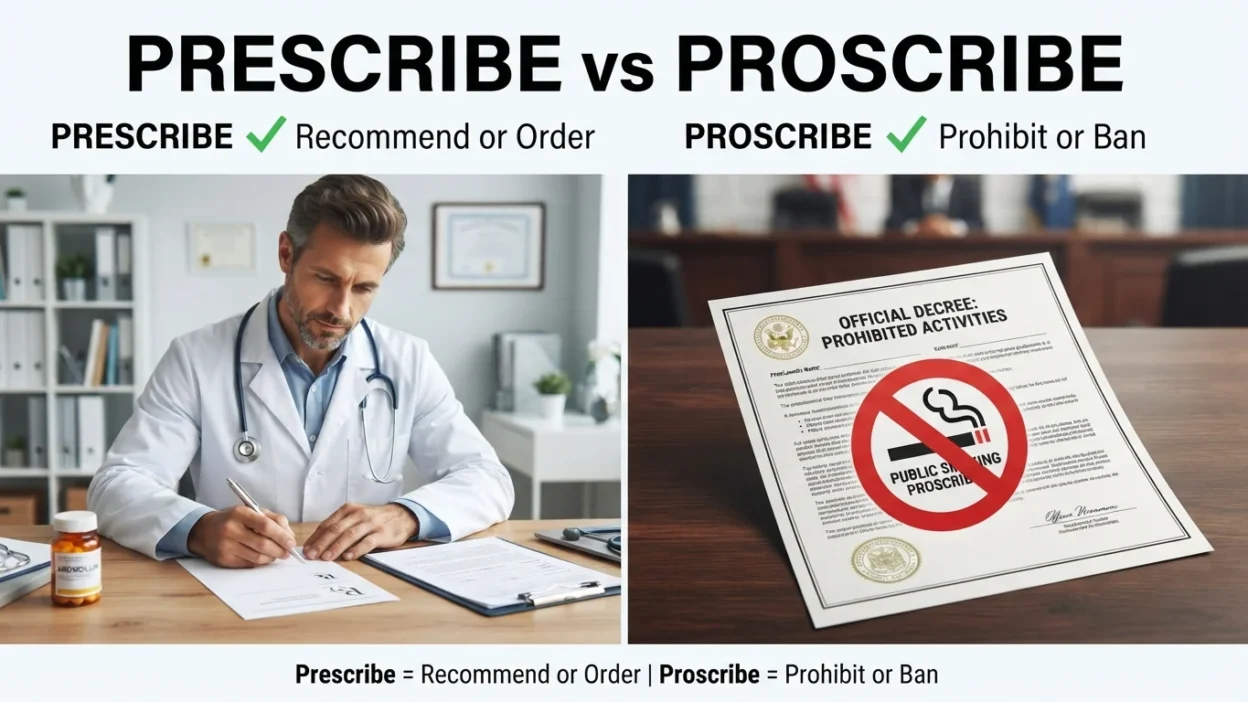
The difference between prescribe vs proscribe can be confusing because these two words look and sound very similar. However, their meanings are almost opposite. One is commonly associated with recommending or officially ordering something, while the other means to forbid or prohibit it.
Understanding prescribe vs proscribe is especially important in professional, medical, legal, and academic writing. A single letter can completely change the meaning of a sentence. In this guide, we’ll explain the difference in simple language, provide clear examples, compare American and British English usage, highlight common mistakes, and give you an easy memory trick to remember which word to use.
Quick Answer: Prescribe vs Proscribe
The simplest way to remember the difference is:
- Prescribe = to recommend, order, or officially establish something.
- Proscribe = to forbid, ban, or officially prohibit something.
Simple Examples
The doctor prescribed antibiotics for the infection.
This means the doctor officially ordered or recommended the medicine.
The school proscribed the use of mobile phones during examinations.
This means the school prohibited or banned mobile phone use during exams.
Easy Memory Trick
Think:
PREscribe = PREscribe something for you
PROscribe = PROhibit something
The words have different meanings even though they look very similar.
What Does “Prescribe” Mean?
The verb prescribe means to recommend, order, or officially state that something should be done.
The word is most commonly associated with doctors and medicine.
For example:
The doctor prescribed medication for the patient.
This means the doctor officially instructed the patient to take the medication.
However, prescribe has a broader meaning. It can also refer to rules, instructions, or requirements established by an authority.
For example:
The law prescribes certain safety standards for businesses.
Here, prescribes means the law officially requires or establishes those standards.
Common Synonyms for Prescribe
Depending on the context, synonyms include:
- Recommend
- Order
- Advise
- Direct
- Specify
- Require
- Establish
- Set out
The exact synonym depends on how prescribe is being used.
What Does “Proscribe” Mean?
The verb proscribe means to officially forbid, prohibit, or ban something.
For example:
The organization proscribed discriminatory behavior.
This means the organization officially prohibited such behavior.
Another example:
The government proscribed certain activities under the new law.
Here, proscribed means officially banned or prohibited.
Common Synonyms for Proscribe
Depending on the context, synonyms include:
- Prohibit
- Ban
- Forbid
- Outlaw
- Disallow
- Prevent
- Restrict
Unlike prescribe, which generally tells you what should be done, proscribe tells you what must not be done.
Prescribe vs Proscribe: Comparison Table
| Feature | Prescribe | Proscribe |
|---|---|---|
| Basic meaning | To recommend, order, or establish | To forbid or prohibit |
| Main idea | What should be done | What must not be done |
| Common context | Medicine, rules, requirements | Laws, rules, bans, restrictions |
| Example | The doctor prescribed medicine. | The law proscribed the activity. |
| Similar words | Recommend, order, require | Ban, prohibit, forbid |
| Memory clue | Prescription = something ordered | Proscribe = prohibit |
| Opposite idea | Require or recommend | Ban or forbid |
The key difference is simple:
Prescribe = say what is allowed, required, or recommended.
Proscribe = say what is forbidden or prohibited.
Prescribe Examples
Let’s look at some examples to understand prescribe more clearly.
Example 1: Medicine
The doctor prescribed a new medication.
The doctor officially ordered or recommended the medication.
Example 2: Treatment
The physician prescribed physical therapy for the patient’s recovery.
The physician recommended or ordered physical therapy.
Example 3: Rules
The regulations prescribe strict safety procedures.
The regulations officially establish or require certain procedures.
Example 4: Instructions
The manual prescribes a specific method for installing the equipment.
The manual specifies how the installation should be done.
Example 5: Requirements
The law prescribes minimum standards for workplace safety.
The law establishes or requires those standards.
In each example, prescribe involves telling someone what should be done, what is required, or what is recommended.
Proscribe Examples
Now let’s examine proscribe in context.
Example 1: Prohibited Behavior
The company proscribes harassment in the workplace.
The company officially prohibits harassment.
Example 2: Legal Restrictions
The law proscribes certain types of conduct.
The law forbids that conduct.
Example 3: School Rules
The school proscribes cheating during examinations.
The school officially prohibits cheating.
Example 4: Organizational Policies
The organization proscribes the use of confidential information for personal gain.
The organization bans this behavior.
Example 5: Historical Usage
The government once proscribed the organization.
This means the organization was officially banned or outlawed.
The common idea in all these examples is prohibition.
Prescribe vs Proscribe: The Main Difference
The easiest way to distinguish these words is to focus on the direction of the action.
When you prescribe something, you say:
“This is what you should do.”
When you proscribe something, you say:
“This is what you must not do.”
Compare these sentences:
The doctor prescribed rest.
This means the doctor recommended or ordered rest.
The doctor proscribed strenuous activity.
This means the doctor prohibited strenuous activity.
The two words can therefore appear in the same general context but have completely different meanings.
Common Mistakes
Mistake 1: Using “Proscribe” When You Mean “Prescribe”
Incorrect:
The doctor proscribed antibiotics for the patient.
If you mean the doctor ordered antibiotics, this is incorrect.
Correct:
The doctor prescribed antibiotics for the patient.
Mistake 2: Using “Prescribe” When You Mean “Proscribe”
Incorrect:
The law prescribes illegal dumping.
If you mean the law bans illegal dumping, use proscribes.
Correct:
The law proscribes illegal dumping.
Mistake 3: Assuming “Proscribe” Means “Recommend”
Because the two words look similar, learners sometimes confuse them.
Remember:
Prescribe = recommend or order
Proscribe = prohibit or ban
Mistake 4: Confusing “Proscribe” With “Describe”
These words are completely different.
Describe means to explain what something is like.
Proscribe means to officially prohibit something.
For example:
She described the new policy.
The policy proscribed certain activities.
Prescribe vs Proscribe in Medical Contexts
The word prescribe is extremely common in healthcare.
Doctors may prescribe:
- Medicine
- Treatment
- Physical therapy
- Rest
- A specific diet
- Medical tests
For example:
The doctor prescribed medication for the patient.
The doctor prescribed regular exercise as part of the treatment plan.
The word proscribe is much less common in everyday medical conversations. However, it can be used when discussing something that is officially forbidden or prohibited.
For example:
The doctor proscribed strenuous exercise during recovery.
In ordinary conversation, people may be more likely to say prohibited, advised against, or told the patient not to.
Prescribe vs Proscribe in Legal and Formal Writing
Both words can appear in formal or legal writing.
Prescribe is used when laws or regulations establish requirements.
The regulation prescribes specific safety measures.
This means the regulation requires or establishes those measures.
Proscribe is used when laws or regulations prohibit something.
The law proscribes discrimination.
This means the law prohibits discrimination.
Because these words have precise meanings, choosing the correct one is especially important in formal writing.
American English vs British English
There is no significant spelling difference between American and British English for prescribe and proscribe.
Both varieties use:
Prescribe
and:
Proscribe
The meanings are also essentially the same.
For example, in both American and British English:
The doctor prescribed medication.
means the doctor officially ordered or recommended medication.
Similarly:
The law proscribes certain activities.
means the law prohibits those activities.
The main difference is not regional spelling but frequency and context. Prescribe is much more common in everyday English, particularly in healthcare, while proscribe is more formal and often appears in legal, academic, or policy-related writing.
Prescribe vs Proscribe: A Simple Memory Trick
Here is an easy way to remember the difference.
PREscribe = PREscription
When a doctor writes a prescription, they are telling you what medicine or treatment you should take.
So:
PREscribe = recommend or order
PROscribe = PROhibit
Think of the first letters:
PROscribe → PROhibit
Both words relate to stopping or banning something.
So:
PROscribe = prohibit or ban
This simple connection can help you remember the difference quickly.
Are Prescribe and Proscribe Opposites?
They can be considered opposites in some contexts, but they are not exact opposites in every situation.
Prescribe generally means to recommend, order, require, or establish something.
Proscribe means to prohibit or ban something.
For example:
The rules prescribe the use of safety equipment.
The rules proscribe unsafe behavior.
The first tells people what they must do, while the second tells them what they must not do.
FAQs
1. What is the difference between prescribe and proscribe?
Prescribe means to recommend, order, require, or officially establish something. Proscribe means to prohibit, forbid, or ban something.
2. Does a doctor prescribe or proscribe medicine?
A doctor prescribes medicine. For example: The doctor prescribed antibiotics.
3. Does proscribe mean prohibit?
Yes. Proscribe means to officially prohibit, forbid, or ban something.
4. Is prescribe the opposite of proscribe?
They can express opposite ideas in some contexts. Prescribe often indicates what should or must be done, while proscribe indicates what must not be done.
5. Is proscribe a common word?
Proscribe is a correct English word, but it is less common than prescribe. It is more frequently found in formal, legal, academic, and policy-related writing.
6. Are prescribe and proscribe pronounced differently?
Yes. Although they look similar, they have different vowel sounds. Prescribe begins with a sound like “pri-,” while proscribe begins with a sound like “pro-.”
7. Is prescribe used only for medicine?
No. It can also mean to establish, specify, require, or set out rules or procedures.
8. How can I remember prescribe vs proscribe?
Remember prescribe = prescription, something recommended or ordered. Remember proscribe = prohibit, something officially banned or forbidden.
Final Summary
The difference between prescribe vs proscribe is important because these words have nearly opposite meanings. Prescribe means to recommend, order, require, or officially establish something. It is commonly used when talking about medicine, treatment, rules, and requirements. For example, a doctor prescribes medication, while a regulation may prescribe certain safety standards.
Proscribe, on the other hand, means to officially forbid, prohibit, or ban something. It is often used in legal, academic, governmental, and formal contexts. A law can proscribe certain activities, and an organization can proscribe certain types of behavior. The easiest distinction is simple: prescribe tells you what should be done, while proscribe tells you what must not be done.