The difference between elegy vs eulogy can be confusing because both words are closely connected with death, grief, remembrance, and honoring someone who has passed away. They are often used in similar conversations, but they describe different things. Understanding the distinction can help you choose the right word when writing, speaking, or discussing memorial traditions.
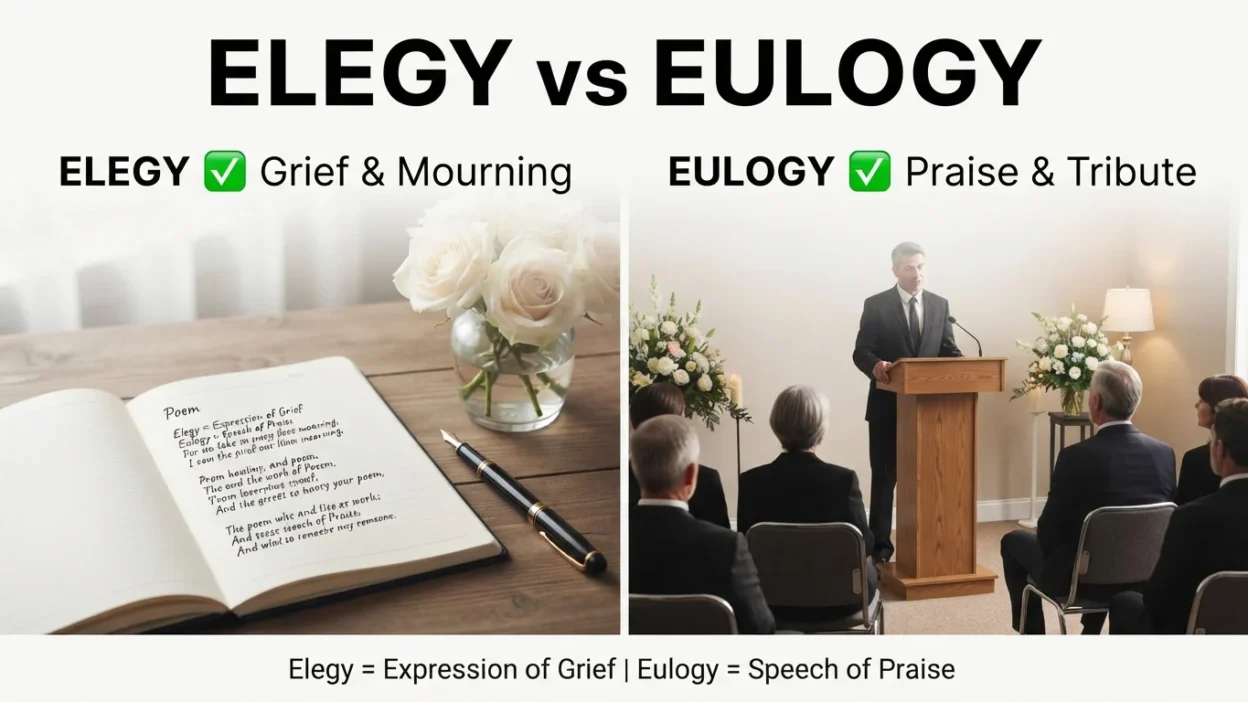
In simple terms, an elegy is a poem, song, or piece of writing that expresses grief or sorrow, often for someone who has died. A eulogy, on the other hand, is a speech or piece of writing that praises and remembers a person, usually delivered at a funeral or memorial service. Although both can honor the deceased, their purpose, form, and typical setting are different.
Quick Answer: Elegy vs Eulogy
Here is the easiest way to remember the difference:
- Elegy = a poem, song, or literary work expressing sorrow or mourning, especially for someone who has died.
- Eulogy = a speech or written tribute praising and remembering someone who has died.
Simple Examples
Elegy:
The poet wrote an elegy mourning the death of his friend.
Eulogy:
Her daughter delivered a heartfelt eulogy at the funeral.
An elegy is usually associated with poetry and literary expression, while a eulogy is usually associated with a spoken tribute or memorial speech.
What Does “Elegy” Mean?
An elegy is a poem, song, or other piece of writing that expresses sadness, grief, or mourning. It is traditionally associated with the death of a person, although the word can sometimes be used more broadly to describe a work mourning the loss of something.
The word comes from the Greek tradition of elegeia, referring to a type of poetic composition associated with mourning and reflection.
An elegy often explores themes such as:
- Death and loss
- Grief and sadness
- Memories of the deceased
- The passage of time
- The meaning of life
- Human mortality
- Acceptance and remembrance
An elegy does not have to be delivered at a funeral. It can be written long after someone’s death and may be published as a poem, song, or literary work.
Example of Elegy
The poet wrote a moving elegy for his late friend.
This means the poet created a literary work expressing grief and remembrance.
Another example:
The poem is an elegy for the soldiers who died in the war.
Here, the poem mourns the loss of the soldiers.
What Does “Eulogy” Mean?
A eulogy is a speech or piece of writing that praises and remembers a person who has died.
A eulogy is most commonly delivered at a:
- Funeral
- Memorial service
- Celebration of life
- Religious service
A eulogy often includes personal memories, stories, achievements, qualities, and expressions of love or respect.
For example:
James gave a touching eulogy for his father.
This means James delivered a speech honoring and remembering his father after his death.
A eulogy is generally intended to celebrate the person’s life while also acknowledging the loss felt by family and friends.
Elegy vs Eulogy: Comparison Table
| Feature | Elegy | Eulogy |
|---|---|---|
| Basic meaning | A work expressing grief or mourning | A speech or tribute praising someone who died |
| Typical form | Poem, song, or literary work | Speech or written tribute |
| Main purpose | Express sorrow, grief, and reflection | Honor, praise, and remember the deceased |
| Common setting | Literature, poetry, music | Funeral or memorial service |
| Usually spoken at a funeral? | Not necessarily | Very often |
| Can be written? | Yes | Yes |
| Focus | Mourning and reflection | Remembrance and praise |
| Example | A poem mourning a friend’s death | A daughter’s speech at her father’s funeral |
The main distinction is form and purpose.
An elegy focuses more on mourning, grief, and reflection.
A eulogy focuses more on honoring, praising, and remembering a person.
Elegy vs Eulogy: The Main Difference
The easiest way to understand the difference is to imagine two situations.
A poet loses a close friend and writes a poem about the person’s death, their memories together, and the pain of loss. That poem is an elegy.
At the friend’s funeral, another person stands before the family and friends and talks about the friend’s personality, achievements, kindness, and memorable moments. That speech is a eulogy.
Both may express sadness. Both may honor someone who has died. However, the elegy is generally a creative or literary expression of grief, while the eulogy is generally a tribute or speech praising the deceased.
Examples of “Elegy”
Here are some examples that show how elegy is used.
The writer composed an elegy after the death of his mentor.
The poem serves as an elegy for a lost generation.
She wrote an elegy expressing her grief and memories.
The musician performed an elegy in memory of his friend.
The novel has been described as an elegy for a disappearing way of life.
Notice that an elegy does not always have to be about one specific person. It can also mourn the loss of a culture, era, place, or way of life.
For example:
The book is an elegy for the old neighborhood.
Here, the word suggests that the book expresses sadness or nostalgia about something that has disappeared or changed.
Examples of “Eulogy”
Here are some examples of eulogy in everyday English.
She delivered a beautiful eulogy at her mother’s funeral.
His brother gave the eulogy during the memorial service.
The eulogy included funny stories from his childhood.
The family asked a close friend to give the eulogy.
She wrote a eulogy to honor her grandfather’s life.
A eulogy usually has a personal and respectful tone. It may include both sadness and positive memories.
What Is the Difference Between a Eulogy and a Funeral Speech?
A eulogy is a specific type of funeral or memorial speech that focuses on honoring and remembering the deceased.
A funeral speech is a broader term. It can refer to any speech delivered at a funeral.
For example, a religious leader might give a sermon, while a family member might give a eulogy.
Therefore, all eulogies can be considered funeral or memorial speeches, but not every funeral speech is necessarily a eulogy.
Can an Elegy Be a Eulogy?
Sometimes, the ideas can overlap, but they are not exactly the same.
A eulogy can contain poetic or elegiac elements. A person giving a eulogy may express deep grief and use beautiful, emotional language.
Likewise, an elegy can praise and remember the person who has died.
However, the terms still have different traditional meanings:
Elegy emphasizes the literary or artistic expression of grief.
Eulogy emphasizes the tribute or praise of the deceased.
The context usually makes the difference clear.
Common Mistakes With Elegy vs Eulogy
Mistake 1: Calling Every Funeral Speech an Elegy
Incorrect usage:
She gave an elegy at her father’s funeral.
This may be understandable, but eulogy is usually the more precise word if she delivered a speech honoring her father.
Better:
She gave a eulogy at her father’s funeral.
Mistake 2: Thinking an Elegy Must Be Spoken at a Funeral
An elegy does not have to be delivered at a funeral.
It can be a poem, song, or literary work written at any time.
For example:
The poet wrote an elegy years after his friend’s death.
Mistake 3: Assuming a Eulogy Is Always a Poem
A eulogy is most commonly a speech or tribute.
For example:
Her brother delivered a eulogy at the memorial service.
It can be written down, but it is generally not considered a specific poetic genre.
Mistake 4: Using the Words Interchangeably
Although both words are connected to death and remembrance, they are not perfect synonyms.
Remember:
Elegy = mourning or grief expressed through a literary or artistic work.
Eulogy = praise and remembrance expressed through a tribute or speech.
American English vs British English
There is no major difference between American and British English in the meanings of elegy and eulogy.
Both varieties use elegy to describe a poem, song, or literary work expressing grief or mourning.
Both also use eulogy to describe a speech or tribute honoring someone who has died.
For example, American and British speakers can both say:
She delivered a eulogy at the funeral.
They can also say:
The poet wrote an elegy for his friend.
The main difference is not regional usage but the context in which the words are used.
How to Remember Elegy vs Eulogy
Here is a simple memory trick.
Elegy = Expression of Grief
Think:
ELEGY → EMOTION
An elegy is often a creative expression of grief, sorrow, or mourning.
Eulogy = Eulogize
Think:
EULOGY → EULOGIZE
To eulogize someone means to speak or write about them with praise.
This gives you an easy connection:
Elegy → grief and mourning
Eulogy → praise and tribute
You can also remember that a eulogy is something you might hear at a funeral, while an elegy is something you might read as a poem.
FAQs
1. What is the difference between an elegy and a eulogy?
An elegy is usually a poem, song, or literary work expressing grief or mourning. A eulogy is usually a speech or tribute praising and remembering someone who has died.
2. Is a eulogy a poem?
Usually, no. A eulogy is generally a speech or written tribute delivered in honor of someone who has died. It can contain poetic language, but it is not normally defined as a poem.
3. Is an elegy always about death?
Traditionally, an elegy is associated with death and mourning. However, the word can also be used more broadly for a work that expresses sadness about the loss or disappearance of something.
4. Is a eulogy given at a funeral?
Often, yes. A eulogy is commonly delivered at a funeral, memorial service, or celebration of life, although it can also be presented in other settings.
5. Can an elegy be spoken?
Yes. An elegy can be read aloud or performed, especially if it is a poem or song. However, its defining feature is its expression of grief or mourning rather than the setting in which it is presented.
6. Can an elegy and a eulogy be about the same person?
Yes. A poet might write an elegy about someone, while a family member might deliver a eulogy for the same person. Both can honor the deceased but serve different purposes.
7. Which word is more appropriate for a funeral speech?
Eulogy is usually the correct word for a speech that praises and remembers someone who has died.
8. Are elegy and eulogy synonyms?
Not exactly. They are related words, but an elegy focuses more on mourning and grief, while a eulogy focuses more on praise and remembrance.
Final Summary
The difference between elegy vs eulogy becomes much easier when you focus on their purpose. An elegy is generally a poem, song, or literary work that expresses grief, sorrow, and reflection, often following the death of someone. It can also be used more broadly to mourn the loss of a place, culture, era, or way of life. A eulogy, by contrast, is usually a speech or written tribute that honors, praises, and remembers someone who has died.
Both words are connected to loss and remembrance, and both can express sadness and appreciation. However, if you’re talking about a speech delivered at a funeral or memorial service, eulogy is usually the right choice. If you’re talking about a poem or artistic work expressing grief or mourning, elegy is generally the better word.