Have you ever typed propose when you meant purpose, or paused to wonder whether these two words are related? You’re not alone.
Because propose and purpose look and sound somewhat similar, many English learners—and even native speakers—occasionally confuse them. However, they have completely different meanings and grammatical roles.
Understanding the difference between propose vs purpose will help you write and speak more accurately.
If you’re drafting an email, preparing a business proposal, writing an essay, or simply improving your English vocabulary, knowing when to use each word can make your communication clearer and more professional.
This guide explains the meanings, grammar, examples, common mistakes, and practical usage of both words.
Quick Answer
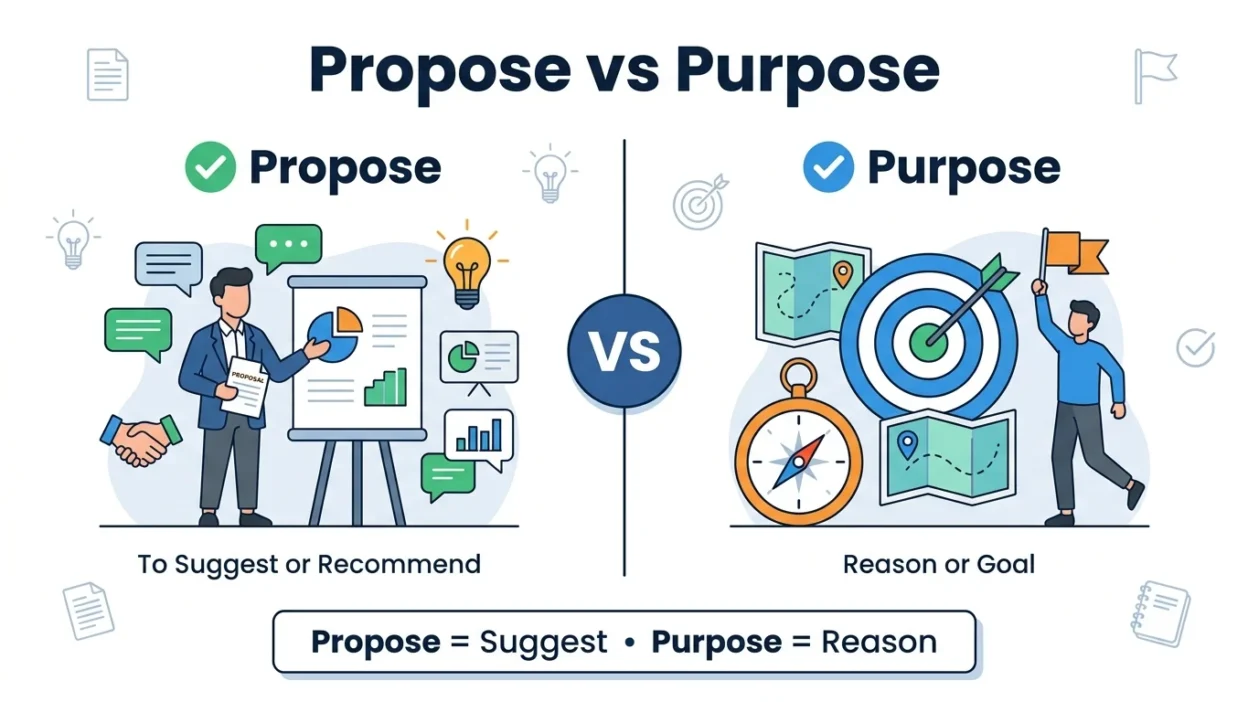
The difference between propose and purpose is simple:
- Propose is usually a verb that means to suggest, recommend, or offer an idea or plan.
- Purpose is usually a noun that means the reason something exists or the goal it is meant to achieve.
Examples
- I propose a new marketing strategy. ✅
- The purpose of this meeting is to discuss next year’s budget. ✅
Although the words sound similar, they are not interchangeable.
What Does “Propose” Mean?
Propose is primarily a verb. It means to put forward an idea, suggestion, plan, or offer for others to consider.
Depending on the context, propose can also mean asking someone to marry you.
Common Meanings of Propose
1. To Suggest an Idea
- I propose we start the meeting at 9 AM.
- She proposed a new solution to the problem.
2. To Recommend a Plan
- The committee proposed several changes.
- We propose increasing the budget next year.
3. To Ask Someone to Marry You
- He proposed during their vacation.
- She said yes when he proposed.
What Does “Purpose” Mean?
Purpose is most commonly used as a noun.
It refers to the reason, intention, function, or objective behind an action or object.
Common Meanings of Purpose
1. Reason
- The purpose of education is to develop knowledge.
- What is the purpose of this exercise?
2. Goal
- Her purpose is to help others.
- Every project should have a clear purpose.
3. Function
- The purpose of a key is to unlock a door.
- This tool serves a specific purpose.
Although purpose can occasionally function as a verb (meaning to intend), that use is relatively formal and much less common than the noun form.
Propose vs Purpose: Key Difference
The easiest way to remember the difference is to focus on what each word does.
| Feature | Propose | Purpose |
|---|---|---|
| Part of speech | Usually a verb | Usually a noun |
| Main meaning | Suggest or recommend | Reason or goal |
| Common use | Ideas, plans, marriage | Objectives, functions, intentions |
| Formal writing | Very common | Very common |
| Everyday conversation | Common | Common |
In short:
- Propose = suggest.
- Purpose = reason.
When Should You Use “Propose”?
Use propose whenever you’re introducing an idea, recommendation, solution, or plan.
Common situations include:
- Business meetings
- Academic writing
- Government proposals
- Team discussions
- Marriage proposals
Examples
- I propose a different approach.
- The manager proposed hiring more staff.
- Scientists proposed a new theory.
- We propose extending the deadline.
- He proposed marriage on their anniversary.
Notice that every sentence involves introducing an idea or offer.
When Should You Use “Purpose”?
Use purpose when discussing the reason something exists or the goal behind an action.
Common situations include:
- Explaining objectives
- Defining functions
- Writing mission statements
- Academic essays
- Everyday conversations
Examples
- The purpose of this lesson is to improve grammar.
- Our company’s purpose is to serve customers.
- Every invention has a purpose.
- The main purpose of exercise is better health.
- She finally found her purpose in life.
Understanding the Difference Through Context
Let’s compare similar sentences.
Example 1
I propose changing the schedule.
Here, you’re suggesting an action.
Example 2
The purpose of the schedule is to organize everyone’s work.
Here, you’re explaining why the schedule exists.
One introduces an idea.
The other explains a reason.
Common Expressions with “Propose”
You’ll often hear phrases like:
- propose a plan
- propose a solution
- propose an amendment
- propose an idea
- propose a budget
- propose marriage
- formally propose
- propose legislation
These combinations are common in business, politics, and everyday English.
Common Expressions with “Purpose”
Similarly, purpose appears in many familiar expressions.
Examples include:
- life purpose
- sense of purpose
- main purpose
- primary purpose
- for this purpose
- on purpose
- serve a purpose
- clear purpose
- common purpose
- business purpose
Learning these collocations helps your English sound more natural.
Common Mistakes to Avoid
Because these words sound alike, learners often confuse them.
1. Using “Purpose” Instead of “Propose”
Incorrect:
- I purpose a new idea.
Correct:
- I propose a new idea.
2. Using “Propose” Instead of “Purpose”
Incorrect:
- The propose of this project is education.
Correct:
- The purpose of this project is education.
3. Confusing Parts of Speech
Remember:
- Propose is mainly a verb.
- Purpose is mainly a noun.
Thinking about grammar first often helps you choose the correct word.
4. Misspelling the Words
Many learners accidentally write:
- purpos
- propose
- purpose
Double-check your spelling before submitting important writing.
American vs British English
The good news is that propose and purpose are used the same way in both American and British English.
There are:
- no spelling differences
- no grammar differences
- no pronunciation differences that affect meaning
Both varieties follow the same usage rules.
Related Words and Synonyms
Synonyms for Propose
Depending on the context, you can use:
- suggest
- recommend
- offer
- present
- submit
- introduce
- nominate
- advocate
Synonyms for Purpose
You can also use:
- goal
- objective
- aim
- intention
- reason
- mission
- function
- target
- motive
- role
Using these alternatives naturally improves vocabulary and supports SEO without overusing the main keyword.
Tips to Remember the Difference
A simple memory trick can make this distinction easy.
Think of the first few letters.
Propose begins with pro-, reminding you of presenting or putting forward an idea.
Purpose contains the word pose, but think of it as the purpose or reason behind something.
Another quick reminder:
- Propose = Suggest
- Purpose = Reason
If you’re suggesting something, choose propose.
If you’re explaining why something exists, choose purpose.
FAQs
What is the difference between propose and purpose?
Propose means to suggest or recommend something, while purpose refers to the reason or objective behind something.
Is “propose” a noun?
No. Propose is primarily a verb, although related nouns include proposal and proposition.
Is “purpose” always a noun?
Usually, yes. It can occasionally be used as a verb meaning to intend, but that usage is formal and relatively uncommon.
Which word should I use in business writing?
Use propose when suggesting ideas and purpose when explaining objectives or goals.
Do American and British English use these words differently?
No. Both varieties use propose and purpose in the same way.
Can “propose” mean asking someone to marry you?
Yes. One common meaning of propose is to ask someone to marry you.
How can I remember the difference?
Think of propose as suggest and purpose as reason. This simple association works in most situations.
Summary
Understanding propose vs purpose is easier once you recognize their different grammatical roles and meanings. Propose is mainly a verb used when suggesting an idea, plan, solution, or marriage. Purpose, on the other hand, is usually a noun that refers to the reason, goal, or function behind something. Although the words are similar in spelling and pronunciation, they are not interchangeable.
Whether you’re writing an academic paper, preparing a business presentation, or improving your everyday English, using the correct word will make your communication clearer and more professional. Since both American and British English follow the same rules, you can confidently apply these distinctions in any variety of English.
Actionable Takeaway
Whenever you hesitate between propose and purpose, ask yourself one question: Am I suggesting something or explaining why something exists? If you’re introducing an idea, choose propose. If you’re describing a reason, goal, or function, choose purpose. Keeping this simple rule in mind will help you avoid one of the most common vocabulary mix-ups in English.