If you have ever wondered about in vs within, you are not alone. These two prepositions are closely related, especially when talking about time, place, limits, or boundaries. In many sentences, they can even appear interchangeable, which makes the difference confusing for English learners.
The good news is that the distinction becomes much easier once you understand the context. In is usually the more general and natural choice, while within often emphasizes a limit, boundary, or deadline. This guide explains the difference between in and within with clear examples, common mistakes, a comparison table, and useful tips for everyday and formal English.
Quick Answer: In vs Within
In and within can both describe time or location, but they do not always communicate exactly the same idea.
When talking about time:
- In can mean after a certain amount of time has passed.
- Within means at any time before a particular limit or deadline.
For example:
I will finish the work in two hours.
This normally means the work will be finished after approximately two hours.
I will finish the work within two hours.
This means the work will be completed no later than two hours from now.
A simple rule is:
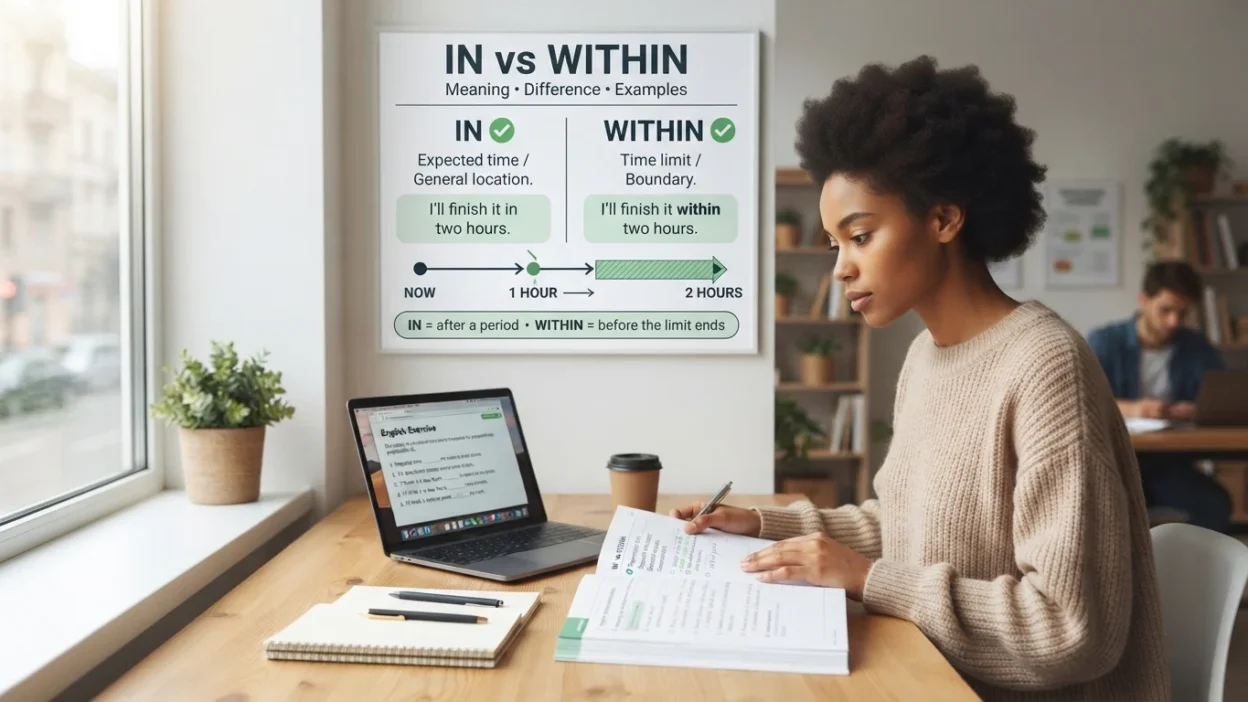
In = after a period of time
Within = before the end of a time limit
However, the distinction can change depending on the context.
What Does In Mean?
In is one of the most common English prepositions. It can describe time, location, inclusion, condition, and many other relationships.
When used with a period of time, in often indicates how long it will take before something happens.
For example:
The train will arrive in ten minutes.
This means the train is expected to arrive ten minutes from now.
I will call you in an hour.
This means the call will happen approximately one hour from now.
She finished the assignment in three days.
Here, in three days indicates the amount of time required to complete the assignment.
The word in is also used for locations:
He is in the room.
She lives in Pakistan.
The keys are in the drawer.
So, in has many uses beyond time.
What Does Within Mean?
Within means inside a particular limit, boundary, or period.
When used with time, it usually means that something will happen before a specified amount of time has passed.
For example:
Please reply within three days.
This means you should reply at any time before the three-day period ends.
It does not necessarily mean you should wait three days.
Another example:
The package should arrive within a week.
This means the package should arrive sometime during the next seven days, but no later than the end of that period.
Within can also describe physical boundaries:
The school is within walking distance.
The village lies within the city limits.
In these examples, within emphasizes being inside a boundary or limit.
In vs Within for Time
Time is where the difference between these words is especially important.
Compare:
I will finish it in two hours.
I will finish it within two hours.
The first sentence generally presents two hours as the expected time before completion.
The second establishes a maximum limit.
If your boss says:
Please complete this task within two hours.
The message is that the task must be completed before the two-hour deadline expires.
You might finish it after 30 minutes, one hour, or one hour and 50 minutes.
Therefore:
In two hours → approximately after two hours
Within two hours → anytime before two hours have passed
Comparison Table: In vs Within
| Feature | In | Within |
|---|---|---|
| Basic idea | During or after a period | Inside a limit or before a deadline |
| Time | Often indicates when something will happen | Indicates the latest allowed time |
| Place | Inside a location | Inside a boundary or limit |
| Tone | General and very common | Often more precise or formal |
| Example | I will return in an hour. | I will return within an hour. |
| Deadline | Less explicit | Strongly emphasizes a limit |
The context is important because in and within can sometimes produce very similar meanings.
Examples of In
Here are some natural examples:
I will see you in a week.
The doctor will arrive in ten minutes.
We moved here in 2020.
She completed the course in six months.
The children are playing in the garden.
There is a restaurant in the building.
He works in an office.
These examples show that in can describe both time and physical location.
Examples of Within
Now consider these examples:
Please respond within 24 hours.
The work must be completed within a week.
The hotel is within walking distance of the station.
The answer can be found within the first chapter.
The temperature remained within normal limits.
The town lies within the national park.
In each example, within emphasizes a boundary, range, or limit.
In Two Days vs Within Two Days
This is one of the most important distinctions to understand.
I will return in two days.
This usually means you expect to return two days from now.
I will return within two days.
This means you will return sometime during the next two days, possibly earlier.
For example, if today is Monday:
I’ll return in two days generally suggests Wednesday.
I’ll return within two days means Tuesday or Wednesday would both satisfy the statement.
The exact interpretation can depend on context, but the deadline idea is much stronger with within.
In an Hour vs Within an Hour
Compare these sentences:
The technician will arrive in an hour.
This suggests the technician is expected approximately one hour from now.
The technician will arrive within an hour.
This means the technician should arrive no later than one hour from now.
The second sentence gives more flexibility about the exact arrival time.
For instructions, deadlines, and service commitments, within is often the better choice.
In Five Minutes vs Within Five Minutes
The food will be ready in five minutes.
This normally gives an expected preparation time.
The food will be ready within five minutes.
This gives a maximum period. The food may be ready sooner.
This distinction is particularly useful in professional communication.
For example:
Our customer service team will respond within 24 hours.
This does not promise that the response will take exactly 24 hours. It establishes the maximum expected period.
In vs Within for Location
The difference is also useful when talking about physical space.
The children are in the playground.
This simply identifies their location.
The children are within the playground area.
This emphasizes that they are inside a particular boundary.
Another example:
The house is in the village.
This simply identifies where the house is located.
The house is within the village boundary.
This emphasizes the limits of the village.
Therefore, within often sounds more precise when boundaries matter.
Within a Range or Limit
Within is commonly used with limits and ranges.
Examples include:
Keep the temperature within the recommended range.
The results are within acceptable limits.
The project stayed within budget.
The building is within the protected area.
Please remain within the designated area.
In these sentences, replacing within with in would often change the meaning or make the sentence sound unnatural.
Common Mistakes With In and Within
Mistake 1: Assuming They Are Always Interchangeable
Although the meanings overlap, they are not always interchangeable.
For example:
Please submit the form within five days.
This clearly establishes a deadline.
Using in five days could suggest that the form should be submitted after five days, which is not the intended meaning.
Mistake 2: Confusing a Deadline With a Future Point
Remember:
In three days often identifies a future point.
Within three days identifies a maximum period.
This is particularly important in instructions.
Mistake 3: Using Within for Every Time Expression
Within is not automatically better or more formal.
For example:
I moved here in 2020.
This is natural.
You would not normally say:
I moved here within 2020.
When referring to a specific year as the time something happened, in is the natural choice.
Mistake 4: Forgetting the Boundary Meaning of Within
Within can refer to physical, numerical, and abstract limits.
For example:
within budget
within the law
within walking distance
within the building
within the limits
Recognizing this broader meaning makes the word easier to use.
In vs Within in Formal and Professional English
Both words are standard English, but within is particularly common when communicating deadlines, policies, requirements, and limits.
For example:
Please submit your application within 14 days.
The company will respond within five business days.
All expenses must remain within the approved budget.
These sentences sound clear and professional because within establishes a specific limit.
In everyday conversation, however, in is often more natural:
I’ll call you in an hour.
I’ll see you in a few days.
American vs British English
There is no major difference between American and British English regarding the basic meanings of in and within.
Both varieties use:
in two hours
and:
within two hours
in essentially the same way.
The distinction is grammatical and contextual rather than regional.
Both American and British speakers commonly use within in formal instructions and deadlines:
Please respond within seven days.
Both also commonly use in for general time expressions:
I’ll be there in ten minutes.
Synonyms and Related Expressions
Depending on the context, alternatives to in and within may include:
- During
- Inside
- Before
- By
- No later than
- Inside the limits of
- During the period of
- Over the course of
For example:
Please respond within three days.
can be expressed as:
Please respond by the end of three days.
or:
Please respond no later than three days from now.
However, within is usually shorter and more natural.
FAQs
1. What is the difference between in and within?
In often indicates when something will happen after a period of time, while within emphasizes that something will happen before a specified limit ends.
2. Is in two hours the same as within two hours?
Not exactly. In two hours usually suggests an expected time around two hours from now. Within two hours means anytime before the two-hour period ends.
3. Is within more formal than in?
Within can sound more precise or formal, especially when discussing deadlines, rules, limits, and requirements. However, it is not simply a formal version of in.
4. Can within be used for location?
Yes. Within can mean inside a physical or abstract boundary.
For example:
The building is within the city limits.
5. Should I say in five days or within five days?
Use in five days when you mean approximately five days from now. Use within five days when you mean any time before five days have passed.
6. Is within used in American English?
Yes. Within is common and standard in American English.
7. Is within used in British English?
Yes. British English also commonly uses within for time limits, physical boundaries, and ranges.
8. Is within interchangeable with by?
Sometimes. For example, within five days and by the end of five days can communicate a similar deadline. However, by has additional uses and is not always a direct replacement.
Final Summary
The difference between in vs within is mainly about how you view time, space, or limits. In is a broad and highly common preposition that can describe a point after a period of time, a location, or a situation. For example, I will call you in two hours generally means the call is expected around two hours from now.
Within, on the other hand, emphasizes a boundary or maximum limit. I will call you within two hours means the call will happen at some point before two hours have passed. The same principle applies to physical space, rules, budgets, ranges, and deadlines. Both expressions are standard in American and British English.