
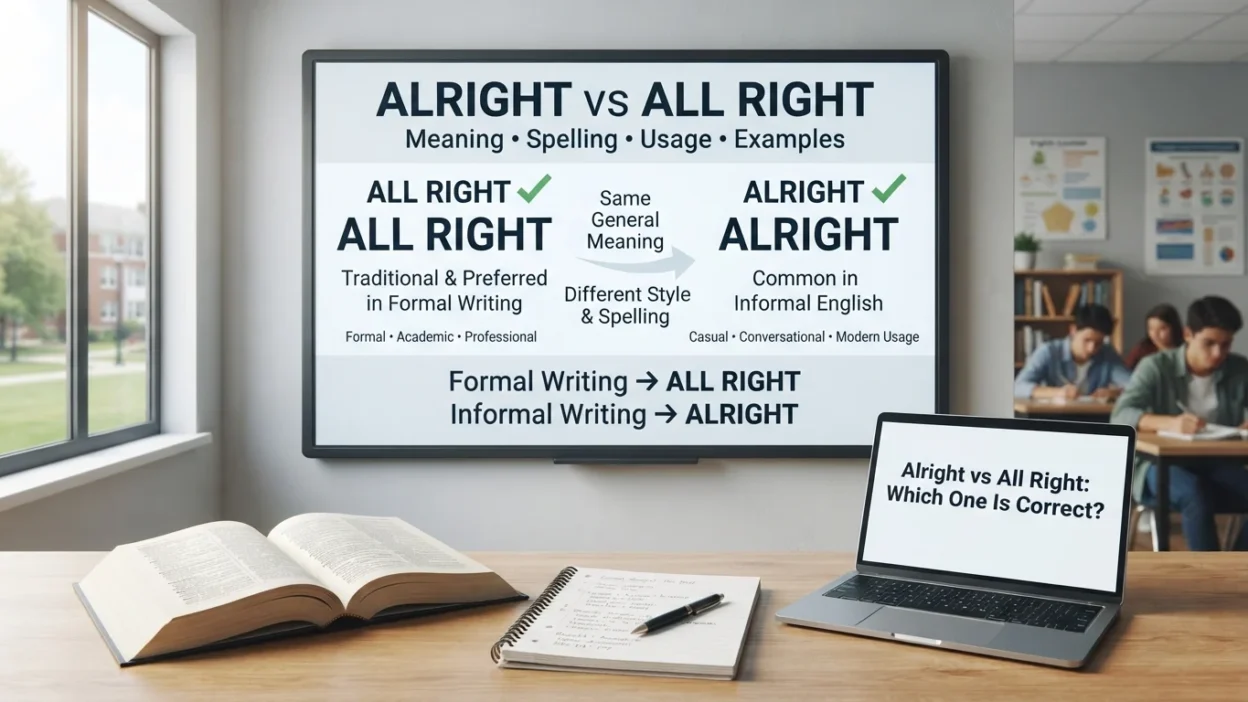
If you have ever wondered about alright vs all right, you are not alone. These two forms look almost identical, and both appear frequently in modern English. The confusion usually comes from deciding whether the expression should be written as one word or two.
The short answer is that all right is the traditional and safest form, especially in formal or academic writing. Alright is also widely used and has become common in informal and everyday English. Understanding the difference in tone, usage, and style will help you choose the right form for every situation.
Quick Answer: Alright vs All Right
All right is the traditional standard form and is the safest choice in formal writing.
Alright is a widely used one-word variant, especially in informal writing and everyday communication.
Both can mean:
- Fine
- Acceptable
- Satisfactory
- Okay
- Safe or unharmed
- Agreement or acceptance
Examples:
Are you all right?
Are you alright?
Both sentences are commonly understood to mean whether someone is okay.
For formal writing, however, all right is generally the better choice.
What Does All Right Mean?
All right is a phrase that can have several meanings depending on the context.
It can mean that something is satisfactory, acceptable, or okay.
For example:
The project is all right, but it could be improved.
It can also describe someone’s condition:
Are you all right?
In other situations, it can express agreement:
All right, let’s begin.
It can even indicate that something has happened successfully:
Everything turned out all right.
Because it has several uses, all right is one of the most versatile expressions in everyday English.
What Does Alright Mean?
Alright is a one-word form of all right that is widely used in modern English, particularly in informal communication.
Examples include:
Are you alright?
Everything will be alright.
Alright, let’s go.
The food was alright.
Many English speakers use alright naturally in conversation, text messages, social media posts, and other informal contexts.
However, some editors, teachers, style guides, and traditional usage authorities still prefer all right, particularly in formal writing.
This means that while alright is widely accepted in everyday usage, all right remains the safer choice when you want to avoid criticism over style.
Alright vs All Right Comparison Table
| Feature | All Right | Alright |
|---|---|---|
| Spelling | Two words | One word |
| Meaning | Fine, okay, satisfactory, safe | Usually the same |
| Formal writing | Preferred | Less preferred by some style guides |
| Informal writing | Common | Very common |
| Conversation | Common | Common |
| Text messages | Common | Very common |
| Academic writing | Safer choice | Usually avoided |
| Meaning difference | Usually none | Usually none |
The key distinction is generally style rather than meaning.
When Should You Use All Right?
Use all right when you want the most traditional and widely accepted form.
It is particularly useful in:
- Academic writing
- School assignments
- Formal reports
- Professional documents
- Business communication
- Edited publications
- Formal essays
For example:
The final report is all right, but several sections need revision.
Are you all right after the accident?
All right, we can proceed with the plan.
Choosing all right in these situations is unlikely to cause a spelling or style objection.
When Is Alright Commonly Used?
Alright is particularly common in informal communication.
You may see it in:
- Text messages
- Social media
- Casual emails
- Online conversations
- Dialogue
- Informal blogs
- Everyday speech
Examples:
Alright, I’ll meet you later.
Are you alright?
It’s alright if you don’t want to come.
The movie was alright.
In casual contexts, alright often feels natural and conversational.
Alright vs All Right in Questions
One of the most common uses of both forms is asking whether someone is okay.
Both are widely understood:
Are you all right?
Are you alright?
The meaning is essentially the same.
If you are writing formally, Are you all right? is the safer version.
For casual texting or conversation, Are you alright? is extremely common.
Alright vs All Right for Agreement
Both forms can also introduce agreement or acceptance.
For example:
All right, let’s start the meeting.
Alright, let’s start the meeting.
The meaning is essentially:
Okay, let’s start the meeting.
This use is particularly common in spoken English and informal dialogue.
In a formal document, however, all right is usually the more conventional choice.
All Right Meaning Fine or Satisfactory
Another common use is to say that something is acceptable but perhaps not excellent.
For example:
The food was all right.
This can suggest that the food was satisfactory but not especially impressive.
Similarly:
The movie was alright.
This usually means the movie was okay, but the speaker did not think it was outstanding.
The context and tone often determine whether the expression sounds positive, neutral, or slightly negative.
All Right Meaning Safe or Well
All right can also refer to someone’s health, safety, or general condition.
For example:
Is your brother all right?
This can mean:
Is your brother safe?
or:
Is your brother okay?
Another example is:
After the difficult journey, everyone was all right.
Here, all right means that everyone was safe or unharmed.
All Right as an Adverb
All right can also function as an adverb meaning satisfactorily or adequately.
For example:
The engine is running all right.
She did all right on the exam.
In these sentences, the expression describes how something is happening or performing.
The one-word form alright is also sometimes used in these contexts, especially in informal English.
Common Mistakes With Alright and All Right
Mistake 1: Assuming Alright Is Always Wrong
This is too absolute.
Alright is widely used in contemporary English and is understood by English speakers around the world.
However, some formal writing standards still prefer all right.
Therefore, it is better to think of alright as a common informal or variant form rather than simply calling it incorrect.
Mistake 2: Assuming the Two Forms Always Have Different Meanings
In most modern uses, alright and all right have essentially the same meaning.
The main difference is spelling and style.
Mistake 3: Using Alright in Formal Writing
Although many readers will understand it perfectly, some teachers, editors, and style guides may prefer all right.
If you are writing an academic assignment or formal document, choosing all right avoids unnecessary style questions.
Mistake 4: Confusing All Right With Allright
The correct forms are:
All right ✓
Alright ✓
Allright ✗
Allright is not the standard spelling.
American vs British English
Both alright and all right appear in American and British English.
There is no simple rule saying that one is exclusively American while the other is exclusively British.
However, formal usage preferences can vary between publications, editors, and style guides.
In both varieties, all right remains the traditional form.
Alright is common in informal communication and has become increasingly familiar in modern English.
If you are writing for an international audience and want the safest standard form, choose all right.
Is Alright Becoming More Accepted?
Yes. Alright has become increasingly common in modern English, particularly in informal writing and digital communication.
Language changes over time, and many speakers naturally use alright without considering it unusual.
It is also frequently found in published writing, dialogue, advertising, and online content.
Nevertheless, the fact that a spelling is widely used does not mean every style guide treats it equally. Some editors continue to prefer the traditional two-word form.
That is why the practical rule is:
Formal writing → all right
Informal writing → alright or all right
All Right vs Okay
Okay and all right are often interchangeable.
For example:
Are you all right?
Are you okay?
Both ask whether someone is fine or safe.
Similarly:
All right, let’s go.
Okay, let’s go.
Both can express agreement or readiness.
However, okay is generally more informal and conversational, while all right can work in both casual and more formal contexts.
FAQs
1. Is alright or all right correct?
Both forms are widely used, but all right is the traditional and safer choice, especially in formal writing. Alright is common in informal modern English.
2. Is alright a real word?
Yes. Alright is widely used as a one-word form of all right. However, some traditional style guides and editors still prefer the two-word form.
3. What is the difference between alright and all right?
In most modern contexts, they have the same basic meaning. The main difference is that all right is the traditional form, while alright is a widely used variant.
4. Should I use all right in an academic paper?
Yes. All right is generally the safer choice for academic, professional, and formal writing.
5. Is alright American or British English?
Alright is used in both American and British English. It is not exclusive to either variety.
6. Is allright correct?
No. The standard forms are all right and alright. Allright is generally considered incorrect.
7. Can alright mean okay?
Yes. For example, Are you alright? can mean Are you okay?
8. Which spelling is best for formal writing?
All right is the best choice for formal writing because it is the traditional form and is accepted by a wider range of formal style preferences.
Final Summary
The difference between alright vs all right is mainly about spelling, style, and formality rather than meaning. Both forms can express ideas such as okay, fine, acceptable, safe, or satisfactory. Both can also be used to express agreement or introduce a decision.
The safest choice depends on your audience and the type of writing. All right remains the traditional and broadly preferred form, making it the best choice for academic, professional, and formal writing. Alright is very common in informal communication and modern everyday English, so you will frequently see it in conversations, messages, social media, and casual writing.