
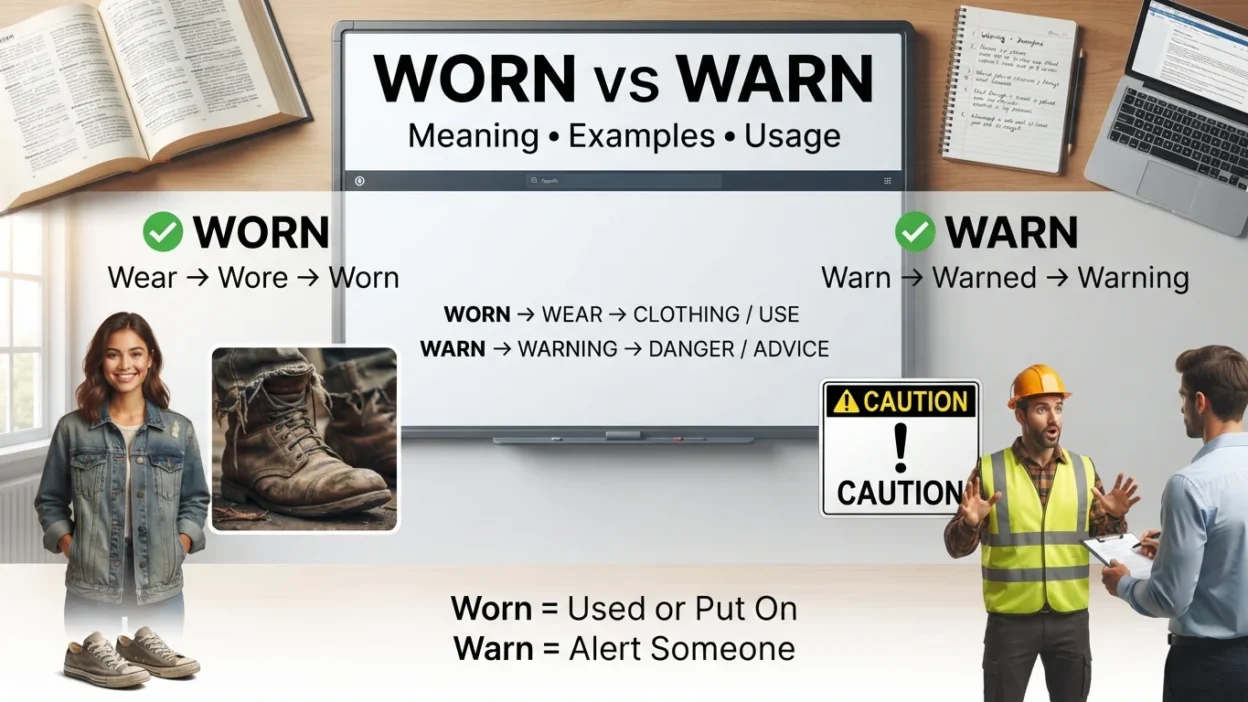
The words worn vs warn are easy to confuse because they look and sound somewhat similar, but they have completely different meanings and grammatical uses. One is connected with wearing or becoming damaged through use, while the other is about giving someone information about a possible danger or problem.
Understanding the difference between worn and warn is important because confusing them can completely change the meaning of a sentence. In this guide, we will explain their meanings, pronunciation, grammar, examples, common mistakes, and American vs British English usage in a simple way.
Quick Answer: Worn vs Warn
The simplest difference is:
- Worn = the past participle of wear, meaning something has been used, carried, or put on.
- Warn = to tell someone about a possible danger, problem, or consequence.
Examples:
She has worn that dress many times.
Here, worn means she has used or put on the dress.
I warned her about the slippery floor.
Here, warned means I told her about a possible danger.
A quick memory trick is:
Worn → wear
Warn → warning
What Does Worn Mean?
Worn is the past participle of the verb wear. It can describe clothing that someone has put on or something that has become damaged, old, or less attractive because of repeated use.
The verb forms are:
Wear → wore → worn
For example:
I wear these shoes every day.
I wore them yesterday.
I have worn them many times.
Worn is commonly used with helping verbs such as has, have, had, is, or was, depending on the sentence.
Worn Meaning Related to Clothing
When worn relates to clothing, it means something has been put on or used as clothing.
Examples:
She has worn this jacket before.
He had worn his new shoes only twice.
I have never worn a suit like this.
In these sentences, worn comes from wear.
Worn Meaning Damaged or Used
Worn can also describe something that has become damaged, faded, rough, or old because it has been used repeatedly.
Examples:
The carpet looks worn.
He was wearing a worn pair of shoes.
The old book had worn pages.
Here, worn does not mean someone put the object on. Instead, it means the object shows signs of repeated use.
What Does Warn Mean?
Warn is a verb meaning to tell someone about a possible danger, problem, risk, or negative consequence.
For example:
The teacher warned the students about the wet floor.
This means the teacher told them to be careful because the floor could be dangerous.
Other examples include:
I warned him not to touch the hot pan.
The doctor warned her about the possible side effects.
They warned us that the road might be closed.
The noun related to warn is warning.
The past tense and past participle are:
warn → warned → warned
Worn vs Warn Comparison Table
| Feature | Worn | Warn |
|---|---|---|
| Word type | Past participle of wear; adjective | Verb |
| Basic meaning | Used, put on, or damaged through use | Give information about danger or a problem |
| Base verb | Wear | Warn |
| Past tense of base verb | Wore | Warned |
| Past participle | Worn | Warned |
| Related word | Wearing | Warning |
| Example | She has worn the dress. | He warned me about the risk. |
The key distinction is simple:
Worn is related to wearing.
Warn is related to giving a warning.
Worn in a Sentence
Here are several examples of worn in different contexts.
She has worn that coat for years.
The coat has been used as clothing for a long time.
I have worn these shoes several times.
The shoes have been put on repeatedly.
The carpet is badly worn.
The carpet has become damaged or less attractive through use.
His jacket looked old and worn.
The jacket appeared used and possibly damaged from repeated use.
The pages of the book were worn.
The pages showed signs of repeated handling.
These examples demonstrate the two main meanings of worn: something being put on and something becoming damaged or aged through use.
Warn in a Sentence
Now compare sentences using warn.
I warned him about the traffic.
Someone gave him information about a possible problem.
The sign warns drivers about the sharp turn.
The sign provides information about a potential danger.
She warned me not to be late.
She told me about a possible negative consequence.
The weather service warned people about the storm.
People were informed about a potentially dangerous weather event.
His parents warned him about the risks.
His parents told him that there could be problems or danger.
Worn vs Wore
Another common confusion is between worn and wore.
Both come from the verb wear, but they are used differently.
Wore is the simple past tense:
I wore my blue shirt yesterday.
Worn is the past participle:
I have worn my blue shirt before.
A useful pattern is:
Wear → present
Wore → past
Worn → past participle
For example:
She wears a uniform every day.
She wore a uniform yesterday.
She has worn a uniform for many years.
Worn vs Warning
It is also useful to connect warn with warning.
Warn is the verb:
They warned us about the storm.
Warning is the noun:
They gave us a warning about the storm.
This connection makes it easier to remember that warn has nothing to do with clothing.
Think:
Warn → warning → danger or advice
Whereas:
Wear → wore → worn → clothing or use
Common Mistakes With Worn and Warn
Mistake 1: Using Warn When You Mean Wear
Incorrect:
She has warn the dress many times.
Correct:
She has worn the dress many times.
The correct past participle of wear is worn.
Mistake 2: Using Worn When You Mean Warn
Incorrect:
The teacher worn us about the danger.
Correct:
The teacher warned us about the danger.
The past tense of warn is warned, not worn.
Mistake 3: Confusing Worn and Wore
Incorrect:
I have wore this jacket before.
Correct:
I have worn this jacket before.
After have, has, or had, you generally need the past participle worn.
Mistake 4: Forgetting the Extra Letters in Warned
The past tense of warn is warned.
Correct:
She warned me.
Not:
She worn me.
How to Remember the Difference
A simple memory trick can make these words much easier to distinguish.
Connect worn with wearing:
Worn → wear → clothes
Connect warn with warning:
Warn → warning → danger
You can also remember these example pairs:
She has worn the shoes.
She warned me about the shoes.
The first sentence is about using the shoes.
The second is about giving information about a possible problem involving the shoes.
American vs British English
There is no significant difference between American and British English in the meanings or standard spellings of worn and warn.
Both varieties use:
worn as the past participle of wear
and:
warn as the verb meaning to alert someone to a danger, problem, or consequence.
Pronunciation can vary slightly by regional accent, but the basic distinction remains the same.
For example, both American and British speakers would naturally say:
She has worn the dress before.
and:
He warned me about the problem.
Worn Synonyms and Related Words
Depending on the context, words related to worn include:
- Used
- Old
- Aged
- Faded
- Weathered
- Damaged
- Threadbare
- Well-used
For example:
The worn carpet looked old and faded.
The exact synonym depends on what kind of wear is being described.
Warn Synonyms and Related Words
Words related to warn include:
- Alert
- Advise
- Caution
- Notify
- Inform
- Forewarn
- Tell
- Remind
For example:
The guide warned us about the difficult trail.
You could also say:
The guide cautioned us about the difficult trail.
However, these words are not always interchangeable in every situation.
FAQs
1. What is the difference between worn and warn?
Worn is the past participle of wear and can refer to clothing being used or something becoming damaged through use. Warn means to tell someone about a possible danger, problem, or consequence.
2. Is worn the past tense of wear?
No. Wore is the simple past tense of wear, while worn is the past participle.
The forms are:
Wear → wore → worn
3. What is the past tense of warn?
The past tense of warn is warned.
Example:
She warned me about the problem.
4. What is an example of worn?
I have worn these shoes many times.
Here, worn means the shoes have been put on and used repeatedly.
5. What is an example of warn?
The teacher warned the students about the dangerous road.
Here, warned means the teacher gave them information about a possible danger.
6. Are worn and warn pronounced the same?
No. They have different vowel sounds in standard pronunciation. Their spelling may look somewhat similar, but they are different words with different meanings and pronunciations.
7. Is worn an adjective?
Worn can function as a past participle and can also be used adjectivally.
For example:
The worn carpet needs replacing.
Here, worn describes the condition of the carpet.
8. Is warn related to warning?
Yes. Warn is the verb, while warning is the noun or present participle depending on its use.
For example:
The sign warns drivers.
The sign gives a warning.
Final Summary
The difference between worn vs warn becomes easy once you connect each word to its base form. Worn comes from wear and is the past participle used when talking about clothing that has been put on or objects that have become damaged or aged through repeated use. The basic verb forms are wear, wore, worn.
Warn, on the other hand, is a verb meaning to alert someone about a possible danger, problem, or consequence. Its past tense and past participle are warned. A useful connection is warn → warning, while worn → wear. American and British English use these words in essentially the same way.