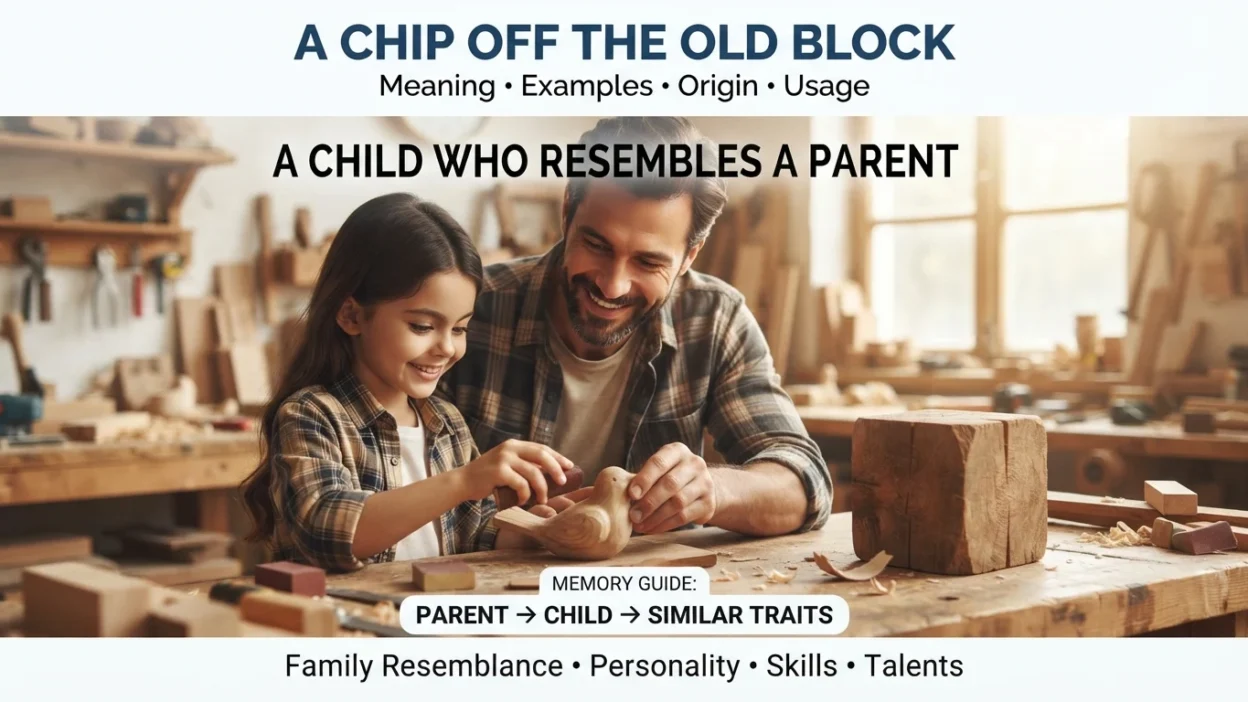
Have you ever noticed that a child behaves, thinks, or works remarkably like one of their parents? The English idiom a chip off the old block is used to describe exactly this kind of resemblance. It suggests that someone has inherited qualities, habits, talents, or characteristics from a parent.
Although the phrase mentions a block and a chip of wood or stone, it is not normally meant literally. Instead, it is a colorful way to say that a person is very much like their parent. In this guide, you will learn the a chip off the old block meaning, its origin, examples, common mistakes, related expressions, and how it is used in American and British English.
Quick Answer: What Does A Chip Off the Old Block Mean?
A chip off the old block means a person who is very similar to one of their parents, especially in personality, behavior, appearance, skills, or abilities.
For example:
Daniel is a talented musician just like his father. He is a chip off the old block.
This means Daniel has inherited or developed musical qualities similar to those of his father.
The idiom can refer to:
- Personality
- Appearance
- Talents
- Skills
- Habits
- Interests
- Behavior
- Values
- Abilities
The expression is usually used in a positive or affectionate way, although the context can sometimes make it humorous or mildly critical.
What Does A Chip Off the Old Block Mean?
The phrase a chip off the old block describes someone who resembles a parent in some noticeable way.
The old block represents the parent, while the chip represents the child. Just as a small piece of wood or stone comes from a larger block and shares its characteristics, a child may resemble a parent.
For example:
His father was an excellent carpenter, and now he is one too. He is a chip off the old block.
The speaker means that the son has followed his father’s example and developed a similar skill.
The resemblance does not have to be physical. Someone can be a chip off the old block because of their personality, interests, talents, or behavior.
A Chip Off the Old Block Examples
Here are some natural examples to help you understand how the idiom works.
My daughter loves painting just like her mother. She is a chip off the old block.
The daughter shares her mother’s artistic interest.
He is becoming just as hardworking as his father. He is a chip off the old block.
The son has developed a characteristic associated with his father.
Sarah has the same sense of humor as her dad. She is a chip off the old block.
The similarity is in personality rather than appearance.
His father was a successful businessman, and now he has started his own company. He is a chip off the old block.
The child is following a similar professional path.
The young athlete has the same determination as his mother. He is certainly a chip off the old block.
The child shares an important personal quality with the parent.
Can A Chip Off the Old Block Refer to Appearance?
Yes. The idiom can describe physical resemblance, although it is often used more broadly for personality or behavior.
For example:
He looks just like his father. He is a chip off the old block.
This suggests a strong physical resemblance.
You could also say:
She has her mother’s smile and cheerful personality. She is a chip off the old block.
Here, the expression covers both appearance and personality.
However, the phrase does not mean that someone must look exactly like their parent. A noticeable similarity in almost any characteristic can make the idiom appropriate.
Can It Describe a Daughter?
Absolutely.
Although some traditional examples focus on fathers and sons, a chip off the old block can describe any child who resembles a parent.
For example:
Her mother is an excellent cook, and she is becoming one too. She is a chip off the old block.
It can describe:
- A daughter like her mother
- A son like his father
- A daughter like her father
- A son like his mother
The important idea is parent-child resemblance, not gender.
Is A Chip Off the Old Block Always Positive?
Not necessarily.
The expression is often affectionate or complimentary, especially when the parent has a positive quality.
For example:
His father was known for his honesty, and he is a chip off the old block.
This is clearly positive.
However, the phrase can also be used humorously or negatively if the parent’s characteristic is undesirable.
For example:
His father was always getting into trouble, and the boy is becoming a chip off the old block.
Here, the speaker is suggesting that the child is developing the same troublesome behavior.
Therefore, the context determines whether the expression sounds complimentary, humorous, or critical.
Origin of A Chip Off the Old Block
The expression is based on the image of breaking or cutting a small piece, or chip, from a larger block of wood or stone.
The small piece naturally resembles the larger piece from which it came.
The figurative idea is easy to understand: a child is like a small piece taken from the same original material as the parent.
The expression has been used in English for centuries and became established as a familiar way to describe strong family resemblance.
Today, speakers generally use it without thinking about the literal image of a piece of wood or stone. It functions as a well-known idiom.
A Chip Off the Old Block vs Like Father, Like Son
These expressions are closely related but have slightly different structures.
A chip off the old block describes a person who resembles a parent.
Like father, like son expresses the idea that a son behaves or acts like his father.
Compare:
James is a chip off the old block.
This focuses on James’s similarity to his parent.
Like father, like son.
This emphasizes the matching behavior or characteristics of the father and son.
Also, like father, like son specifically mentions a father and son, while a chip off the old block can be used more flexibly for parent-child relationships.
Comparison Table
| Expression | Meaning | Main Focus |
|---|---|---|
| A chip off the old block | A child resembles a parent | Family resemblance |
| Like father, like son | A son behaves like his father | Father-son similarity |
| Takes after | Resembles a family member | Appearance or personality |
| Runs in the family | A trait appears among relatives | Family-wide characteristic |
| Just like their parent | Very similar to a parent | General resemblance |
| Follows in their parent’s footsteps | Chooses a similar path | Career or life choices |
These expressions overlap, but they are not always interchangeable.
A Chip Off the Old Block vs Takes After
Takes after is another common expression for family resemblance.
For example:
She takes after her mother.
This means she resembles her mother.
You can also say:
She is a chip off the old block.
Both communicate a similar idea.
The difference is that takes after is a phrasal verb and can sound more neutral, while a chip off the old block is a colorful idiom that often emphasizes a strong resemblance.
Common Mistakes With A Chip Off the Old Block
Mistake 1: Taking the Expression Literally
The phrase does not normally mean that someone is physically a piece of wood or stone.
It is figurative language describing family resemblance.
Mistake 2: Using It Only for Appearance
The idiom can describe much more than physical appearance.
It can refer to:
- Personality
- Talent
- Habits
- Skills
- Interests
- Behavior
- Values
For example:
She is a chip off the old block because she has the same determination as her father.
Mistake 3: Thinking It Applies Only to Sons
It can describe daughters as well as sons.
For example:
Her mother is a talented artist, and she is a chip off the old block.
Mistake 4: Assuming It Is Always a Compliment
The expression often has a positive meaning, but context matters.
If the parent has a bad habit, the idiom can be used humorously or critically.
Mistake 5: Confusing It With Following in Someone’s Footsteps
These expressions are related but not identical.
A chip off the old block means someone resembles a parent.
Following in a parent’s footsteps usually means choosing a similar career, activity, or life path.
American vs British English
A chip off the old block is used in both American and British English.
There is no major difference in its basic meaning or grammar.
American speakers may use it frequently in casual conversation, sports discussions, entertainment, and family-related situations. British speakers also understand and use the expression naturally.
For example, both varieties can use:
He is a chip off the old block.
The phrase is therefore a good example of an idiom that works across major varieties of English.
Synonyms and Related Expressions
Depending on the context, similar expressions include:
- Takes after
- Like father, like son
- Like mother, like daughter
- Runs in the family
- Inherited the family traits
- Just like their parent
- Follows in their parent’s footsteps
- Has the same qualities as their parent
- Resembles their parent
However, these expressions do not always carry exactly the same meaning.
Runs in the family, for example, usually suggests that a characteristic appears among several family members.
Example:
Musical talent runs in the family.
This is broader than a chip off the old block.
FAQs
1. What does a chip off the old block mean?
It means a person is very similar to one of their parents in appearance, personality, behavior, skills, talents, or other characteristics.
2. Is a chip off the old block an idiom?
Yes. It is a common English idiom used figuratively to describe family resemblance.
3. Can you use a chip off the old block for a daughter?
Yes. The expression can describe any child who resembles a parent.
4. Is a chip off the old block positive?
It is often positive or affectionate, but context matters. It can also be humorous or critical if the parent’s characteristic is undesirable.
5. What is another way to say a chip off the old block?
Depending on the situation, you can say takes after, like father, like son, or runs in the family.
6. Does a chip off the old block mean physical resemblance?
It can, but it is not limited to appearance. It can also describe personality, behavior, abilities, interests, and habits.
7. Where did a chip off the old block come from?
The expression comes from the literal idea of a small piece, or chip, coming from a larger block of wood or stone and therefore resembling the original block.
8. Is a chip off the old block used in British English?
Yes. The expression is understood and used in both British and American English.
Final Summary
The idiom a chip off the old block means that someone strongly resembles one of their parents. The resemblance may involve physical appearance, personality, behavior, talents, skills, interests, or habits. For example, if a father is an excellent musician and his son develops the same talent, you might say that the son is a chip off the old block.
The expression comes from the image of a small piece being taken from a larger block of wood or stone. Just as the chip comes from the same material as the original block, a child may share characteristics with a parent. The idiom is common in both American and British English and is usually friendly or affectionate, although context can make it humorous or critical.