
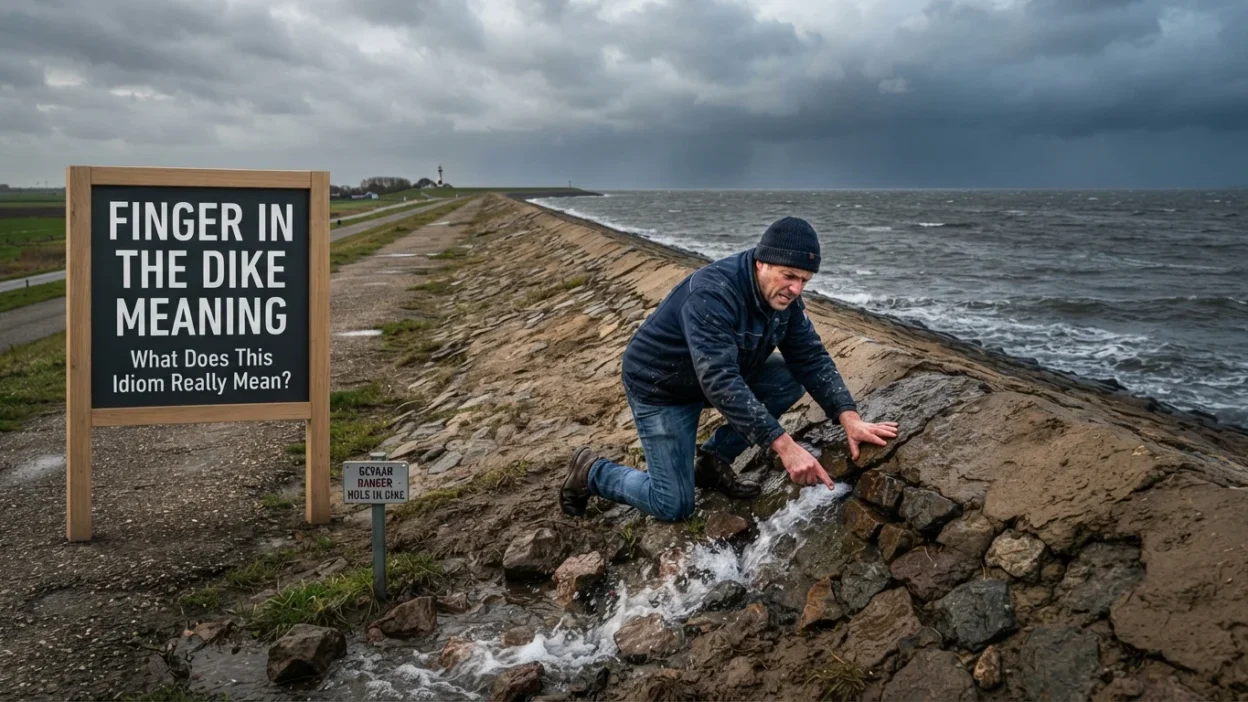
Have you ever seen someone describe a temporary solution as “putting a finger in the dike” and wondered what that unusual phrase means? It may sound strange when taken literally, but finger in the dike is an English idiom used to describe an attempt to prevent a much bigger problem by dealing with a small issue before it gets worse.
The expression is often used when people are constantly fixing individual problems without addressing the real cause behind them. It can apply to business, technology, finance, politics, education, and everyday life. In this guide, we’ll explain the finger in the dike meaning, explore its origin, provide clear examples, compare it with similar expressions, and explain how it is used in American and British English.
Quick Answer: Finger in the Dike Meaning
The phrase “finger in the dike” means using a small or temporary action to prevent a much larger problem from getting worse.
It often suggests that the immediate solution is necessary, but it does not solve the underlying or root cause of the problem.
Simple example:
This means the person is repeatedly dealing with small problems while the larger issue remains unresolved.
In simple words:
Finger in the dike = a temporary measure used to hold back a much bigger problem.
Related expressions include:
- Temporary fix
- Band-Aid solution
- Stopgap measure
- Damage control
- Putting out fires
- Treating the symptoms
- Short-term solution
What Does “Finger in the Dike” Mean?
Finger in the dike is an idiomatic expression. An idiom is a phrase whose intended meaning is different from the literal meaning of the individual words.
A dike is a structure designed to hold back water and protect land from flooding. The expression creates a mental image of a small leak appearing in a dike and someone trying to stop the water by blocking the opening with a finger.
The idea is that the person is taking immediate action to prevent a small problem from becoming a disaster.
In modern usage, the phrase is usually metaphorical.
For example:
The temporary workers may help for a while, but the company’s deeper staffing problem remains.
The phrase can therefore describe situations where someone is containing a problem rather than permanently solving it.
Finger in the Dike Meaning in Simple English
If you want to explain the idiom in very simple English, you can say:
Another simple explanation is:
For example, imagine a computer system that keeps crashing. Every time it crashes, the IT team restarts it, but nobody investigates why it keeps failing.
You could say:
The restart solves the immediate problem, but the underlying technical issue is still there.
Origin of the “Finger in the Dike” Expression
The expression is commonly associated with a famous story about a young Dutch boy who discovers a small hole in a dike. According to the popular version of the story, he places his finger in the hole to stop the water and remains there until help arrives.
The story became widely known as an example of courage and quick thinking. It is often connected with the 19th-century children’s novel Hans Brinker, or the Silver Skates, written by American author Mary Mapes Dodge.
Interestingly, the famous finger-in-the-dike episode is not actually presented in the original novel in the exact way many people believe. The story became popular through later retellings and cultural references.
Over time, the image became a metaphor for trying to prevent a major disaster by immediately stopping a small problem.
Today, the phrase can be used positively or negatively depending on context. It may praise someone for taking immediate action, or it may criticize a situation where people keep applying temporary solutions instead of addressing the root cause.
How to Use “Finger in the Dike” in a Sentence
Here are several natural examples.
Example 1: Business
The company is solving the immediate problem but not addressing the underlying issue.
Example 2: Technology
The restart provides temporary relief, but the real technical problem remains.
Example 3: Personal Finance
The action may delay the problem rather than solve it.
Example 4: Education
The temporary measure does not address the deeper educational issue.
Example 5: Home Repairs
The small repairs may help temporarily, but the main problem remains.
Finger in the Dike vs Temporary Fix
These expressions are related, but they are not exactly the same.
A temporary fix is any solution that works for a limited time.
Finger in the dike goes a step further. It suggests that the temporary fix is being used to prevent a potentially much larger problem.
| Expression | Meaning | Example |
|---|---|---|
| Finger in the dike | A small action that prevents a larger problem from getting worse | Fixing repeated leaks without replacing a damaged roof |
| Temporary fix | A solution that works for a short period | Using tape to hold a broken item together |
| Band-Aid solution | A quick solution that does not address the root cause | Giving temporary relief instead of fixing the real issue |
| Stopgap measure | A temporary action used until a permanent solution is available | Hiring temporary staff during a recruitment shortage |
| Damage control | Actions taken to limit the negative effects of a problem | Responding quickly after a public mistake |
| Putting out fires | Dealing with problems one after another as they arise | Constantly fixing urgent workplace problems |
The best expression depends on the context.
Finger in the Dike vs Band-Aid Solution
Finger in the dike and Band-Aid solution are sometimes used in similar situations, but there is a slight difference.
A Band-Aid solution usually refers to a quick, superficial solution that does not fix the underlying cause.
For example:
The action may make people feel better temporarily, but the deeper problem remains.
By contrast, finger in the dike emphasizes the idea of holding back a larger problem.
For example:
Both expressions can suggest that a permanent solution is needed.
Is “Finger in the Dike” Positive or Negative?
The expression can have either a positive or negative meaning depending on the situation.
Positive meaning
It can describe someone taking immediate action to prevent a problem from becoming worse.
For example:
Here, the action is presented as useful and necessary.
Negative meaning
It can also criticize a repeated pattern of temporary fixes.
For example:
Here, the phrase suggests that the company should address the root problem.
Common Mistakes About “Finger in the Dike”
Mistake 1: Taking the Expression Literally
In most modern contexts, finger in the dike is metaphorical.
It usually does not mean that someone is literally using a finger to stop water.
Instead, it describes temporary problem-solving.
Mistake 2: Assuming It Always Means a Bad Solution
A temporary solution is not necessarily useless.
Sometimes immediate action is essential.
For example, stopping a leak temporarily while waiting for professional repairs is sensible. The problem arises when the temporary measure becomes a permanent strategy.
Mistake 3: Using It for Every Small Problem
The idiom works best when there is a larger underlying problem.
If you fix a one-time minor issue, that is not necessarily “putting a finger in the dike.”
The expression usually suggests a continuing pattern of temporary solutions.
Mistake 4: Confusing It With “Bite the Bullet”
These expressions have completely different meanings.
Finger in the dike means temporarily preventing a larger problem.
Bite the bullet means accepting and facing something difficult or unpleasant.
American English vs British English
The expression finger in the dike is understood in both American and British English, although it may not be equally common in everyday conversation.
American speakers may also use expressions such as:
- Band-Aid solution
- Temporary fix
- Stopgap measure
- Putting out fires
British speakers may use similar expressions, including:
- Stopgap measure
- Temporary fix
- Putting a plaster over the problem
- Putting out fires
There can also be a spelling difference. Dike is common in American English, while dyke is also used in British English for certain structures or geographical features.
Despite these spelling differences, the basic idiomatic meaning remains the same.
When Should You Use “Finger in the Dike”?
You can use the expression when you want to describe a situation where:
- A temporary solution is preventing a larger problem.
- Someone is repeatedly fixing small issues.
- The root cause remains unresolved.
- Immediate action is needed before a permanent solution can be found.
- An organization is managing symptoms instead of addressing the underlying problem.
For example:
This sentence suggests that the immediate repairs are helpful but insufficient.
FAQs
1. What does “finger in the dike” mean?
Finger in the dike means taking a small or temporary action to prevent a much larger problem from getting worse. It often suggests that the root cause has not yet been solved.
2. Is “finger in the dike” an idiom?
Yes. It is an English idiom based on the image of stopping a leak in a dike before it causes a major flood.
3. Where does “finger in the dike” come from?
The phrase is associated with a popular story about a Dutch boy who supposedly stops water from flowing through a hole in a dike by blocking it with his finger. The story is often linked to the 19th-century book Hans Brinker, or the Silver Skates.
4. What is another phrase for “finger in the dike”?
Similar expressions include Band-Aid solution, temporary fix, stopgap measure, damage control, and putting out fires.
5. Is “finger in the dike” a negative expression?
It can be negative when it criticizes someone for repeatedly using temporary solutions instead of solving the underlying problem. However, it can also describe necessary immediate action in an emergency.
6. Can you give an example of “finger in the dike”?
The sentence means that the small repairs are preventing immediate damage but are not solving the larger problem.
7. Is “finger in the dike” common in American English?
It is understood in American English, although phrases such as Band-Aid solution, temporary fix, and putting out fires may be more common in everyday speech.
8. What is the opposite of a “finger in the dike” solution?
A permanent or long-term solution that addresses the root cause of a problem is the opposite. Instead of repeatedly managing symptoms, the underlying issue is solved.
Final Summary
The finger in the dike meaning is essentially about using a small or temporary action to prevent a much larger problem from getting worse. The expression comes from the famous image of someone stopping a leak in a dike before the water can cause a major disaster. In modern English, the phrase is usually used metaphorically to describe situations where people are constantly managing immediate problems without fixing the underlying cause.
The idiom is closely related to expressions such as Band-Aid solution, temporary fix, stopgap measure, and putting out fires, but each phrase has its own nuance. Finger in the dike is particularly useful when a series of small actions is holding back a potentially serious problem. It can be used in business, technology, finance, education, government, and everyday situations.