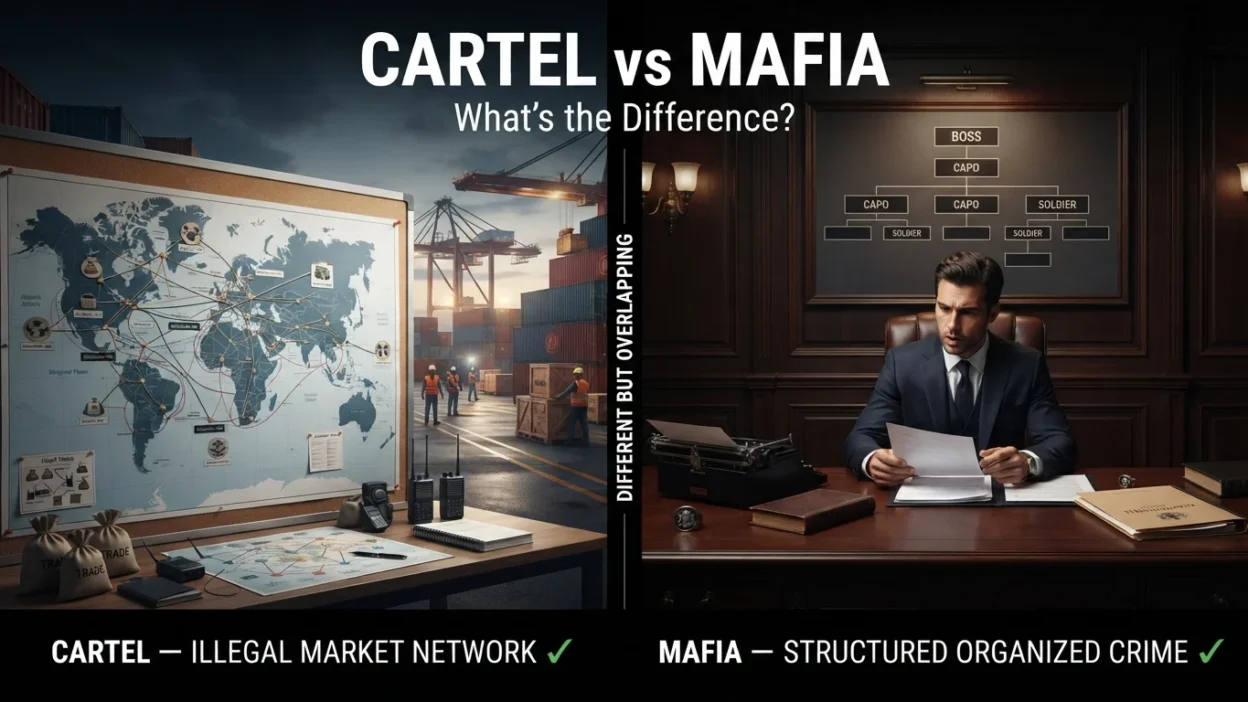
The terms cartel vs mafia are often used interchangeably in movies, news reports, and everyday conversations, but they do not mean exactly the same thing. Both can refer to powerful criminal organizations, yet they have different historical backgrounds, organizational structures, and typical activities.
Understanding the difference between a cartel and a mafia can help you better understand crime-related news, documentaries, books, and films. In simple terms, a cartel is often associated with coordinated criminal activity involving markets and trafficking, while the word mafia traditionally describes a secretive, structured criminal organization built around loyalty, hierarchy, and long-term control. However, the reality is more complicated, and there can be significant overlap between the two.
Quick Answer: Cartel vs Mafia
The main difference between a cartel and a mafia is their traditional structure and purpose.
- Cartel: A coordinated organization or network that often controls or participates in illegal markets, especially drug trafficking.
- Mafia: A secretive, hierarchical criminal organization traditionally associated with organized crime, protection rackets, corruption, and illegal businesses.
A cartel is often focused on controlling a particular criminal market or territory, while a mafia-style organization may operate across several types of criminal activity and maintain long-term influence through a structured network.
However, these definitions are not absolute. Some cartels have mafia-like structures, and some mafia organizations participate in international trafficking and other activities commonly associated with cartels.
What Is a Cartel?
The word cartel originally has a broader meaning than organized crime.
In economics, a cartel is an agreement between independent businesses or producers to cooperate in ways that reduce competition. This can involve agreements about prices, production, or market share.
However, in popular culture and modern news reporting, cartel often refers to a powerful criminal organization involved in illegal markets.
Criminal cartels are commonly associated with:
- Drug trafficking
- Illegal smuggling
- Money laundering
- Extortion
- Illegal trade networks
- Territorial control
- Corruption
The word is especially associated with organized drug-trafficking groups operating across international borders.
A cartel may have a complex structure involving leaders, regional groups, financial networks, transportation systems, and other supporting organizations.
What Is a Mafia?
The term mafia has historical roots in Sicily, Italy, and is often associated with the Sicilian Mafia. Over time, the word has become a general term for organized criminal groups that operate through secrecy, hierarchy, loyalty, and influence.
A mafia-style organization may be involved in various criminal activities, including:
- Extortion
- Illegal gambling
- Protection rackets
- Smuggling
- Corruption
- Money laundering
- Fraud
- Infiltration of legitimate businesses
One of the traditional characteristics of mafia organizations is the use of relationships and loyalty networks.
Mafia groups may seek influence over businesses, local institutions, or political systems rather than focusing exclusively on one illegal market.
Cartel vs Mafia: Comparison Table
| Feature | Cartel | Mafia |
|---|---|---|
| Basic meaning | Organized group or network controlling illegal markets | Structured criminal organization |
| Historical association | Often linked to drug trafficking and smuggling | Traditionally linked to Sicily and organized crime |
| Typical structure | Can be centralized or network-based | Often hierarchical and family or loyalty-based |
| Common activities | Drug trafficking, smuggling, illegal trade | Extortion, corruption, gambling, smuggling, racketeering |
| Geographic focus | Often operates across borders and territories | May operate locally, nationally, or internationally |
| Main goal | Often controlling illegal markets and profits | Long-term criminal influence and financial power |
| Use of the term | Frequently used for drug-trafficking organizations | Often used for traditional organized crime groups |
| Modern usage | Can overlap with mafia-style organizations | Can also participate in trafficking and international crime |
This comparison describes general patterns rather than strict rules. Real criminal organizations can be highly complex and may combine characteristics of both.
Cartel vs Mafia: Organizational Structure
One of the biggest differences between cartels and mafia-style groups is their traditional organizational structure.
A mafia organization is often imagined as a hierarchical system. It may have leaders, trusted members, and lower-level associates. Loyalty and personal relationships can play an important role.
A cartel, on the other hand, may operate as a network of connected groups. Depending on the organization, it can include different factions or regional units that cooperate or compete with one another.
However, this distinction is not always clear.
Some cartels have highly centralized leadership, while others are decentralized. Similarly, some mafia groups operate through flexible networks rather than a simple hierarchy.
Therefore, organizational structure alone cannot always determine whether a group should be called a cartel or mafia.
Cartel vs Mafia: Typical Activities
Another difference is the type of criminal activity traditionally associated with each term.
Cartels are frequently connected with the control of illegal markets. Drug trafficking is one of the most commonly reported examples.
Mafia organizations have historically been associated with a broader range of activities. These may include extortion, illegal gambling, corruption, smuggling, and attempts to influence legitimate businesses.
That said, there is considerable overlap.
A mafia organization can be involved in drug trafficking, while a cartel may use corruption, extortion, and money laundering.
This is why the terms should not be treated as completely separate categories.
Cartel vs Mafia: Geographic Differences
The term mafia has strong historical connections to Sicily and Italy, although the word is now used more broadly.
The term cartel is often associated with organized criminal groups operating across international borders, especially those involved in drug trafficking.
However, neither term is limited to a single country or region.
Criminal organizations can operate internationally, establish connections across borders, and move money and goods through complex networks.
The geographic location of a group alone does not necessarily determine whether it is a cartel or mafia.
Are Cartels and Mafias the Same Thing?
No, not exactly.
The terms describe different traditions and organizational concepts, but their activities can overlap.
For example, a criminal organization may operate an illegal trafficking network while also using hierarchical structures, corruption, and extortion. In such a case, it may display characteristics associated with both cartels and mafia-style organizations.
It is therefore more accurate to think of cartel and mafia as broad labels rather than perfectly defined categories.
The exact meaning often depends on the context in which the term is being used.
Cartel vs Mafia in Popular Culture
Movies, television shows, and video games often portray cartels and mafias as clearly separate groups.
In popular culture, a mafia organization is often shown as a secretive family-like group with a strict hierarchy, while a cartel is portrayed as a large organization involved primarily in drug trafficking.
These portrayals can be entertaining, but they may oversimplify reality.
Real organized criminal groups can have complicated relationships, changing alliances, and different sources of income.
For this reason, it is important to distinguish fictional portrayals from academic, legal, and journalistic descriptions.
Common Mistakes About Cartels and Mafias
Mistake 1: Thinking Every Cartel Is a Drug Cartel
The word cartel does not always mean a criminal organization.
In economics, a cartel can refer to businesses that cooperate to limit competition.
However, in news and popular culture, the term often refers to criminal organizations involved in drug trafficking.
The context matters.
Mistake 2: Thinking Every Mafia Organization Is Italian
The word mafia originated in a specific historical context connected to Sicily, but it is now sometimes used more broadly to describe organized criminal groups with similar characteristics.
However, using mafia as a generic label for every criminal organization can be misleading.
Mistake 3: Assuming Cartels Only Traffic Drugs
Drug trafficking is strongly associated with criminal cartels, but organized criminal groups may also be involved in other illegal activities.
The exact activities vary by organization.
Mistake 4: Believing the Two Terms Are Perfect Opposites
They are not.
A cartel can have mafia-like characteristics, and a mafia organization can participate in activities commonly associated with cartels.
The distinction is often about historical background, structure, and context rather than a strict legal definition.
American English vs British English
There is no major difference between American and British English in the basic meanings of cartel and mafia.
Both varieties use cartel to describe groups that cooperate to control a market, particularly in economic contexts. The term can also refer to criminal organizations, especially in news reporting.
Similarly, mafia is used in both American and British English to refer to organized criminal groups, particularly those associated historically with Sicily or Italy.
The main differences may appear in pronunciation, accent, or specific journalistic style, but the general meanings remain similar.
FAQs
1. What is the main difference between a cartel and a mafia?
A cartel is often associated with controlling illegal markets, particularly drug trafficking, while a mafia traditionally refers to a secretive, structured criminal organization involved in various forms of organized crime.
2. Are cartels and mafias the same?
No. They are different concepts, but their activities and organizational structures can overlap.
3. Is a cartel always involved in drugs?
No. The word cartel can also describe an economic agreement between businesses. Criminal cartels are often associated with drug trafficking, but organized crime can involve many other activities.
4. Is the mafia only from Italy?
The term mafia has historical roots in Sicily, Italy. However, it is now sometimes used more broadly to describe organized criminal groups with similar structures or characteristics.
5. Which is more powerful, a cartel or a mafia?
There is no universal answer. The power of a criminal organization depends on its size, resources, geographic reach, financial networks, and ability to influence institutions.
6. Can a cartel have a mafia-style structure?
Yes. Some criminal organizations described as cartels may have hierarchical leadership, loyalty networks, and other characteristics commonly associated with mafia-style organizations.
7. What does “cartel” mean in economics?
In economics, a cartel is an agreement between independent businesses or producers to cooperate in ways that reduce competition, such as coordinating prices or production.
8. Why are the terms cartel and mafia often confused?
The terms are often confused because both can refer to organized criminal groups involved in illegal activities and because popular media sometimes uses them loosely. In reality, the terms have different historical and organizational associations.
Final Summary
The difference between cartel vs mafia is mainly based on historical background, organizational structure, and the activities traditionally associated with each term. A cartel is often connected with controlling illegal markets, particularly drug trafficking and smuggling, while a mafia traditionally describes a secretive and hierarchical criminal organization involved in activities such as extortion, corruption, illegal gambling, and racketeering.
However, the distinction is not absolute. Criminal organizations can evolve, change their structures, and become involved in many different activities. Some groups may display characteristics of both cartels and mafia-style organizations. Therefore, the best way to understand the difference is to consider the specific context, history, structure, and activities of the organization being discussed.